On 9/9, Apple unveiled its new generation iPhone. Among the tech giant's new products, the iPhone Duo garnered the most attention with its foldable screen design and a price tag of 1,999 USD, making it the most expensive iPhone from the company to date.
According to The Guardian, Apple's first foldable phone requires complex hinge and screen technology, necessitating new materials and manufacturing standards. Additionally, global semiconductor price pressure driven by the AI wave has contributed to the increased production cost of the iPhone Duo compared to standard versions.
With gasoline prices soaring in many regions due to the Middle East conflict over the past six months, Apple's launch of the iPhone Duo raised questions on Wall Street about whether consumers would be willing to spend up to 2,000 USD on a new phone. However, historical data indicates that consumers remain willing to pay for increasingly expensive iPhone models, regardless of rising fuel costs or economic instability.
In a report preceding Apple's event, analyst Samik Chatterjee at JPMorgan noted that for many years, the selling price has not significantly impacted iPhone sales volume. iPhone shipments increased by approximately 10% between fiscal year 2015 and 2026, even as the average selling price rose by 50% and the smartphone market peaked in 2016-2017.
Consumer preference for iPhone models has also increasingly shifted towards the premium segment. In 2020, the Pro and Pro Max series accounted for only about 37% of total iPhone shipments, a figure that climbed to around 65% last year.
"During the launch, we expect the company to emphasize to investors that consumers can easily own the product through attractive device leasing programs," Chatterjee stated.
Before the event, Citi also projected that Apple's first foldable iPhone would start at 2,000 USD. The bank estimates Apple will sell approximately 5 million units in the second half of this year and an additional 2.3 million products in Q1/2027.
The excitement surrounding each new iPhone launch typically signals positively for the company's stock. Investors anticipate a period of higher-than-normal demand as users upgrade their devices.
A report by Wamsi Mohan, an analyst at Bank of America, indicates that Apple's stock often experiences a slight dip immediately after product launch events, attributed to the "sell-the-news" effect. However, the stock typically recovers within 30 to 60 days afterward.
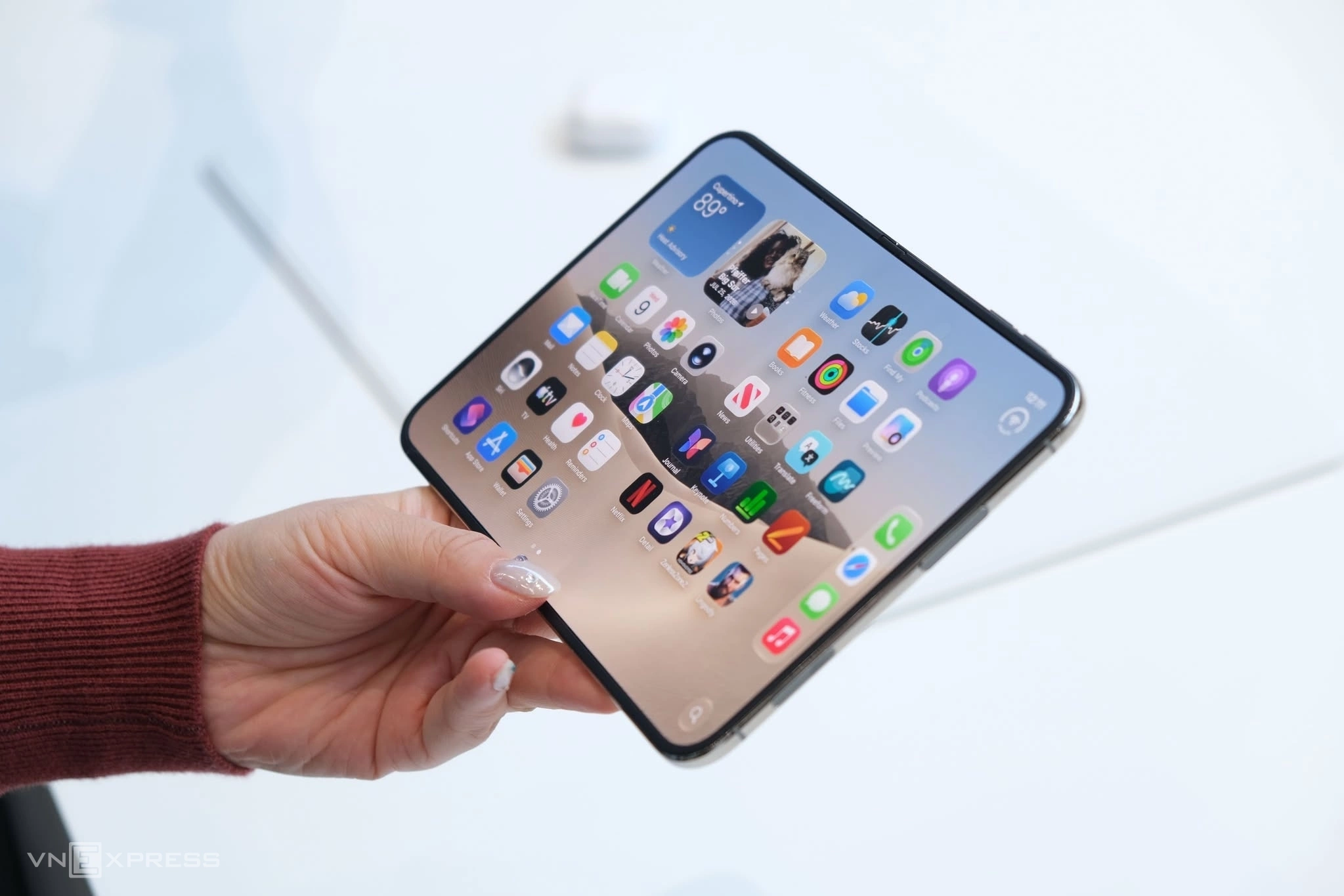 |
The newly launched iPhone Duo foldable phone by Apple. Photo: Tuan Hung |
Mohan's research also reveals that since the first iPhone launched in 2007, Apple's stock has risen 17 times within 60 days following a new iPhone model announcement. The most significant increase, 20%, was recorded in 2019 when the iPhone 11 was introduced.
Apple's stock closed slightly down by 0.3% on 9/9. Nevertheless, the stock has risen over 16% since the beginning of the year. Apple is currently the world's second most valuable company, with a market capitalization of 4.6 trillion USD, trailing only chipmaker Nvidia.
Ha Thu (according to CNBC, Yahoo Finance)