The Ho Chi Minh City People's Committee, representing the State, wholly owns Urban Railway Company No. 1 Limited (HURC), the operator of the city's first metro line.
In a decision announced on August 24, HURC was assigned a total revenue target of 615 billion dong and a post-tax profit of nearly 22 billion dong. The return on equity (ROE) target is 8.15%, meaning for every 100 dong of capital invested, the company aims for a net profit of over 8 dong.
HURC is also required to fulfill its mission of providing public products and services as ordered by the State, ensuring output and quality meet prescribed standards.
This year's revenue plan represents double-digit growth compared to 2025, which was the company's first full 12 months of commercial operation. Last year, HURC collected 547 billion dong, 50 times higher than the same period in 2024. The company reported a significant profit, exceeding its targets and clearing all accumulated losses since its establishment in 2019, prior to commercial operation.
HURC's revenue primarily comes from subsidies, calculated based on operational distance and a unit price (per km) agreed between the company and the Ho Chi Minh City Public Transport Center. The remaining revenue is generated from passenger ticket sales and infrastructure maintenance.
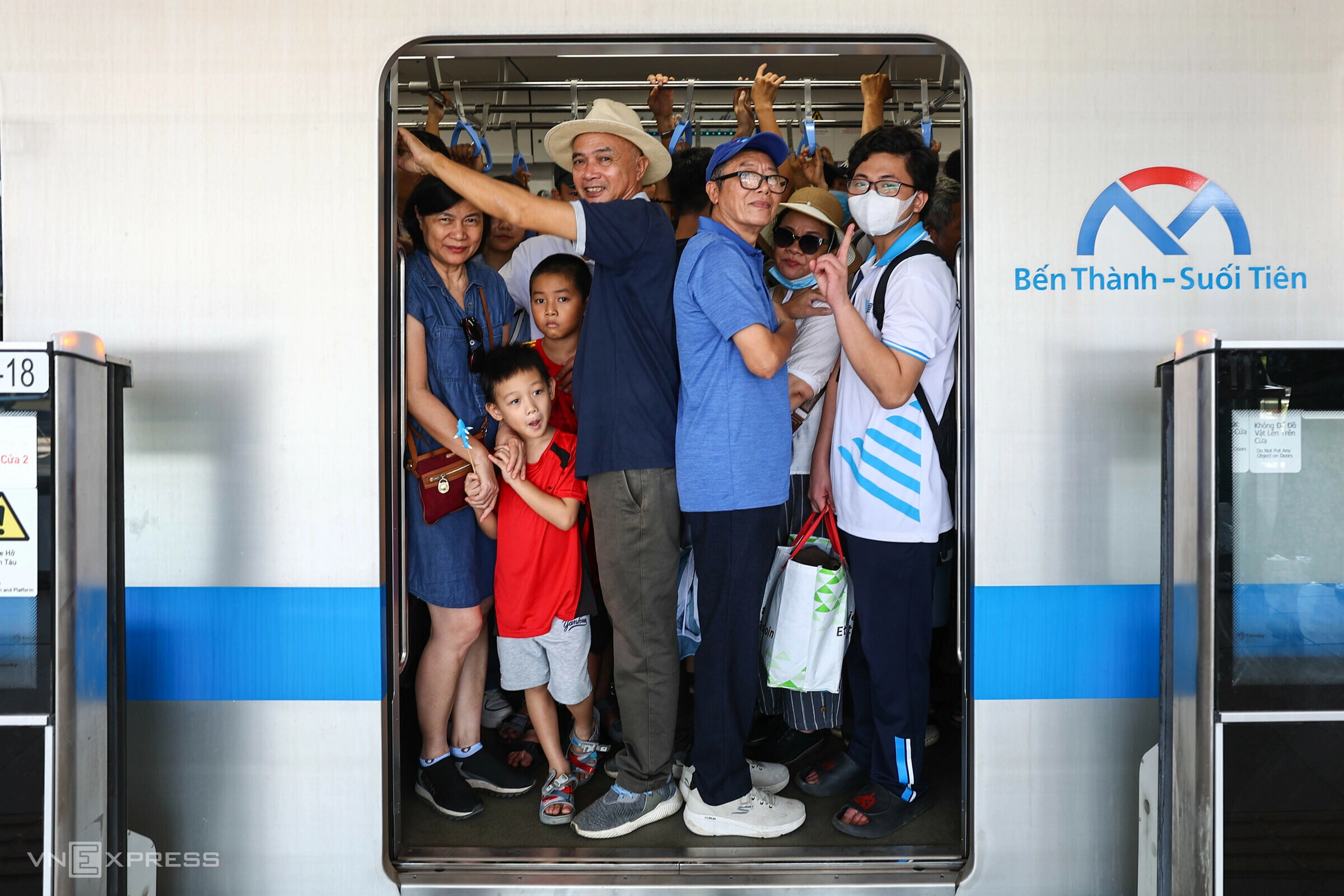 |
Ho Chi Minh City residents travel on the Ben Thanh - Suoi Tien metro. *Photo: Quynh Tran* |
HURC currently operates the Ben Thanh - Suoi Tien Metro line, which spans nearly 20 km and connects the city center to the eastern gateway. This is Ho Chi Minh City's first urban railway project, with a total investment of over 43,700 billion dong, completed after 12 years of construction. The line features 14 stations, including three underground stations in the central area of Ho Chi Minh City.
Ticket prices range from 6,000-20,000 dong per ride, depending on the distance and payment method. Passengers can purchase one-day, three-day, or monthly passes for unlimited rides, priced at 40,000 dong, 90,000 dong, and 300,000 dong respectively. Monthly passes for students are half price, at 150,000 dong.
In the long term, Ho Chi Minh City expects its urban railway system to handle 20-30% of residents' travel needs by 2030, increasing to 35-50% by 2035, and reaching 50-60% by 2045.
To achieve this, the city will simultaneously implement several projects in phases. In addition to the Ben Thanh - Suoi Tien Metro, the city aims to complete five more lines in the next five years, increasing the total length of the urban railway to 187 km. This expansion will integrate urban development with transit-oriented development (TOD).
Phuong Dong