"Our orders are steady through Quarter II," said Tran Lam Son, founder of Thien Minh Furniture. The wood furniture manufacturer reported entering 2026 with a "no worries" mindset regarding the market.
Phung Quoc Man, Chairman of the HCMC Handicraft and Wood Industry Association (Hawa), which represents one-half of the country's wood furniture businesses, stated that most members are experiencing average to good conditions. They are not facing the panic of declining orders seen previously. "Many businesses have orders for Quarter I and early Quarter II, with some even securing orders until may," Man said.
Similarly, according to the Vietnam Textile and Apparel Association (Vitas), Quarter I orders have been finalized, and many businesses are currently negotiating orders for Quarter II.
The Purchasing Managers' Index (PMI) report, recently released by S&P Global, indicated that Vietnamese manufacturers recorded a faster increase in new orders compared to december, driven by improved customer demand. Notably, export orders have rebounded after a decline in late 2025.
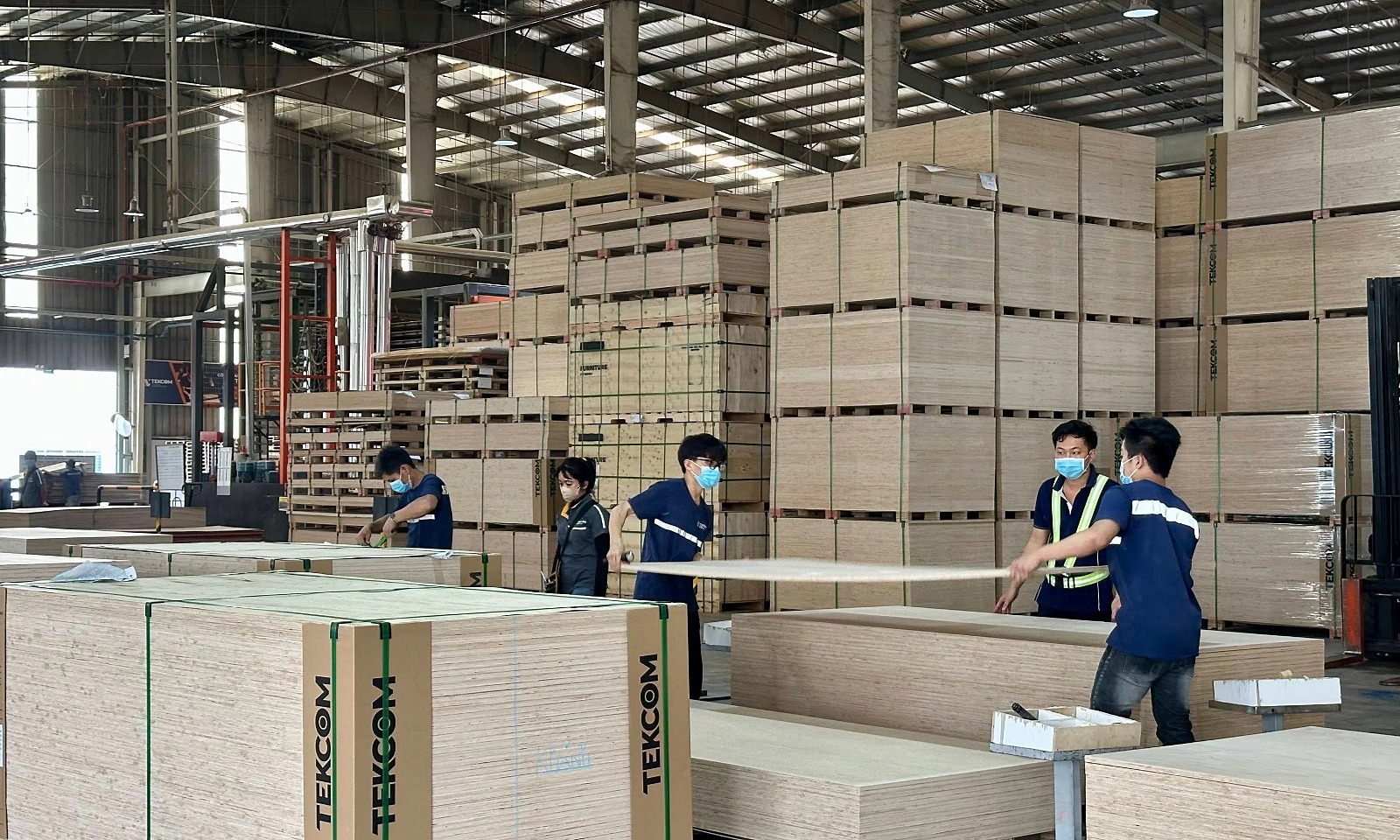 |
A formwork plywood factory in Nam Tan Uyen Industrial Park, TP HCM. Photo: Vien Thong
Businesses reported receiving new orders from other Asian economies, such as India. Andrew Harker, Economics Director at S&P Global Market Intelligence, noted that Vietnam's manufacturing sector has had a strong start. "Building on the growth momentum accumulated through late 2025, the manufacturing sector has good prospects for a successful 2026," Harker commented.
According to the US data analytics firm, business confidence in Vietnam's manufacturing sector reached its highest level in 22 months. Companies are increasing production and hiring more staff. Employment has risen for the fourth consecutive month, marking the fastest pace since 6/2024.
In TP HCM, a key economic hub, city statistics show that the labor index for january improved, increasing by 1,3% compared to the previous month and by 1,1% year-on-year against 2025. Several sectors recorded growth, including electrical and electronic manufacturing, motor vehicles, and computers.
Despite the positive outlook, challenges persist. Andrew Harker highlighted the ongoing scarcity of raw material supplies. Businesses responded by implementing stronger price increases last month.
"Demand has not yet shifted under these pressures, but we will need to watch for any signs of weakening in new orders in the coming months," he stated. Tran Lam Son also predicted that wood furniture businesses might face difficulties in labor recruitment and raw material sourcing.
Non-tariff barriers also present a significant issue. The Vietnam Association of Seafood Exporters and Producers (VASEP) reported that the US Marine Mammal Protection Act (MMPA) and the Certificate of Admissibility (COA) are increasingly showing their impact, affecting the export of tuna and other seafood species.
Nguyen Xuan Thanh, a public policy lecturer at Fulbright University Vietnam, forecasts that exports this year could slow compared to the 17% growth seen in 2025. In its latest report, UOB shared a similar view, citing the end of the front-loading period and uncertain US tax policies.
The US was Vietnam's largest market last year, with a turnover exceeding USD 153,1 billion, an increase of 28,1% compared to 2024, according to the Customs Department. According to Thanh, the most optimistic scenario is that exports to the US remain unchanged from 2025. However, there is a risk of reduced turnover due to high inventory levels in the US.
Experts and businesses suggest increasing efforts to find new drivers in other markets. According to Nguyen Xuan Thanh, the Chinese market holds significant promise due to rising household incomes.
The seafood sector provides an example: exports to mainland China and Hong Kong in january increased by 28,7%, while those to the US decreased by 10%. According to VASEP, this situation indicates that growth momentum currently depends heavily on Asian markets. Alongside China, Japan and Southeast Asia also increased their purchases of Vietnamese seafood by 21,3% and 32,2%, respectively.
For wood furniture, Hawa Chairman Phung Quoc Man believes businesses can further leverage markets opened recently, such as the Middle East and India. Meanwhile, President Donald Trump's decision to postpone tariff increases on upholstered furniture, kitchen cabinets, and bathroom vanities until 2027 provides businesses with an additional year to prepare appropriate pricing strategies.
Vien Thong