HayWay Logistics, a Polish company providing truck and trailer rental, transshipment yards, and cargo transport services, is making a strategic entry into the US market. According to CEO Artur Lewandowski, the group currently employs about 900 staff in Europe and operates across 11 countries. By June, HayWay's European fleet is expected to reach 600 units, with an additional 200 vehicles already on order.
For its US operations, HayWay has established a team of 7 staff members. The company anticipates receiving its first 5 trucks by the end of March, with the total increasing to 20 by June. All 80 Volvo VNL 860 trucks will be delivered according to the initial deployment schedule.
These trucks, though registered in Wyoming, will not operate exclusively within the state. HayWay plans to utilize the 80 vehicles for long-haul interstate routes, primarily transporting goods for Amazon between southern California and New York. "We are focusing on routes from Los Angeles to New York, from New York to Chicago, and from Chicago back to Los Angeles," Lewandowski stated, outlining the core operational strategy.
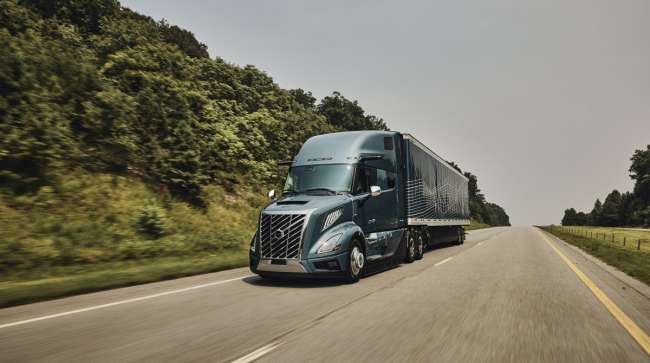 |
HayWay provides truck, trailer rental, and storage yard services, as well as cargo transportation for customers. Photo: Volvo Trucks North America |
HayWay will implement a team driving model to maximize efficiency and has registered with prominent freight exchanges, DAT Freight & Analytics and Amazon Relay. The company prioritizes urgent delivery orders to meet market demand.
Lewandowski views this expansion into the US market as embodying the "American dream," reflecting a commitment to building from the ground up, taking calculated risks, and making long-term investments. HayWay's long-term objective is to expand its US fleet to 1,400 vehicles by 2029. The immediate focus involves deploying the initial trucks in North America, in close collaboration with Volvo Trucks North America (VTNA).
Despite a recent downturn in the freight transport market, new businesses continue to enter the sector. A representative from Volvo Trucks North America confirmed the company's active support for partners navigating this challenging market phase.
Jared Ruiz, vice president of the Western region for VTNA, highlighted Volvo's close collaboration with HayWay from the outset. This partnership ensured the development of a truck delivery plan aligned with HayWay's expansion roadmap, synchronizing investment progress with growth targets. He emphasized that establishing clear expectations and close coordination early on is crucial, especially when finance plays a pivotal role for companies expanding or entering new markets. Volvo Financial Services was also involved early to secure necessary conditions before placing truck orders. This strong relationship extends to Europe, where SIS Trans, a unit of HayWay Group, ordered 150 Volvo FH Aero trucks earlier in January.
Peter Voorhoeve, president of Volvo Trucks North America, described HayWay's decision to enter the US market with an order for 80 brand-new Volvo VNL trucks as a bold step, demonstrating HayWay's confidence in the Volvo brand. He noted that this order builds on the long-standing partnership between HayWay and Volvo Trucks in Europe. HayWay's commitment to safety, innovation, and long-term growth aligns with Volvo's strategy to support customers expanding into new markets.
While North American heavy-duty truck orders weakened throughout most of Q4 2025, leading Volvo Group factories to temporarily halt production for several scattered weeks during the first three months of 2026, the company remains optimistic about market prospects for the remainder of 2026. According to ACT Research data, preliminary Class 8 truck orders in December increased by 118% to 42,700 vehicles, compared to 19,547 vehicles in November, and also saw a 16% rise year-over-year.
Ruiz indicated that some transport companies have observed signs of freight rate recovery, while declining interest rates are also expected to support the market. Additionally, EPA 2027 regulations could stimulate early vehicle purchases in the near future, especially in the latter half of 2026.
Gia Han (Source: Transport Topics)