Reuters reported on Canada's new electric vehicle (EV) strategy on 6/2, aiming to ease the burden on the domestic automotive industry.
According to an announcement from Prime Minister Mark Carney, the government allocated 2.3 billion CAD (equivalent to 1.68 billion USD) to support individuals and businesses in purchasing or leasing electric vehicles. Carney stated that incentives of up to 5,000 CAD (over 3,650 USD) would be provided per transaction.
The government also allocated 1.5 billion CAD to develop a charging station network and 3.1 billion CAD to support the domestic automotive industry's transition to electric vehicle production.
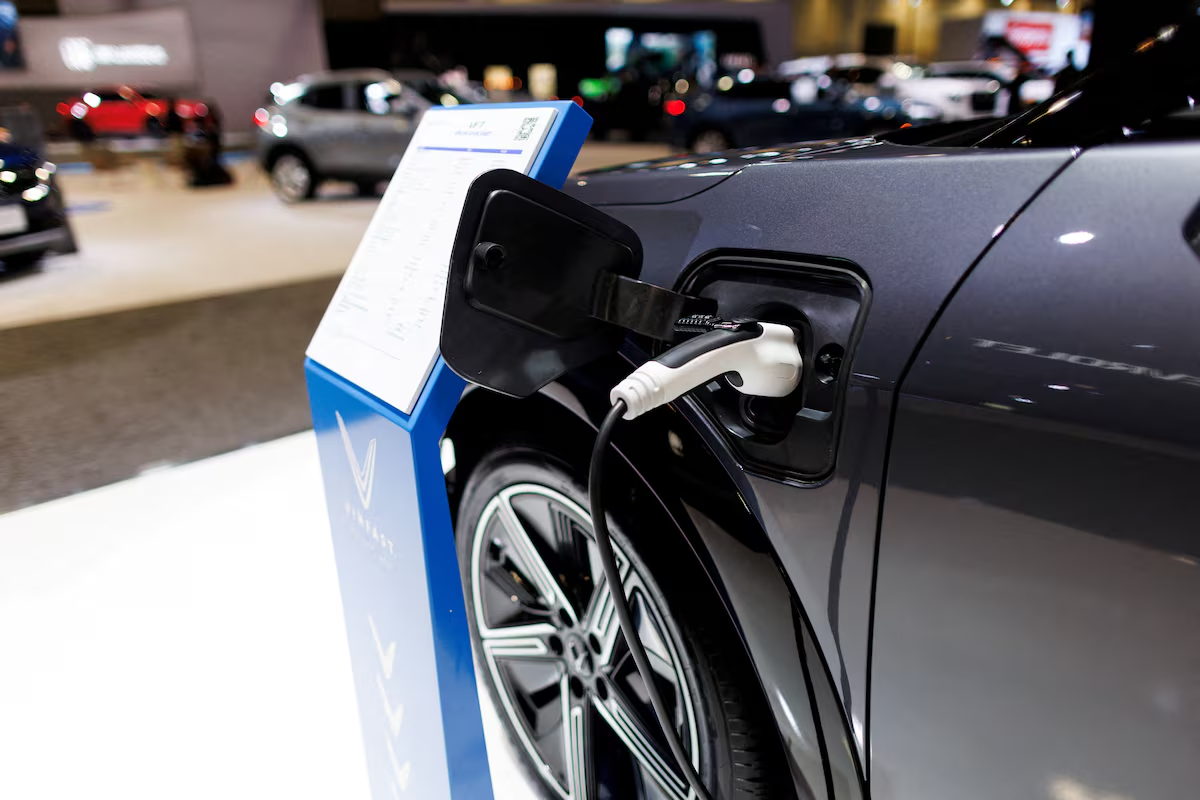 |
A VinFast electric vehicle charging at the Canadian International AutoShow in Toronto, Ontario, Canada, on 15/2/2024. Photo: Reuters |
Carney also added that electric vehicles from China are not eligible for government incentives. Last month, Canada reached an initial trade agreement with China to reduce tariffs on electric vehicle imports from that country to 6.1%, with a quota of 49,000 units annually.
In addition to increasing incentives, Canada also abolished the mandatory electric vehicle sales quota. Under previous regulations, automakers were required to ensure that electric vehicles accounted for 20% of their total sales in 2026.
Instead of imposing this quota, Ottawa plans to introduce stricter emission standards for vehicle models manufactured between 2027 and 2032. The government believes the new emission regulations will help the country achieve its goal of electric vehicles accounting for 75% of sales by 2035 and increasing to 90% in the following five years.
"The new regulations will focus on important outcomes for Canadians, while avoiding undue burdens on the domestic automotive industry," Carney stated. He added that Canada remains a leader in climate change and will announce an ambitious climate strategy in the coming weeks.
Canada's new automotive strategy was introduced after Europe decided to lift the ban on gasoline vehicle imports from 2035. Carney suggested this move was necessary due to tariff damage inflicted by the United States on the automotive industry, forcing Canada to diversify trade and boost domestic production.
Last November, the federal government also canceled plans to cap emissions in the oil and gas sector and revoked clean electricity regulations.
Commenting on Canada's new automotive strategy, Sam Hersh, a representative of the environmental advocacy group Environmental Protection, called it "a major setback." He stated, "This might be seen as a short-term solution for automakers, but it will lead to long-term difficulties and push the industry down an unavoidable path of decline."
Meanwhile, the Canadian Automobile Manufacturers Association welcomed the Prime Minister's new move, suggesting that the policy of financial incentives for vehicle purchases, coupled with a robust charging station development strategy, will accelerate the transition to electric vehicles.
Bao Bao (according to Reuters)