Observations in the Mekong Delta indicate that durian prices have reached a two-year high. Thai durian, grade A (2,7 compartments), is being purchased for up to 140,000 VND per kg, while grade B ranges around 120,000 VND per kg. For the Ri6 variety, prices generally hover around 80,000 VND per kg for grade A and 60,000 VND per kg for grade B, representing a 30-50% increase compared to peak harvest season.
Despite the rapid price increase, the supply remains limited. Cuong, a durian farmer in Can Tho, shared that last year his family attempted off-season cultivation for Tet sales, but prices subsequently plummeted. Exercising caution due to this risk, he allowed his trees to develop naturally this year for the main season. "Now prices are very high, but my orchard has no fruit left to sell," he stated.
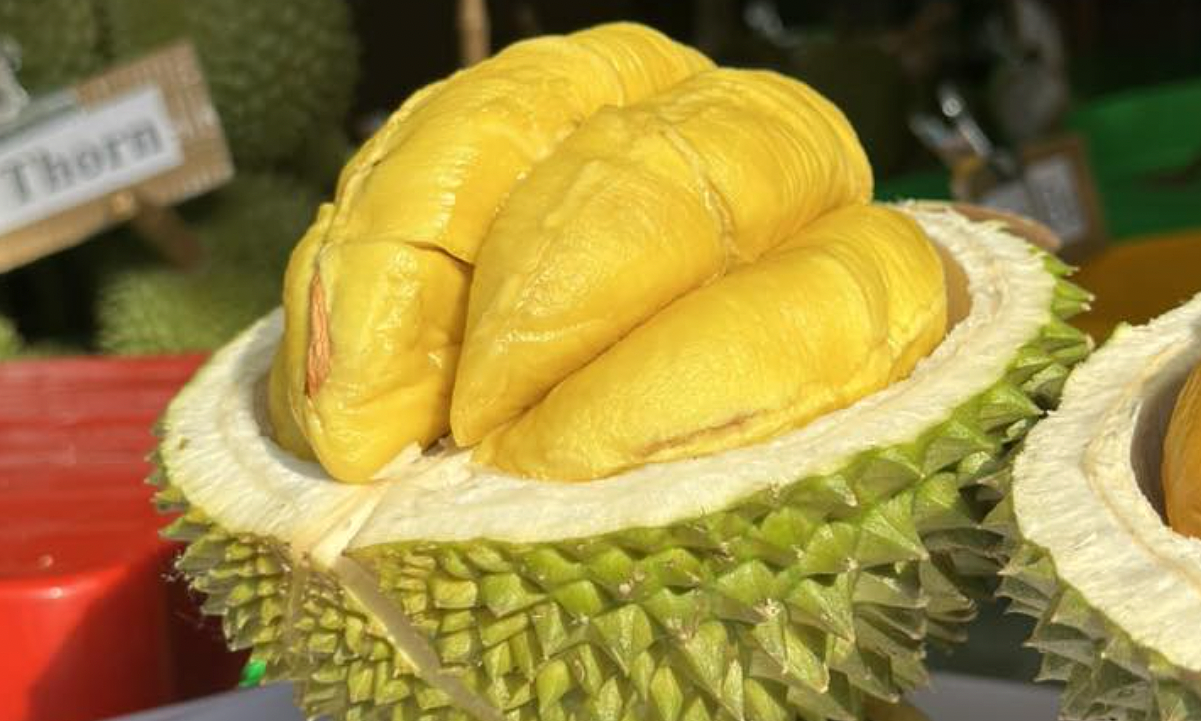 |
Off-season durian harvested in February from a Mekong Delta orchard. Photo: Manh Khuong
Many other farmers face a similar situation. Dien from Tien Giang (now Dong Thap) recently sold approximately 200 kg of off-season durian for 130,000 VND per kg but acknowledged that this year's yield decreased by about 30%. According to Dien, erratic weather conditions made off-season cultivation challenging, leading to higher investment costs and lower yields. Consequently, many orchards skipped the flowering treatment process entirely, a departure from previous years.
In the purchasing phase, traders also encounter significant pressure due to the lack of supply. Nguyen Thanh, a trader in Dong Thap, noted that he continuously increased prices to gather late-season durian, but the volume acquired was negligible. As Tet draws nearer, transportation and harvesting labor costs both rise, while the supply becomes increasingly scarce.
According to the Vietnam Fruit and Vegetable Association, the market is currently in its off-season, so supply is inherently limited and even more so this year. One reason is that many durian orchards in the Mekong Delta were affected by floods. Another factor stems from last year's low off-season durian prices, which made farmers less enthusiastic about investing in off-season cultivation. Instead, they allowed trees to fruit naturally, awaiting the main harvest from April. Meanwhile, durian harvesting in the Central Highlands concluded in 11/2025, leaving the market largely dependent on scattered supplies from the Mekong Delta.
Conversely, export demand continues to be an important support for domestic durian prices. According to the Customs Department, durian export turnover in 2025 reached approximately 3,86 billion USD, an increase of more than 20% compared to the previous year, accounting for over 45% of total fruit and vegetable export value. This upward trend helps maintain high durian prices, especially during the period leading up to Tet when supply becomes increasingly tight.
Thi Ha