"We don't need Canada, they need us!", former US President Donald Trump posted on Truth Social earlier this week, amid a severe deterioration in trade relations between the two countries.
On 25/8, Canada announced a list of approximately 700 US products that will face new import tariffs of up to 50%, effective from 8/9. This policy aims to retaliate against the 50% tariffs the US imposed on 20 billion USD worth of Canadian goods last week, following a breakdown in negotiations.
In fact, President Trump has repeatedly claimed the US does not need Canada. In a recent statement, he suggested that "without the US, Canada cannot survive". However, experts highlight the deep integration of the two economies. An escalating trade war could pose unavoidable risks to US energy, raw material, and supply chain sectors, given their dependence on Canada.
Canada is currently the US's second largest trading partner after Mexico, with an exchange of approximately 872 billion USD in goods and services last year. While Canada's exports are heavily reliant on the US, accounting for three-quarters of its total trade turnover and nearly 25% of its gross domestic product, this also signifies a high US demand for its neighbor's goods, particularly energy.
Daniel Beland, a Professor of Political Science at McGill University, stated that Trump's claim of the US not needing Canada is "completely false". He emphasized US dependence on Canadian oil, natural gas, and deeply integrated production chains such as automotive.
According to the US Energy Information Administration (EIA), crude oil imported from Canada accounts for 20% of total US consumption. Most of this oil is transported to refineries in the US Midwest, which are specifically designed to process heavy crude into gasoline, diesel, and jet fuel.
Energy trade is a significant factor in the US trade deficit with Canada, a point of frequent contention for Trump. This week, the White House described the bilateral trade relationship negatively, alleging that Canada has taken approximately 50 billion USD from the US each year over the past decade. However, most of this imbalance stems from US purchases of Canadian energy to fuel its economy, accounting for 48,3 billion USD of the deficit last year. If energy is excluded, the US actually maintains a trade surplus with Canada.
The EIA notes that Canadian heavy crude oil is often cheaper than the US WTI benchmark. Following the collapse of trade negotiations last week, Trump imposed 50% tariffs on approximately 20 billion USD worth of Canadian goods, but notably excluded energy. As a result, approximately 4 million barrels of Canadian crude oil continue to flow south daily.
Speaking on television, Prime Minister Mark Carney stated that Canada supplies 99% of US natural gas imports, 85% of its electricity, and 60% of its crude oil imports. "I don't think they want us to stop selling any of that energy," he remarked.
Furthermore, the US is looking to develop artificial intelligence (AI) data centers, which are highly electricity-intensive. Ottawa has offered assistance in this regard. Prime Minister Mark Carney indicated that Canada could help the US "meet exploding electricity demand for AI" by doubling its grid capacity by 2050 through large-scale hydropower and nuclear projects.
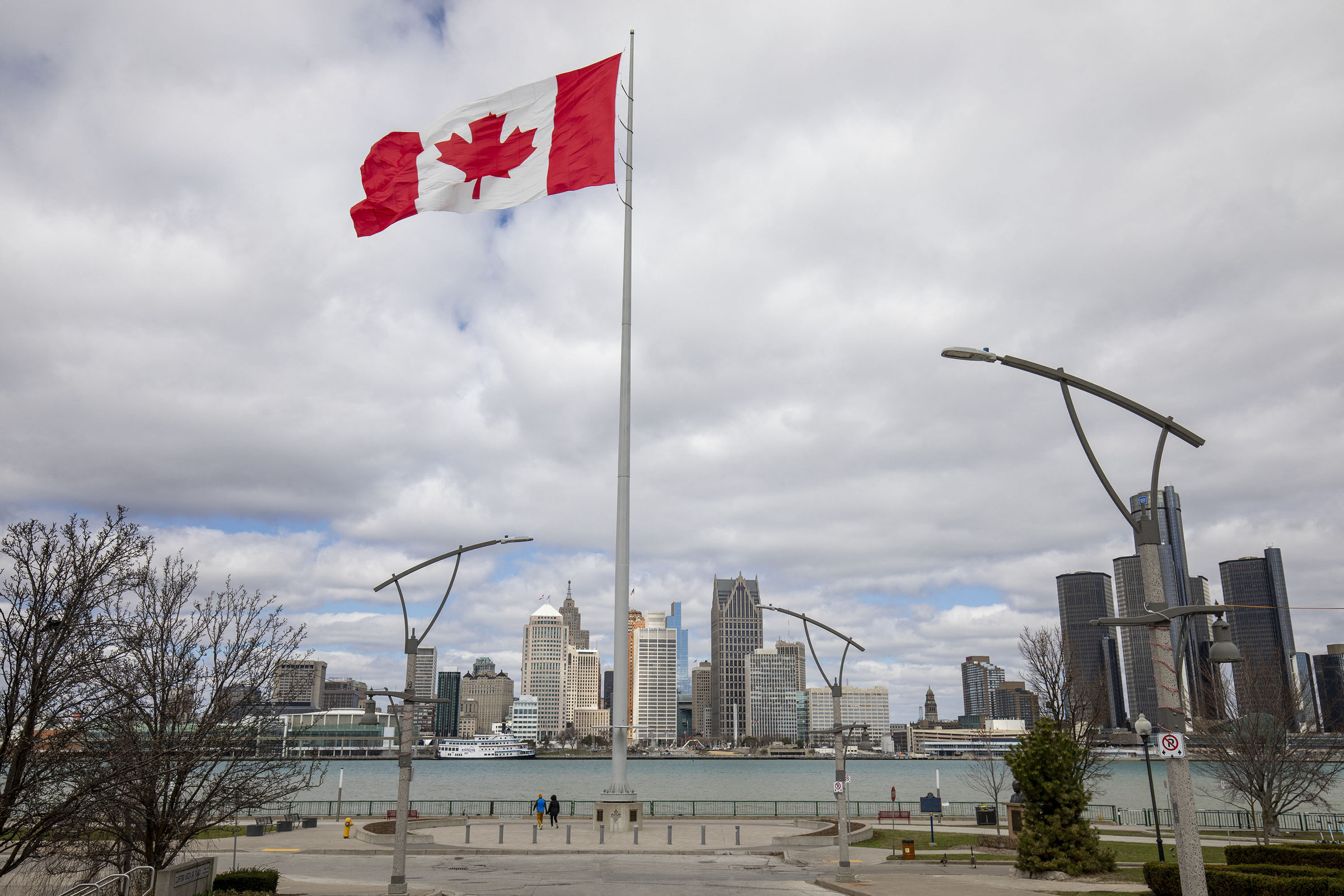 |
Canada's national flag in Windsor, Ontario on 1/4. Across the river is Detroit, Michigan, US. AFP
Beyond energy, US farmers rely on Canadian potash, an essential fertilizer for crops such as corn and soybeans. Over 80% of US potash imports originate from Canada. Even US Ambassador to Canada Pete Hoekstra has refuted the notion that the US needs nothing from its neighbor. "We need potash," he stated in June.
Understanding this leverage, Canadian officials are debating whether to use energy or fertilizer as a bargaining chip to seek concessions from the White House. Ontario Premier Doug Ford declared he would "play to the end". "Ontario supplies power to 1,5 million US homes and businesses. All options are on the table," he warned.
Former Alberta Premier Jason Kenney also suggested that export taxes on oil, fuel, or potash should not be ruled out if Trump continues to escalate. "They should remember that if they really want to escalate, it won't end well for the US economy, with only two months before the midterm elections," he said.
However, Alberta Premier Danielle Smith opposed such measures, arguing they would cause a "disaster" and could severely damage the Canadian economy.
In the automotive sector, the two countries have established an integrated production chain where components can cross the border up to six times before being assembled into a complete vehicle. Earlier this week, Trump announced plans to impose a 50% tariff on Canadian cars, trucks, and auto parts from early next year. This means that tariff policies targeting Canada could ultimately have a reverse impact on US industrial centers like Michigan or Ohio, as US automakers might face higher costs for aluminum and increased assembly expenses due to taxed cross-border components.
By Phien An (according to AP, Independent)