On 27/5, the European Union Chamber of Commerce in China released a survey of nearly 300 member companies. Nearly one-third reported increasing production in China, while 37% stated they had not changed their supply chain strategy over the past two years.
A significant 68% of respondents said they would remain or expand production in China. In contrast, only 7% indicated plans to relocate factories to other countries or establish alternative production facilities elsewhere.
"We are not seeing a de-risking trend here," said Jens Eskelund, President of the European Union Chamber of Commerce in China. "The data even shows European companies becoming more dependent on China for sourcing and manufacturing their products."
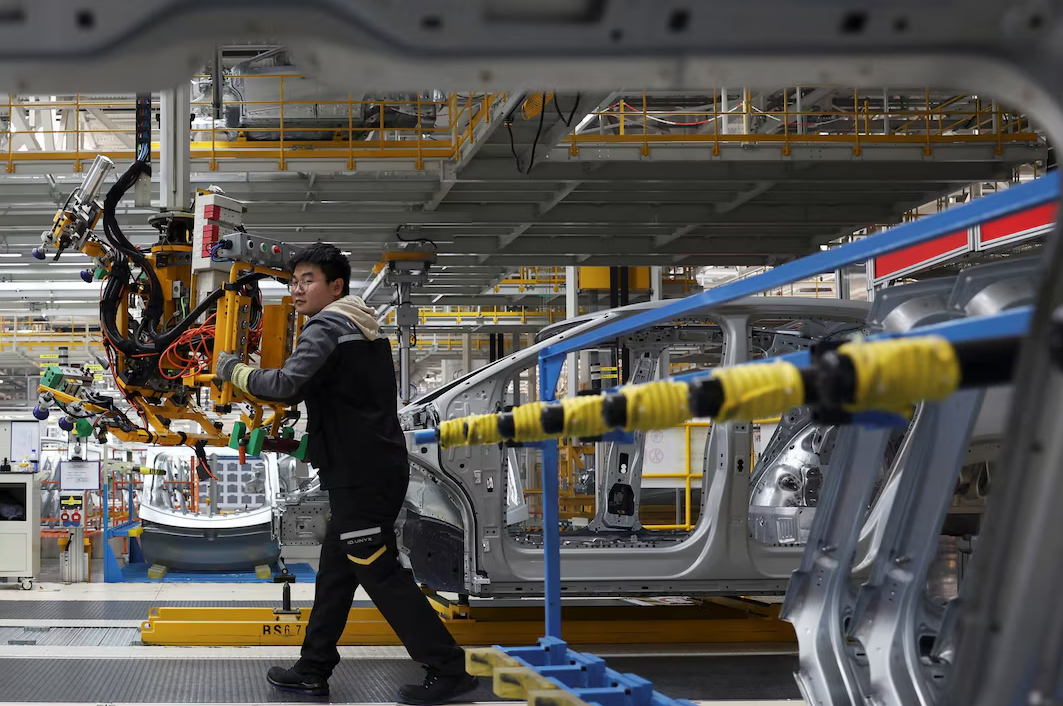 |
Workers at a Volkswagen factory in Anhui, China, in 2/2026. Photo: Reuters |
China currently accounts for approximately 28% of global manufactured goods output, despite import tariff policies from the United States and the European Union (EU). The EU is reportedly increasing its scrutiny of China's trade practices.
Cost is a primary reason European companies are increasing production in China, the survey indicated. While low labor costs historically helped the country become a global manufacturing hub, factories now face labor shortages, prompting many businesses to rapidly accelerate automation.
"Although still low, labor costs are now almost irrelevant due to automation," said Denis Depoux, Managing Director at Roland Berger, the company that supported the survey's execution. "The difference in the level of automation compared to two years ago is significant. Today, you barely see workers anymore." Depoux added that while automation can be more expensive than human labor initially, factories can produce faster in the long run.
Chinese electric vehicle manufacturer Nio previously stated that one of its factories in China operates with 941 robots. This facility can operate fully automatically on multiple vehicle lines simultaneously without human workers, allowing for continuous 24/7 operation.
In March, Roland Berger released a report titled "China's Cost and Speed Advantage: A Wake-Up Call for Western Companies." The report observed that China's domestic manufacturing ecosystem benefits from lower industrial energy and raw material costs. It also indicated that quarterly price negotiations with suppliers, combined with selective government subsidies, often enable Chinese products to reach global markets sooner and at significantly lower costs.
Approximately three-quarters of EU businesses in China reported that their production facilities there are more efficient than those elsewhere. "Most industries today have at least one Chinese competitor, or an international competitor leveraging China's supply chain," Eskelund stated. "Therefore, I believe that in many industries, if you want to compete on price and quality, businesses need to be part of the Chinese supply chain."