On 20/2, the US Supreme Court rejected former President Donald Trump's import tariff policy based on the International Emergency Economic Powers Act (IEEPA). While many businesses welcomed this outcome after a long period of litigation, trade associations, companies, and analysts in Europe are concerned the ruling could further complicate trade relations, especially after both sides struggled to reach an agreement last year.
"This ruling could create a boomerang effect, causing more instability and stalling orders as businesses await a clearer legal framework," commented Paolo Castelletti, general secretary of Italy's wine association UIV.
The US is currently the largest market for Italian wine, with export turnover estimated at 1,9 billion euros (2,3 billion USD) in 2024. This market accounts for nearly one-quarter of Italy's total global wine exports.
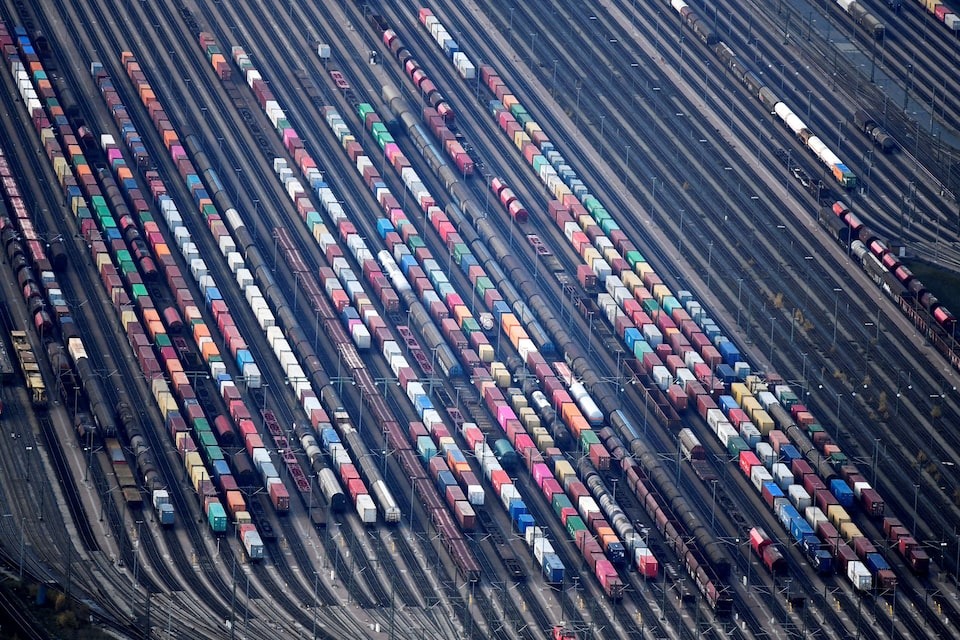 |
Containers are loaded onto a cargo ship at a railway station near Hamburg, Germany in 11/2019. Photo: *Reuters* |
Many businesses had warned that Trump might seek other ways to impose similar tariffs. The ruling could also escalate tensions between the US and its major trade partners. Tariff refunds would also be difficult. On 21/2, the US president announced a 15% tariff for 150 days on all countries to replace the rejected tariffs.
Steve Ovara, an expert at the law firm King & Spalding, said most of their clients believe any tariff reduction would only be short-term. "The big issue everyone will face, at least in the short term, is increased instability," he stated.
Wolfgang Grosse Entrup, director of the German Chemical and Pharmaceutical Association VCI, representing companies like BASF, Bayer, and Evonik, agreed with this view. "For our member companies, this is not the start of a stable phase, but a new cycle of instability. It would be a mistake for anyone to believe this means the tariff conflict is over. New tariffs based on different legal grounds could emerge at any time," he warned.
Peter Sand, an analyst at the shipping valuation platform Xeneta, noted that political risks persist for shipping companies. The trend of reducing supply chain risks is irreversible. "Damage to the supply chains of many shipping businesses has already occurred," he said.
The French cosmetics association FEBEA, whose members include L'Oreal, stated they are "very cautious" about the ruling and will monitor how the US government reacts, including the possibility of new tariffs. "We are all accustomed to the twists and turns in this import tariff story," said FEBEA general secretary Emmanuel Guichard.
Massimiliano Giansanti, president of the Italian farmers' association Confagricoltura, believes the US Supreme Court's ruling "removed the entire legal basis" for Trump's tariffs. However, this further complicates the situation for exporters, just as they had begun adapting to US tariffs.
"All of this creates significant instability at a time when we need certainty. We had already begun collaborating with US import companies," he added.
In Ireland, whiskey exporters are awaiting further developments before taking action. Eoin O Cathain, director of the Irish Whiskey Association, believes negotiations could resolve the tariff challenges.
"This is not a 'silver bullet' to eliminate tariffs, but merely a new variable, another twist in this story," he said.
Ha Thu (according to Reuters)