Hashdex, a digital asset management firm, will close and liquidate its spot bitcoin ETF, valued at USD 14,7 million. This marks the first US spot bitcoin ETF to be dissolved.
Previously, some bitcoin futures ETFs, such as VanEck's XBTF in 2024, had closed. However, no US ETF directly holding bitcoin had been liquidated until now.
Hashdex stated that the decision followed an evaluation of multiple factors: assets under management (AUM), liquidity, operational costs, investor interest, and the fund's role within the company's product portfolio.
According to SoSoValue, the Hashdex Bitcoin ETF (DEFI) is currently the smallest spot bitcoin ETF in the US by net asset value and recorded the lowest capital inflows among its peers. The second smallest fund is WisdomTree BTCW, with USD 142,4 million in assets, while the leading fund, BlackRock IBIT, manages up to USD 47,08 billion.
According to filings with the US Securities and Exchange Commission (SEC), August 17 will be DEFI's final trading day. Subsequently, the fund will sell all remaining bitcoin holdings and distribute cash to investors.
DEFI's failure to attract capital inflows contrasts with the overall growth of the US spot bitcoin ETF market. The entire group of funds currently manages approximately USD 77,6 billion in assets and has drawn a total of USD 51,5 billion in net capital since its launch.
Hashdex entered the spot bitcoin ETF market later than many competitors. The company launched DEFI as a bitcoin futures ETF in September 2022, but only converted it to a spot ETF in late March 2024, nearly three months after BlackRock's IBIT began operations.
At the time of conversion, DEFI applied a management fee of 0,25%, comparable to BlackRock and Fidelity. This meant it gained no cost advantage to offset its small size and low liquidity.
US-approved spot bitcoin ETFs, launched in January 2024, were once seen as a turning point, reshaping how the crypto market matured by bridging the gap for large financial institutions' capital. However, recent capital inflows have weakened as investors shifted to more attractive artificial intelligence (AI)-related investments. According to SoSoValue, this group of funds recorded net outflows for three consecutive months.
"The market largely believes that the opportunity cost of holding bitcoin is currently too high, while AI-related assets continue to appreciate", stated Vetle Lunde, Head of Research at K33 Research, in a June report.
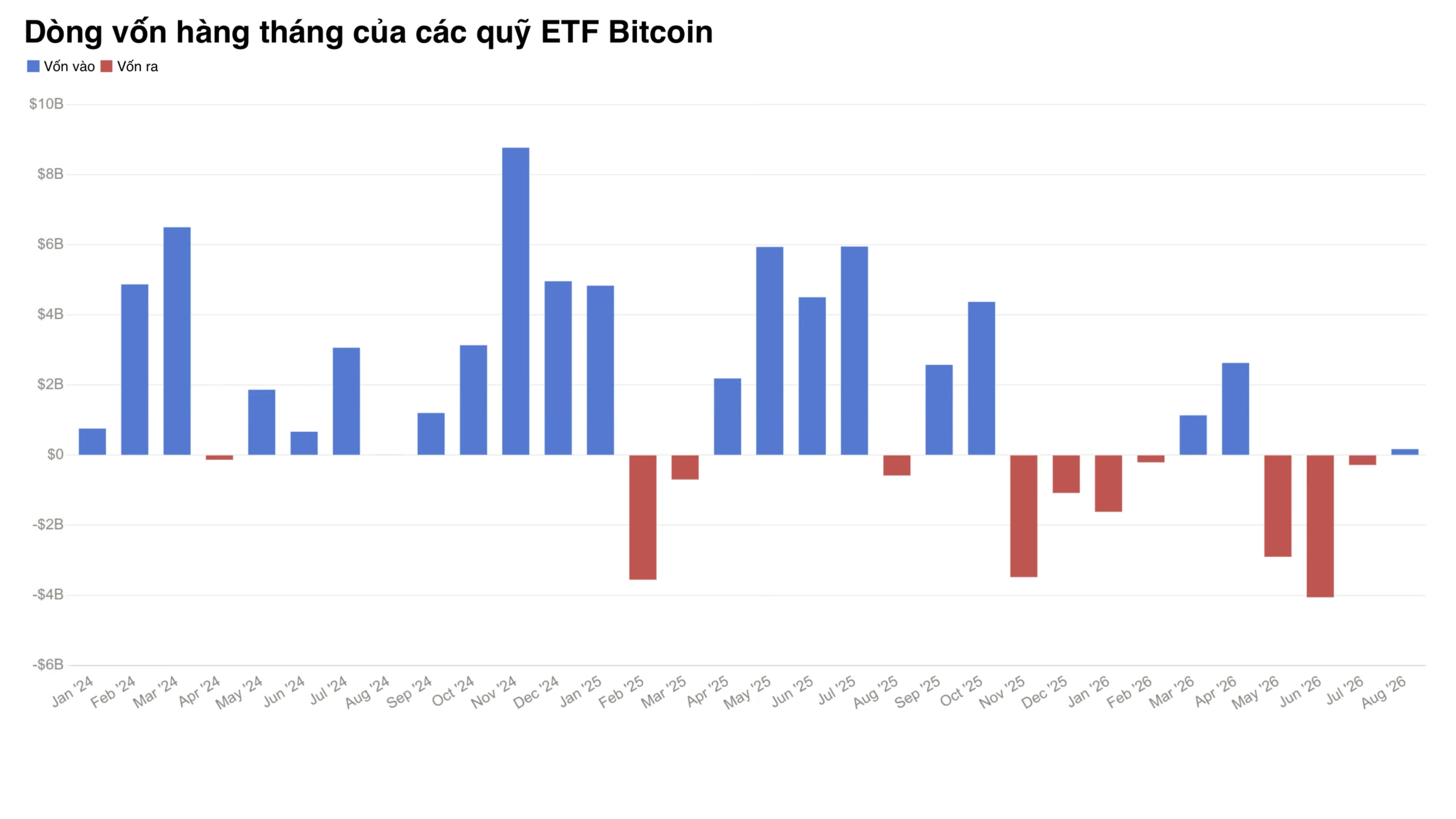 |
Bitcoin ETF inflows are showing a slight recovery after months of net outflows. Source: SoSoValue. |
As of the end of July, BlackRock's iShares Future AI & Tech ETF had increased by 39% and managed USD 3,6 billion in assets. Meanwhile, the overall digital currency market declined by approximately 36% according to the CoinDesk 20 – an index of the top 20 digital currencies by market capitalization, excluding stablecoins, memecoins, and exchange tokens.
Nevertheless, Hashdex's move does not signify a weakening US spot bitcoin ETF market. The majority of capital inflows for this group of funds remain concentrated in BlackRock's IBIT, with USD 60,5 billion in net capital, followed by Fidelity's FBTC, with USD 9,95 billion. Grayscale's GBTC, however, has seen USD 27,47 billion in net outflows since converting to a spot ETF.
Hashdex also affirmed that it is not withdrawing from the US digital currency ETF market. The company currently manages over USD 200 million in assets through other products, including the Hashdex Nasdaq Crypto Index US ETF (NCIQ).
The closure of spot digital currency ETFs has occurred outside the US before. In November 2022, Cosmos Asset Management withdrew two bitcoin and ether ETFs listed in Australia after only six months of operation, as their total assets reached only approximately AUD 1,1 million (USD 710.000).
By Tieu Gu (Source: CoinDesk)