Germany's economy relies on manufacturing and exporting complex, high-value products essential for global business, including oto, train locomotives, factory machinery, aircraft, and construction equipment. However, this growth model faces significant pressure from a new rival: China, which offers exports of comparable or nearly equal quality at significantly lower prices.
Economists refer to this as the "China shock," identifying it as a key factor in Germany's economic stagnation since the pandemic. German businesses once reaped substantial profits from sales to China, but the situation has now reversed.
Beijing has been supporting businesses in key sectors, many of which are areas where Germany traditionally excels. When its domestic market cannot absorb all these products, China shifts its focus to exports.
Europe's largest economy declined throughout 2023 and 2024, growing by only 0.2% last year. While its 4% unemployment rate is lower than the European Union (EU) average, Germany has recently seen continuous news of staff reductions at key companies like Volkswagen, BMW, and Bosch. Additionally, post-pandemic inflation has outpaced wage growth, meaning real wages last year only returned to 2019 levels.
Costs must decrease "as the Chinese market shrinks by 20% and businesses increase exports, intensifying competitive pressure in Europe," explained Volkswagen chief financial officer Arno Antlitz earlier this month.
Germany's economy relies on exporting product categories similar to those China is currently supporting. Germany now imports more from China than it exports to the country, particularly in sectors Berlin once dominated: oto, trucks, buses, trains, aircraft, factory machinery, and medical equipment.
Many businesses have found a way to cope: if you cannot beat them, join them.
Jungheinrich, a German manufacturer of forklifts and warehouse vehicles, is collaborating with China's EP Equipment to produce AntOn. This mainstream forklift series is competitively priced against rivals.
This partnership combines EP's large-scale, low-cost production in China with Jungheinrich's global sales network and reputation. They are currently one of the three leading manufacturers of warehouse vehicles worldwide.
AntOn does not possess all the features of vehicles produced entirely in Germany, but it meets essential needs and costs half the price. This product targets customers who do not require continuous 24/7 equipment operation.
Volkswagen is also implementing a "in China, for China" strategy. The company established a development center in Hefei to design models specifically for this market.
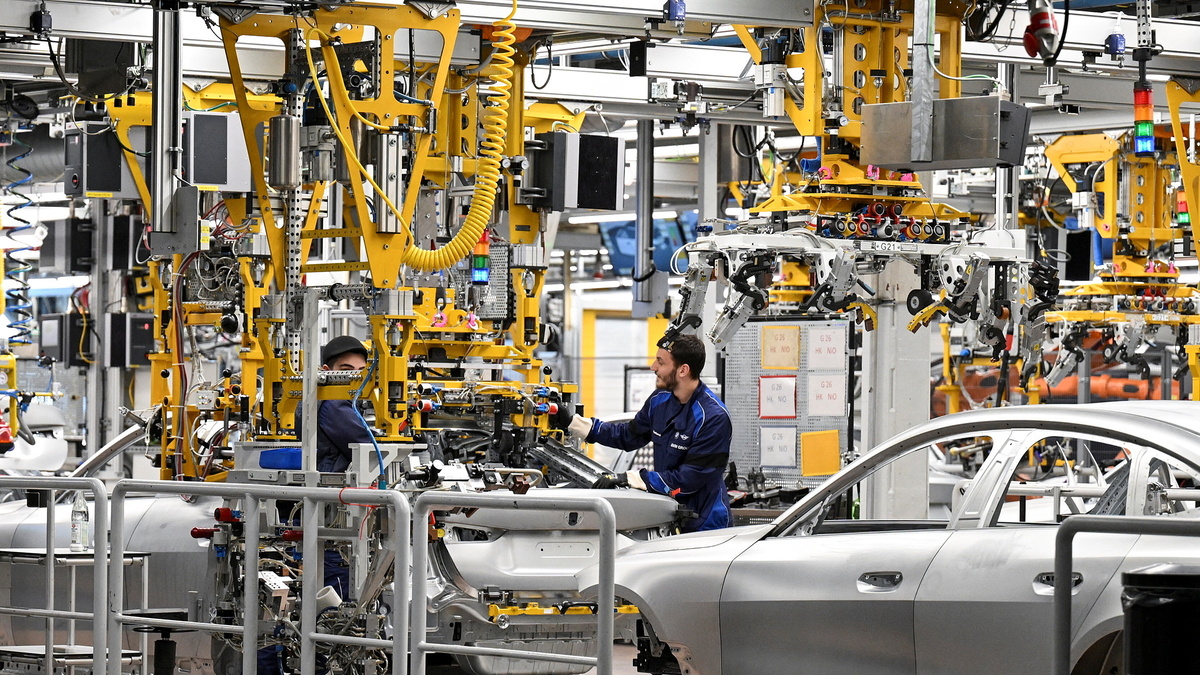 |
Workers at a BMW factory in Munich, Germany on 5/12/2023. Photo: Reuters |
German officials are trying to avoid a repeat of what happened to the country's solar energy industry. Germany was an early adopter of solar panels in the early 21st century, but cheaper products from China later caused many German companies to struggle. Currently, most solar panels in this European nation are imported from China.
Beijing's support policies mean key sectors receive various forms of incentives: from credit and raw materials to land and domestic production quotas. Workers in China also have lower incomes than those in Europe.
However, China's export strength is not solely based on government support. Faced with fierce price competition amid domestic economic stagnation, businesses must also continuously cut costs and race to adopt new technologies.
In Germany, the government is trying to stimulate growth through a fund worth 500 billion euros (579 billion USD) for investment in new infrastructure like roads, bridges, and railways. A policy package proposed in july includes income tax reductions for middle and low-income earners, alongside efforts to reduce bureaucracy.
However, economist Brad Setser told AP that the solution might be beyond the German industry's capabilities. The ultimate responsibility lies with the EU's trade policy, set by the European Commission (EC). The EC has recently applied narrowly targeted tariffs on certain goods imported from China, such as electric oto and construction site lifting platforms.
"We believe Europe needs a tougher trade policy if it wants to protect its market from the spillover effects of China's industrial policy," Setser concluded.
Ha Thu (via AP)