This message was delivered by Governor of the State Bank of Vietnam, Pham Duc An, at the Conference on unlocking financial and banking resources to serve the Capital's economic growth for the 2026-2030 period, held on 12/9.
He stated that bank credit is a vital resource but cannot, and should not, be the only capital source for all development needs. For large-scale, long-term projects, he emphasized the need for an appropriate structure combining equity, credit, public investment, public-private partnerships (PPP), and other legal resources. The Governor added that combining multiple capital sources enhances project sustainability and reduces maturity pressure on the banking system.
For businesses, access to capital also depends on management capacity, financial transparency, equity, and the quality of cash flow.
He urged the city and businesses to diversify medium- and long-term financial resources, utilizing tools from the capital market, bonds, green finance, and ODA. This approach aims to lessen dependence on a single capital channel.
"The more complete a project's legal framework, clear its progress, and defined its financial plan, the stronger the basis for credit institutions to appraise and quickly approve funding," the Governor explained.
 |
Governor of the State Bank of Vietnam, Pham Duc An, delivered a keynote speech at the conference, 12/9. Photo: SBV |
Governor of the State Bank of Vietnam, Pham Duc An, delivered a keynote speech at the conference, 12/9. Photo: SBV
Recently, the regulatory body has introduced policies to expand banks' lending capacity for large projects. These include proposals to increase the lending limit to 52% of equity capital for some projects in Hanoi, and to exclude outstanding loans for certain projects by Vingroup, Sun Group, and Masterise from annual credit growth targets.
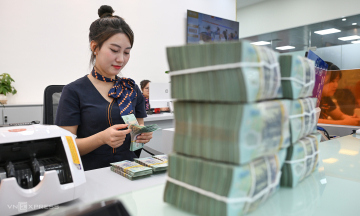
As of 28/8, total outstanding credit across the system reached approximately 20,5 quadrillion dong, marking a 10,24% increase compared to the end of 2025. Approximately 77,3% of outstanding loans support production and business sectors.
Hanoi alone currently has 165 credit institutions with over 2,000 transaction points, accounting for more than 37% of total capital mobilization and about 31% of outstanding loans for the entire economy. In the first eight months of the year, credit growth in the area increased by 13,05%, higher than the overall growth rate of the entire system.
Since late last year, leaders of the State Bank of Vietnam have reported multiple times on the high credit growth. By the end of 2025, Vietnam's credit-to-GDP ratio reached 146%, the highest among lower-middle-income countries.
According to the Governor, unlocking capital sources requires synchronized coordination among regulatory bodies, local authorities, banks, and businesses.
He directed the State Bank of Vietnam, Region 1 Branch, to closely monitor capital mobilization, credit growth, interest rates, bad debt, and capital absorption capacity in the area. This agency also needs to coordinate with Hanoi to review the capital needs of important programs, works, and projects.
Issues must be clearly categorized as either credit-related or pertaining to other fields, ensuring they are directed to the correct handling agency. This approach aims to prevent businesses from having to navigate through multiple contact points.
Quynh Trang