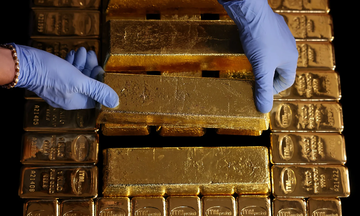
After successive corrections, the global gold price increased again on Wednesday (US time). Spot gold at one point gained over $130 USD, reaching $5,011 USD, before narrowing its gains to $4,992 USD. April gold futures also rose to nearly $5,025 USD.
The precious metals market rebounded strongly as positive geopolitical signals waned. Two days of negotiations between Ukraine and Russia in Switzerland concluded yesterday without significant breakthroughs. The White House also stated that nuclear talks with Iran made limited progress and are expected to resume next week for detailed discussions.
"There are some concerns related to geopolitical tensions between Iran and the US. It is not yet possible to confirm a clear trend for gold prices," said Edward Meir, an analyst at Marex.
Silver also saw significant gains, rising over 5% to $77 USD per ounce. In the previous session, silver dropped sharply to $71 USD—its lowest price since the beginning of the year.
The minutes of the US Federal Reserve (Fed) January meeting, released last night, showed officials almost unanimously agreed to keep interest rates unchanged, but remained divided on the policy outlook. Some warned that interest rates could rise again if inflation remains elevated, while others debated whether and when further cuts would be needed.
The current mixed movements align with the forecasts of most Wall Street experts. Adrian Day, President of Adrian Day Asset Management, believes that the fundamental factors supporting gold remain. The issue now is that the accumulation process is slow and unstable, leading to a few short corrections.
According to Alex Kuptsikevich, a senior market analyst at FxPro, gold fluctuated between $4,900 USD and $5,100 USD for most of the week, opening and closing near the midpoint of this range.
Domestically, the market is still closed for the Tet holiday. Each tael of SJC gold bars remained stable at 178-181 million dong.
Reuters