The international gold market experienced a dismal week, closing at 4,017 USD, a loss of over 90 USD per ounce, or 2,2%. Prices briefly fell below the psychological 4,000 USD mark. This decline was primarily due to renewed Middle East tensions, which sent oil prices soaring, sparking inflation concerns and raising the possibility of the US Federal Reserve (Fed) maintaining high interest rates.
Domestically, SJC gold bars closed the week with buying prices at 144 million dong and selling prices at 147,5 million dong, a decrease of one million dong from the start of the week. This marks the second consecutive week of decline, widening the gap from its previous peak to approximately 45 million dong.
The downward trend is not expected to end soon. Kitco's weekly survey reveals an overwhelming pessimistic sentiment on Wall Street. Among 14 participating analysts, 11 (approximately 80%) predict a further decline in prices this week. Two analysts believe the precious metal will remain stable, while only one expert anticipates an end to the current downturn and a market recovery.
Conversely, retail investor sentiment remains divided and indecisive. Out of 170 individuals surveyed by Kitco, about 40% believe gold prices will rise, and 36% lean towards the scenario that the correction has not ended. The remaining investors predict the market will enter a narrow consolidation phase.
Alex Kuptsikevich, senior market analyst at FxPro, points out that gold's rallies are progressively lower, continuing a downtrend that became evident in May.
Sharing this view, Adrian Day, Chairman of Adrian Day Asset Management, believes the market is unlikely to see a breakout until investor sentiment fully anticipates the Fed not raising interest rates.
Experts are also concerned that a tech stock sell-off in the US stock market could trigger a widespread "everything sell-off." In such a scenario, gold prices could soon test 3.943 USD, which is the lowest level since the beginning of the year.
On the other hand, neutral analysts view gold's repeated struggle but failure to completely lose the 4,000 USD mark as a sign that selling pressure has weakened, creating opportunities for a short-term recovery.
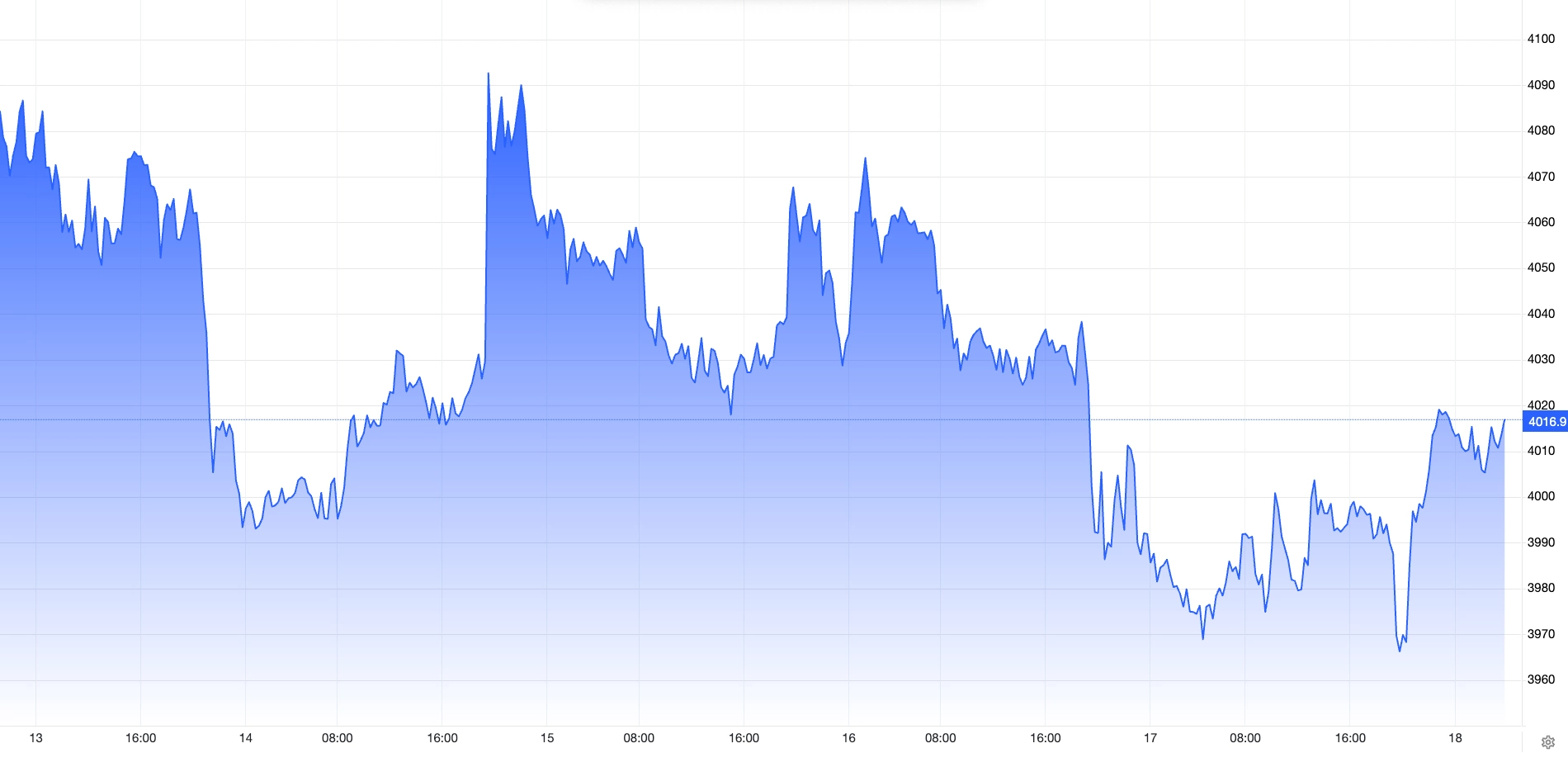 |
World gold price chart last week (13-18/7). *Screenshot* |
While individual investors are still waiting for the right moment to invest, large funds have actually been buying during market dips of 1-2%. ETF flows also signal a similar trend, with reduced selling and all outflows from Europe and North America being absorbed by increasing demand in Trung Quoc.
Rich Checkan, President of Asset Strategies International, shares this perspective, stating that he has observed consistent new buying pressure around current price levels. "We are not ready for a sustained rally, but from this support level, I see prices potentially moving higher," he remarked.
After a busy week filled with important indicators, the precious metals market is entering the quietest period for events this summer. Traders will have to wait until thursday for the first major event: the European Central Bank (ECB) monetary policy decision, along with US unemployment benefit data and preliminary PMI.
In this data-light period, gold prices are predicted to be more sensitive to news headlines and geopolitical developments, specifically Middle East tensions and oil price volatility.
Phuong Dong (according to Kitco)