According to port representatives, container trade between Hamburg and the US saw a significant decline of 23,9% to 395,000 TEU due to "trade fluctuations". However, this decrease was offset by growth from the Asian and European markets, which increased by 11% and 14% respectively. Specifically, the route with China reached 1,8 million TEU, an increase of 7,9%, while Malaysia’s volume nearly doubled (89,8%) to 273,000 TEU.
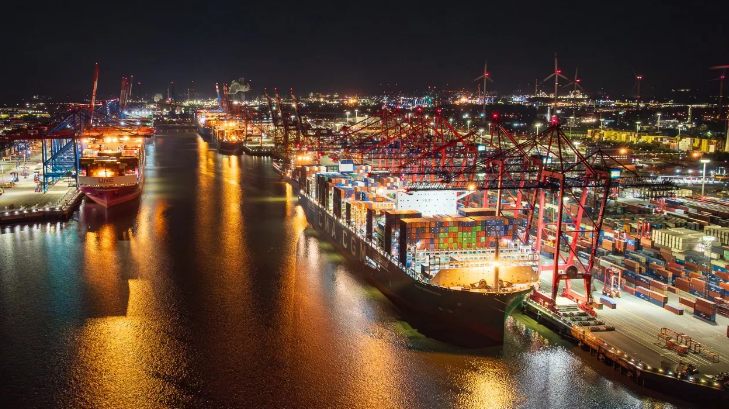 |
Hamburg Port. Photo: HHM
In other cargo categories, performance was lower compared to 2024. Bulk cargo reached 24,6 million tons, a decrease of 0,8%, although Q3 recorded a 9,4% growth driven by increased imports of coal and ore, up 16,4% and 3,8% respectively. Agricultural products declined by 10,3% to 4,2 million tons, and break bulk cargo fell by 7,4% to 0,8 million tons. Conversely, liquid cargo increased by 7,4%, reaching 7 million tons.
From July to September, container throughput was supported by new shipping services to Southern Europe, the Mediterranean, and South America. Transshipment activity continued its strong upward momentum, reaching 2,4 million TEU, a 22,5% year-on-year increase.
Rail transport volume at the port remained at a high level, comparable to 2024, with only a slight decrease of 0,5% to 2 million TEU. The port stated that demand for rail container transport remained high.
The Dan (according to Seatrade Maritime News)