This assessment was presented by experts at an online seminar titled "A multidimensional picture of the position of Ho Chi Minh City's private enterprises", organized by Sai Gon Entrepreneur magazine and the Vietnam Initiative Institute on the morning of 26/5.
Do Thien Anh Tuan, a lecturer at the Fulbright School of Public Policy and Management, highlighted business registration data indicating that the average capital of an enterprise in Ho Chi Minh City is very low, only a few billion dong.
While Ho Chi Minh City was once a cradle of entrepreneurial spirit after the Doi Moi (renovation) period, with many renowned brands, large state-owned economic groups, "Big 4" banks, and leading private corporations are now primarily concentrated in the North.
"Ho Chi Minh City is currently lacking 'national champions', meaning leading enterprises with international stature", Tuan stated. In fact, Vietnam Report's Top 500 Largest Enterprises in Vietnam (VNR500) indicates that the city has no enterprises in the top 10 largest businesses overall, and only 4 enterprises in the top 10 largest private enterprises.
Dinh Hong Ky, Vice Chairman of the Ho Chi Minh City Union of Business Associations (HUBA), observed that the city has a relatively strong business ecosystem, but it is not yet sufficient to create "leading cranes" (major companies), and there are few enterprises of Southeast Asian scale.
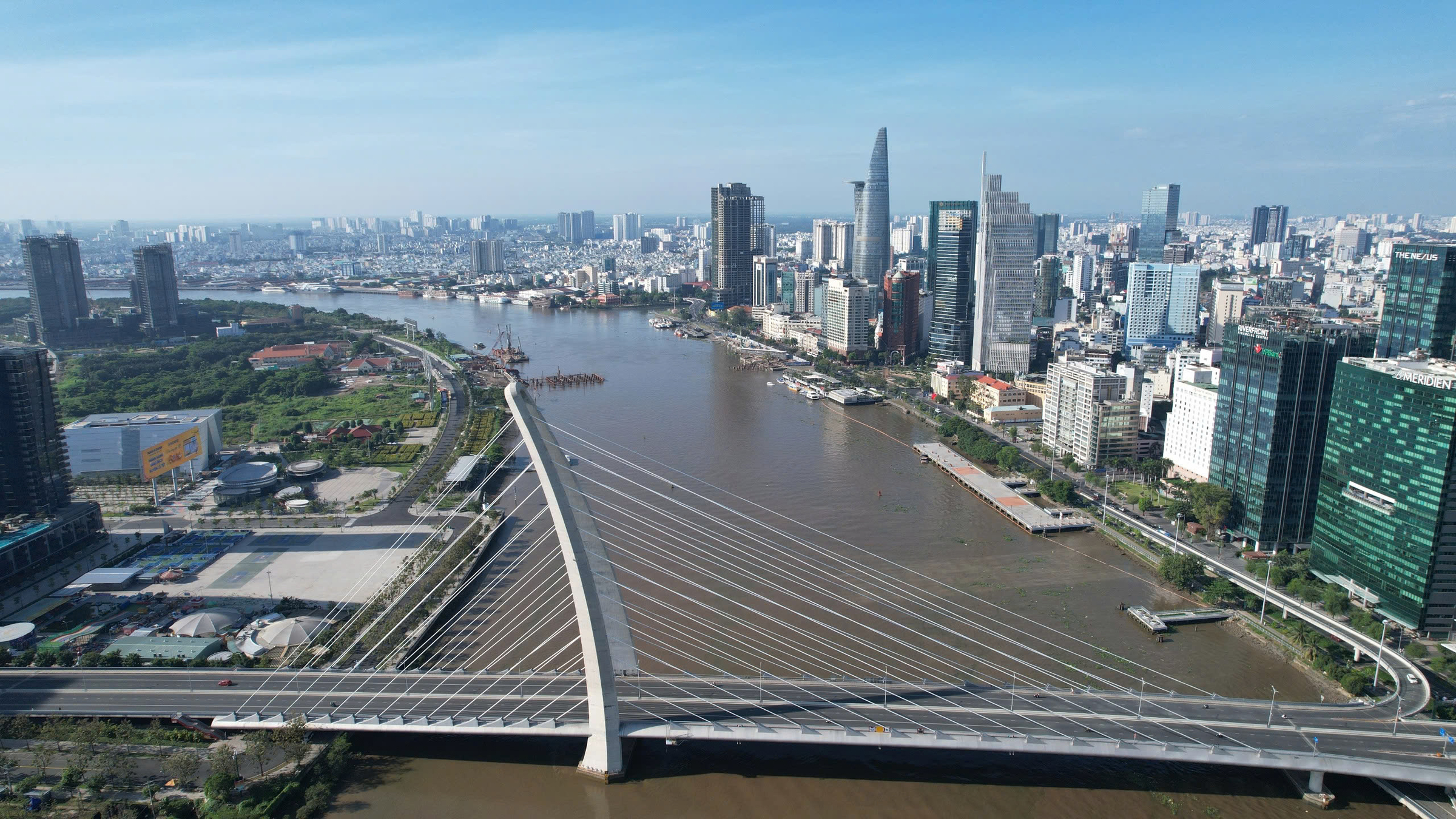 |
Ho Chi Minh City center on 17/2. Photo: Dinh Van. |
Ho Chi Minh City has approximately 350,000 enterprises, accounting for 30,6% of the national total. However, 80% are medium, small, and micro-sized, with very weak expansion capabilities, according to Ky. "Even long-standing private enterprises, aged 30-40 years, have shown slow expansion rates in recent years", he added.
Experts have identified a series of barriers to enterprise expansion in Ho Chi Minh City. According to Le Phung Hao, Chairman of Global AAA Consulting, many local businesses focus on the digital economy, technology, and high-end services.
These businesses primarily possess intangible assets such as algorithms, customer data, and brand value, rather than physical infrastructure, which becomes a bottleneck when seeking expansion capital. This is because 93,5% of bank loans require real estate as collateral, making it nearly impossible for "brainpower" enterprises to use intellectual property for loans.
"Consequently, once they reach a mid-level scale, they often choose to 'sell themselves' to foreign investment funds due to a lack of capital to become 'giants'", he explained. Furthermore, many founders of once-prominent private groups, after 30-40 years of success, also opt to sell to foreign entities due to generational transfer crises within their families.
Dinh Hong Ky cited the "Private Economic Report 2025", recently published by the Vietnam Chamber of Commerce and Industry (VCCI), which indicates that the primary challenges for businesses today are securing capital and acquiring customers.
The business community also faces high land, logistics, and infrastructure costs. Globally, an unstable situation makes it difficult for businesses to formulate long-term strategies, making investments in large, groundbreaking projects risky.
Despite these challenges, Ho Chi Minh City is still regarded as a dynamic economic hub, offering a favorable environment for business development. VCCI's Vietnam Private Economy Report (BPI) 2025 ranks the city as leading the nation in private economic governance effectiveness, thanks to its market size and the depth of its innovation ecosystem.
The locality averages 4,33 newly established businesses and 23,75 operating businesses per 1,000 residents, the highest nationwide. "This is home to the most dynamic SME and startup ecosystem, with high entrepreneurial spirit and adaptability", Ky remarked.
Experts recommend better policies for unsecured loans based on contracts and cash flow to support technology-strong businesses that lack land assets. To prevent premature "sell-offs", appropriate credit support mechanisms are needed for growing mid-sized enterprises.
According to Do Thien Anh Tuan, Ho Chi Minh City needs to accelerate the privatization of its state-owned enterprises. "If privatized and listed, the scale of some local businesses would be substantial", he commented. The expert also recommended breakthrough policies to connect the ecosystem for the post-merger super-city, providing businesses with the space and resources to compete on an ASEAN and global scale.
For businesses, Le Phung Hao advised consistently building core competencies, avoiding trend-driven diversification; simultaneously, proactively managing with data, and deeply integrating into inter-regional ecosystems and foreign direct investment (FDI) value chains.
Regarding the generational crisis in family businesses, the Global AAA Consulting expert proposed governance reform, separating ownership and management rights through a "Family Council" model common in other countries. This Family Council should boldly hire professional chief executive officers (CEOs) and chief financial officers (CFOs), and ensure financial transparency through a holding model to distinguish family capital from business investment capital.
Vien Thong