Ho Chi Minh City's ambition to foster a "smart economy" was articulated by Vice Chairman of the People's Committee, Nguyen Loc Ha, during a press conference for the "Autumn Economic Forum 2025" on 14/11. He emphasized that the strength of an economy is now measured by its ability to create and transform knowledge and technology into value.
Mastering technology, data, and green restructuring of production will provide a competitive edge, he noted. Therefore, digital transformation and green transformation must converge as strategic pillars, mutually reinforcing to generate dual development capacity.
Specifically, digital transformation enhances operational efficiency, optimizes processes, ensures transparency, and boosts economic effectiveness. Green transformation, in turn, guarantees development without compromising the environment or future resources, while meeting evolving market standards.
"When these two transformations operate synchronously, we can form a smart economy", Nguyen Loc Ha stated. He defined a smart economy as one where digital technology, innovation, and green standards are integral components of the development strategy, rather than isolated, standalone pilot projects.
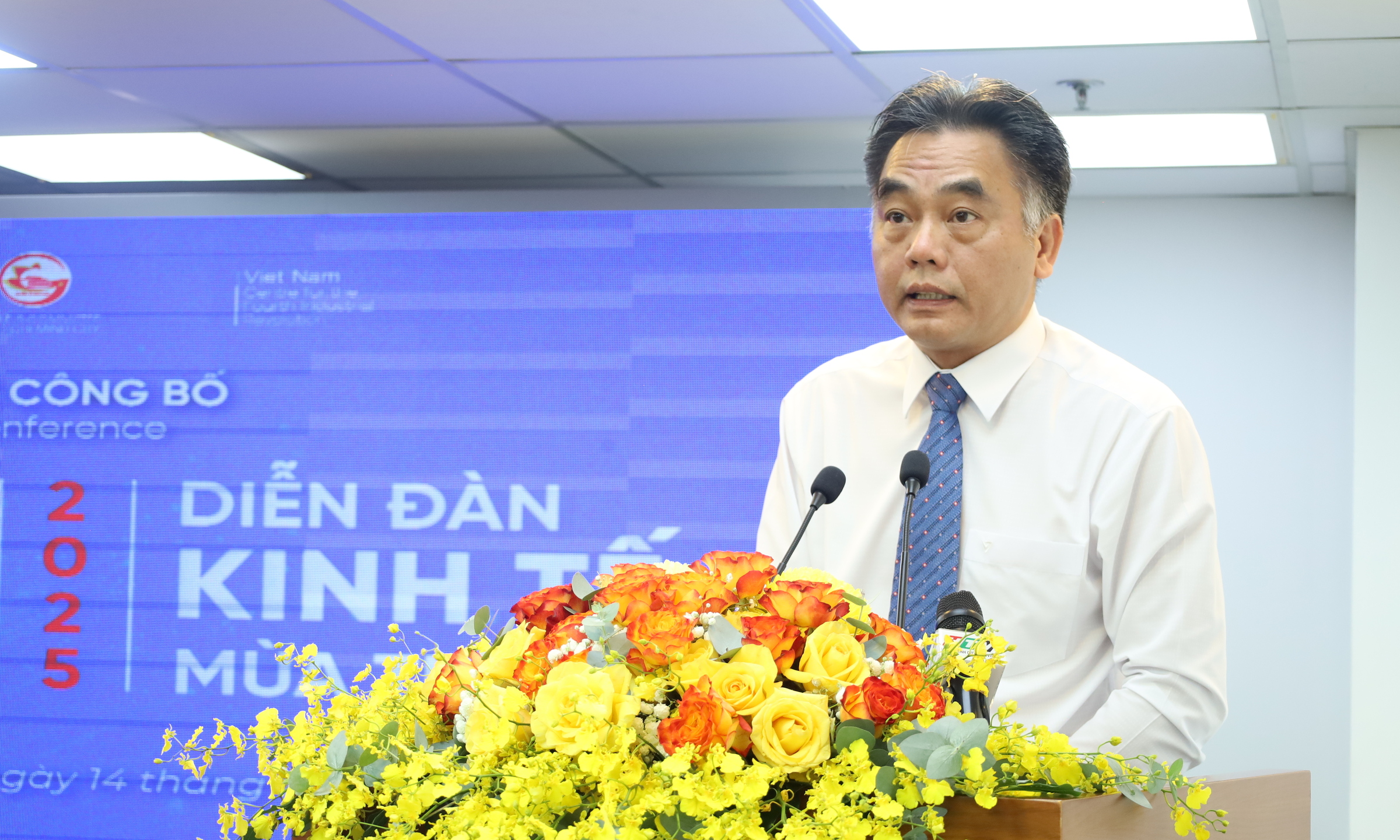 |
Vice Chairman of Ho Chi Minh City People's Committee Nguyen Loc Ha at the press conference on 14/11. Photo: *Organizers*. |
The pursuit of a "smart economy" is particularly urgent for Ho Chi Minh City, especially after recent mergers, which have solidified its position as a leading economic, financial, logistics, and science and technology hub. The city currently accounts for 23% of the nation's Gross Regional Domestic Product (GRDP) and hosts over 30% of its businesses. Ha emphasized that with this expanded development scope, the city must demonstrate its capacity for transformation, befitting its role as a central megacity.
Nationally, Vietnam is entering a new growth cycle. Traditional drivers, such as low-cost labor and foreign direct investment (FDI) attraction, are reaching their limits, according to the Forum organizers. This necessitates digital and green transformations to sustain competitiveness and enhance growth quality.
The European Chamber of Commerce in Vietnam (EuroCham) believes the nation's economy has a "golden opportunity to become the region's green manufacturing and innovation hub". Vietnam's digital economy is experiencing robust growth, contributing 18,3% to the Gross Domestic Product (GDP) and targeting 20,5% of GDP by 2025, an equivalent of 52 billion USD.
Concurrently, environmental and energy challenges are becoming increasingly pressing. Vietnam has committed to achieving net-zero emissions by 2050, requiring investments exceeding 2.400 billion USD for this transition. Electricity demand is projected to rise by 12-13% annually, necessitating a significant shift towards renewable energy, green manufacturing, and energy conservation. The World Bank warns that without timely action, annual growth could decline by up to 0,33 percentage points each year between 2025 and 2050.
The "Autumn Economic Forum 2025" will be held from 25 - 27/11. It will bring together: government leaders from various countries, 500 high-level guests, 8 international organizations (WEF, UN, IMF, ITU, UNESCO, IFC, FAO, ADB), 10 Centers for the Fourth Industrial Revolution (C4IR), 67 delegations from science and technology centers, innovation centers, and leading global corporations.
Prime Minister Pham Minh Chinh is scheduled for a 60-minute dialogue with WEF Managing Director Stephan Mergenthaler, focusing on how science and technology are shaping Vietnam's era of development. He will also attend the "CEO 500 - Tea Connect" networking event, bringing together 500 leading business chief executive officers.
*Vien Thong*