The Ho Chi Minh City People's Council (HDND) approved a resolution on the afternoon of 26/12, outlining the procedures for establishing, expanding, and adjusting the boundaries of the Ho Chi Minh City Free Trade Zone. This resolution concretizes National Assembly Resolution 260, which amends Resolution 98 on piloting specific mechanisms. It enables Ho Chi Minh City to test unique policies to attract investment and develop high-quality trade, logistics, and services.
The city will implement the free trade zone using a "one zone, many sub-zones" model, rather than establishing multiple independent zones. Initially, Ho Chi Minh City will establish a single free trade zone in the Cai Mep Ha area, spanning approximately 3,800 hectares. This area is designated as the core zone, necessarily linked to a deep-water seaport, to leverage the advantages of the Cai Mep - Thi Vai port cluster on the Asia-Europe and Asia-America international shipping routes.
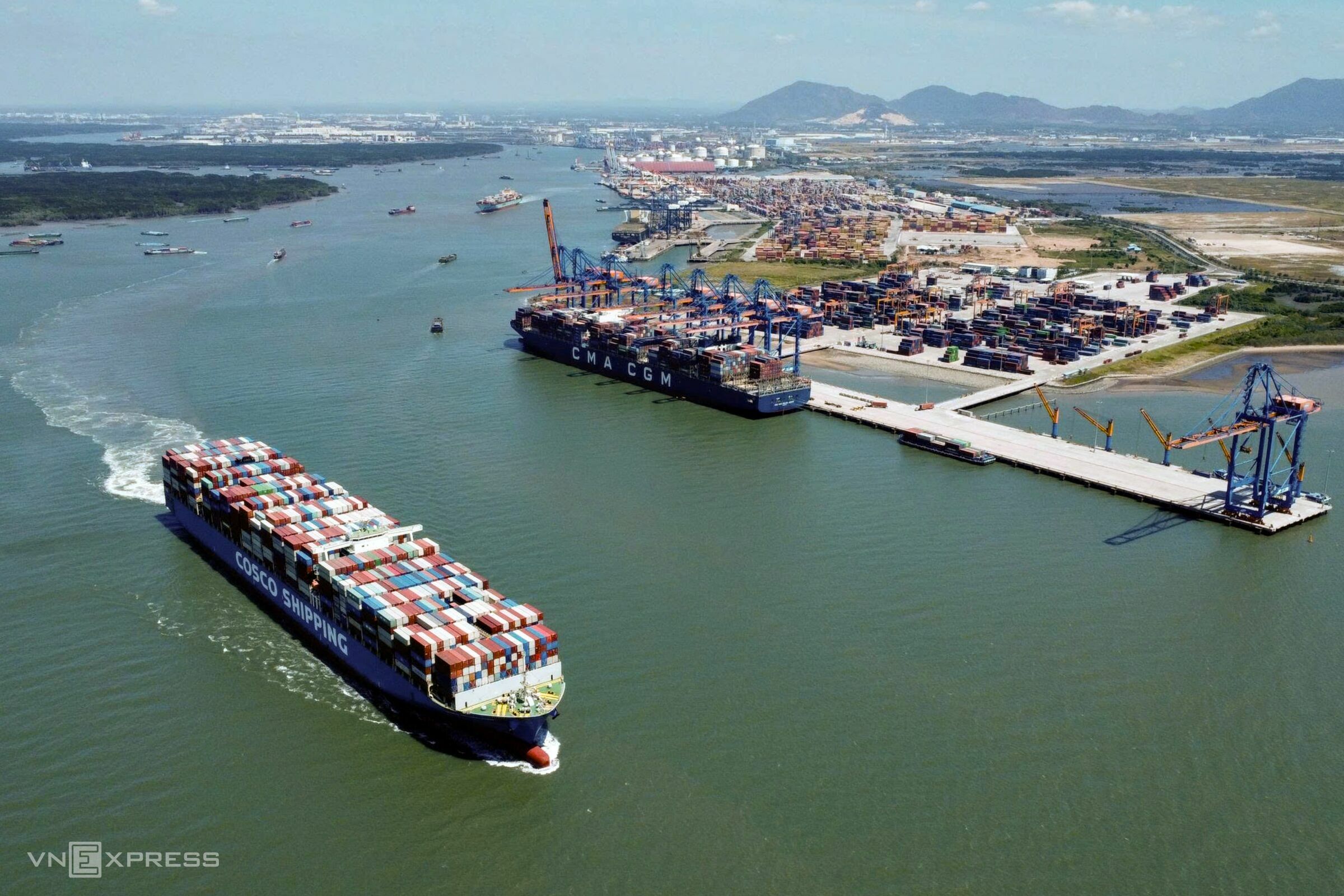 |
The Cai Mep - Thi Vai port cluster viewed from downstream. Photo: Truong Ha |
From the Cai Mep Ha core zone, Ho Chi Minh City will expand functional sub-zones to areas with specific advantages in logistics, seaports, and transport connectivity. Can Gio, An Binh, and Bau Bang will not be established as separate free trade zones but will be designated as expanded sub-zones through boundary adjustments of the existing zone.
According to the Resolution, the free trade zone's expansion is not limited to geographically contiguous areas. The city is permitted to extend to non-contiguous areas, provided these sub-zones can connect technical infrastructure and logistics, and share a common management system with the Cai Mep Ha core zone. This approach ensures unified management, prevents institutional fragmentation, and maximizes the advantages of each locality.
The An Binh sub-zone, located in the former Binh Duong province, covers approximately 100 hectares and is planned to integrate with existing dry ports and logistics centers. This area is near key transport routes and inter-regional transport hubs, facilitating cargo transshipment by road and rail. An Binh is identified as a satellite logistics sub-zone, supporting cargo consolidation, distribution, and direct connectivity with the Cai Mep Ha core zone.
Similarly, the Bau Bang sub-zone, also in the former Binh Duong province, spans approximately 100 hectares and benefits from exceptional railway connectivity. This area is linked to the Ho Chi Minh City - Loc Ninh railway line, connecting the Cai Mep - Thi Vai deep-water port cluster with the inland region and the Trans-Asian economic corridor. As a sub-zone of the free trade zone, Bau Bang is expected to serve as a transshipment hub for goods from Tay Nguyen, Cambodia, and northern provinces to the international seaport system.
The Can Gio sub-zone is planned to integrate with the international transshipment port project, with an estimated size of 1,000 to 2,000 hectares. This area holds a strategic maritime gateway position, favorable for developing container transshipment, international logistics services, and trade activities linked to the maritime economy. Once incorporated into the free trade zone, Can Gio will act as a "transshipment gateway," complementing functions that the Cai Mep Ha core zone struggles to accommodate due to spatial limitations for large-scale transshipment port development.
 |
Perspective of the Can Gio international transshipment port project. Photo: Portcoast |
The choice of the "one zone, many sub-zones" model stems from jurisdictional limits and the need for flexible implementation. Under Resolution 260, Ho Chi Minh City can only decide to establish a free trade zone linked to Cai Mep Ha. Therefore, to integrate other areas into the system, the city must use an expansion mechanism rather than creating new independent zones.
Generally, functional zone expansion is typically allowed only when an established zone reaches an occupancy rate of approximately 70%. However, the resolution permits Ho Chi Minh City to expand into sub-zones like Can Gio, An Binh, and Bau Bang even if the Cai Mep Ha core zone has not yet reached this rate, provided the expansion serves national objectives or urgent requirements for integration and attracting strategic investment.
Regarding policy direction, the free trade zone is designed to operate as a non-tariff zone, applying specific customs and management mechanisms to facilitate international trade. All sub-zones, even if not contiguous, will apply the same policy framework and be managed by a single authority, ensuring uniformity and seamless operation.
Ho Chi Minh City anticipates that establishing a free trade zone with multiple sub-zones will generate new growth momentum, capitalizing on its port, logistics, and regional connectivity advantages. This model is considered a vital foundation for the city to enhance its position in the global supply chain and strengthen its role as the economic engine of the Southeast region in the coming period.
Le Tuyet - Truong Ha