Vingroup shared this information at a community consultation meeting for its carbon credit project on 10/2. The project is registered under the Gold Standard's GS4GG standard.
A carbon credit is a tradable permit or certificate, with market value, granting its holder the right to emit one tonne of CO2 or another listed greenhouse gas.
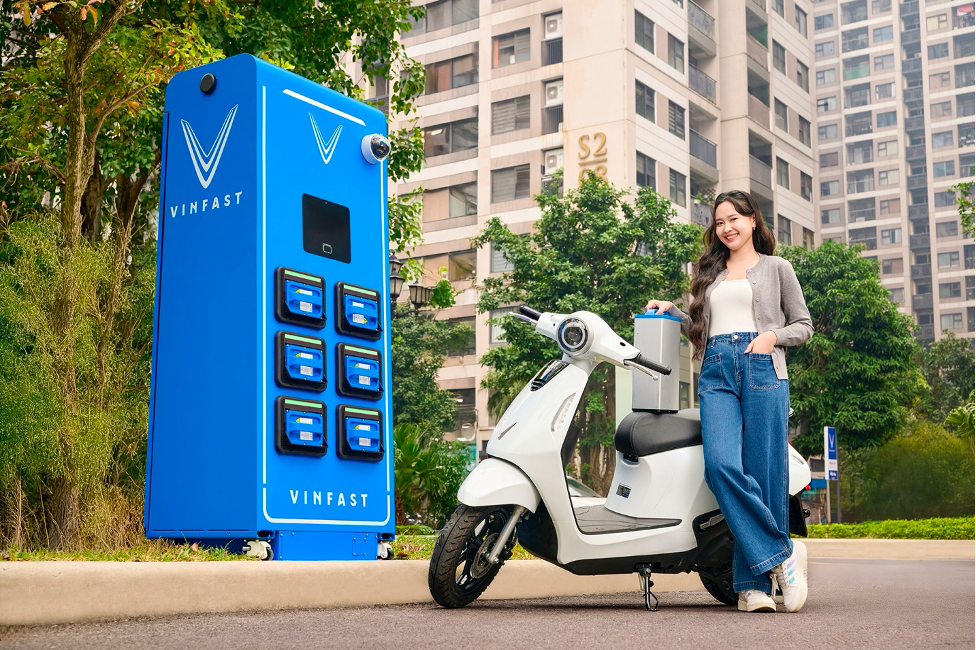 |
A VinFast electric motorbike battery swap station operated by V-Green. *Photo: VinFast*
To calculate emission reduction potential, Vingroup developed two emission scenarios: one for gasoline vehicles (pre-project) and one for electric vehicles (post-project), based on an assumed annual distance of 12,000 km per vehicle. Sales are projected to reach 2 million vehicles by 2029. Of these, 85% are expected to be conversions from gasoline motorbikes, and 10% from other modes of transport like oto, bicycles, or walking.
The emission reduction is calculated as the difference between emissions from gasoline and electric vehicles (including grid electricity emissions) over the same travel distance. End-users contributing to this reduction include individuals switching from gasoline to electric vehicles, delivery drivers, and businesses electrifying their transport fleets.
Tran Ky Anh, Vingroup’s Carbon Credit Transaction Manager, stated that the project is expected to generate 1 million carbon credits during the 2025-2029 phase. This project can be extended two times, for a maximum term of up to 15 years.
The generated credits will be traded domestically, according to carbon exchange regulations, or internationally. The domestic carbon trading mechanism was issued last month. For the international market, the Ministry of Agriculture and Environment has submitted a draft decree on credit trading for government approval.
Waste battery management is a major concern for the electric vehicle credit project. Le Song Ha, a representative from the project's consulting unit, noted that environmental and social protection is a core principle of the project under the Gold Standard. Regarding extended producer responsibility (EPR) for collection and recycling, VinFast, Vingroup’s electric vehicle manufacturer, has complied with current regulations for batteries and tires.
For waste batteries, VinFast has strategic partnerships with Canada’s Li-Cycle and India’s BatX Energies, a startup, for recycling and recovering lithium, cobalt, and nickel from end-of-life batteries. This collaboration is expected to establish a closed-loop value chain, contributing to a circular economy, reducing reliance on mineral extraction, and minimizing environmental impact.
Regarding carbon credit ownership, while electric vehicle users contribute to greenhouse gas reduction, Vingroup representatives assert that ownership belongs to the company implementing the project. However, customers of VinFast and the V-Green charging station network can benefit indirectly through promotions such as "trade-in gasoline for electric vehicles" or free charging until mid-2027 or longer.
Additionally, users will directly benefit from lower operating costs, improved air quality, and modern mobility solutions.
Thuy Truong