I purchased a three-story, 4-bedroom terraced house with a land area of 75 m2 in a residential project in the Phu Huu area, TP HCM. I bought it 8 years ago for 3,8 billion VND, but I still haven't received the title deed. My initial goal was to provide a home for my children studying in the city. However, they later found jobs in the city center, making commuting inconvenient, so they didn't live there.
I currently rent out this house for 10 million VND per month. The market price in this area is now around 4,8-5,1 billion VND, which is not a significant increase over a long period. However, according to the master plan, my house is less than 1 km from a station on the Thu Thiem - Long Thanh railway line.
The slow appreciation makes me wonder if I should sell it now to buy a house elsewhere, or continue to hold it, await legal completion and the crucial infrastructure development, and then sell with the expectation of a better price. Given that the house has lacked a title deed for 8 years, how should I assess its potential for price increase and liquidity risks to decide whether to sell?
Van Nga
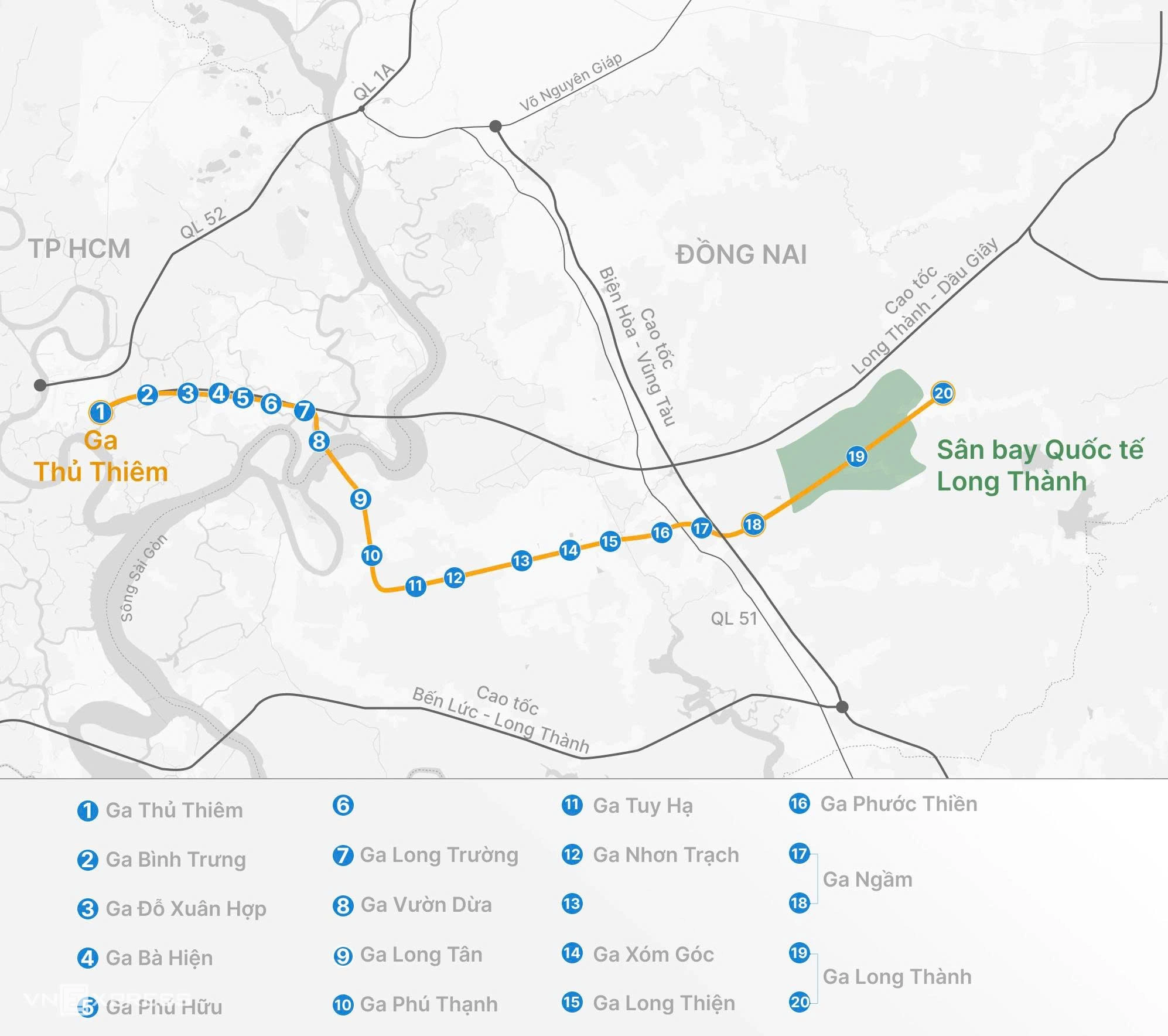 |
Route of the Thu Thiem - Long Thanh railway and its stations. *Graphics: Hoang Thanh* |
Consulting expert advice:
It appears that your real estate investment has not met expectations. The initial purpose of buying for residence was not optimal, as your children found jobs in the city center, making travel inconvenient. Consequently, the house had to be rented out. Both the appreciation rate and rental yield are very low. Additionally, 8 years is a very long time, yet the legal status remains incomplete.
To review the investment efficiency over 8 years, let's look at the key data: the purchase price was 3,8 billion VND, and the current market value ranges from 4,8-5,1 billion VND. This indicates a capital gain of approximately 1-1,3 billion VND, or 26-34% over 8 years. The average annual appreciation rate is only about 2,9-3,7%.
The current rent is 10 million VND per month, which equates to 120 million VND per year. Based on the current value of 4,8-5,1 billion VND, the gross rental yield is only about 2,35-2,5% per year, before deducting maintenance, vacancy periods, taxes, or fees.
Purely from an investment perspective, this asset has shown very low growth over the past 8 years. Most of the current expectation hinges on the completion of legal procedures and regional infrastructure, rather than rental income.
One of the key factors for customers making investment decisions is the legal status of the property. This point requires careful scrutiny and directly impacts the property's liquidity. A house without a title deed cannot be mortgaged for a bank loan, and most investors are hesitant to purchase such properties.
Therefore, it is crucial to determine the exact reason for the "8 years without a title deed": whether the developer has not fulfilled financial obligations related to the land, the project has not completed legal procedures, or the construction deviates from the license or master plan. After considering these factors, you need an answer regarding the feasible estimated time for the house to receive its title deed.
Regarding whether to keep the house due to its proximity (less than 1 km) to the Thu Thiem - Long Thanh railway, I believe infrastructure will certainly create a new price level. However, for this to translate into profit for the homeowner, several conditions must be met simultaneously: good infrastructure, clean legal status, good liquidity, and actual demand for living or renting.
In this case, infrastructure may be a positive, but the legal status is a major negative. Even when regional infrastructure develops, properties with title deeds often benefit more clearly than those without, as secondary buyers can more easily access bank financing and conduct transactions more conveniently.
Moreover, even after the infrastructure and railway are completed and operational, it will take several years for residents to move in and fill the residential area along that route. The opportunity cost, measured by the waiting time for legal completion and the time for a new community to form, is the crux of the issue that needs addressing here.
In summary, I believe you need to thoroughly evaluate the factors mentioned above. Simultaneously, consider exploring better investment options regarding legal status, rental yield, and suitability for your children's use before making a final decision.
Dinh Trung Duc
Head of Project Real Estate - Real Estate Block
FIDT Investment Consulting and Asset Management Company