For diamonds measuring 3,6 mm or larger, equivalent to 0,18 carats (typically sold loose or as the main stone in jewelry), businesses often include an international certification report.
The most reputable and widely recognized international certification bodies in the market are the Gemological Institute of America (GIA) and the International Gemological Institute (IGI). Their role is to independently assess and record the diamond's characteristics according to unified standards.
What is the role of a domestic independent certification unit?
Unlike gold, which has a relatively consistent reference price, the value of each diamond depends on multiple factors simultaneously. These include the 4C standards: carat weight, color, clarity, and cut, along with the certification report, brand, and the purchasing policies of individual businesses.
Because standardizing value is challenging, the market increasingly needs independent appraisal organizations to reduce information asymmetry between buyers and sellers. According to Nguyen Viet Hao, a diamond jewelry expert, instead of individuals describing the quality of a stone themselves, the market has developed independent appraisal organizations. These create a common set of standards for all parties to use. In the international market, GIA (Gemological Institute of America) or IGI (International Gemological Institute) certificates are common bases for determining diamond characteristics in transactions.
"These organizations do not price or certify asset value. Their role is to independently assess and record the diamond's characteristics according to unified standards," he said.
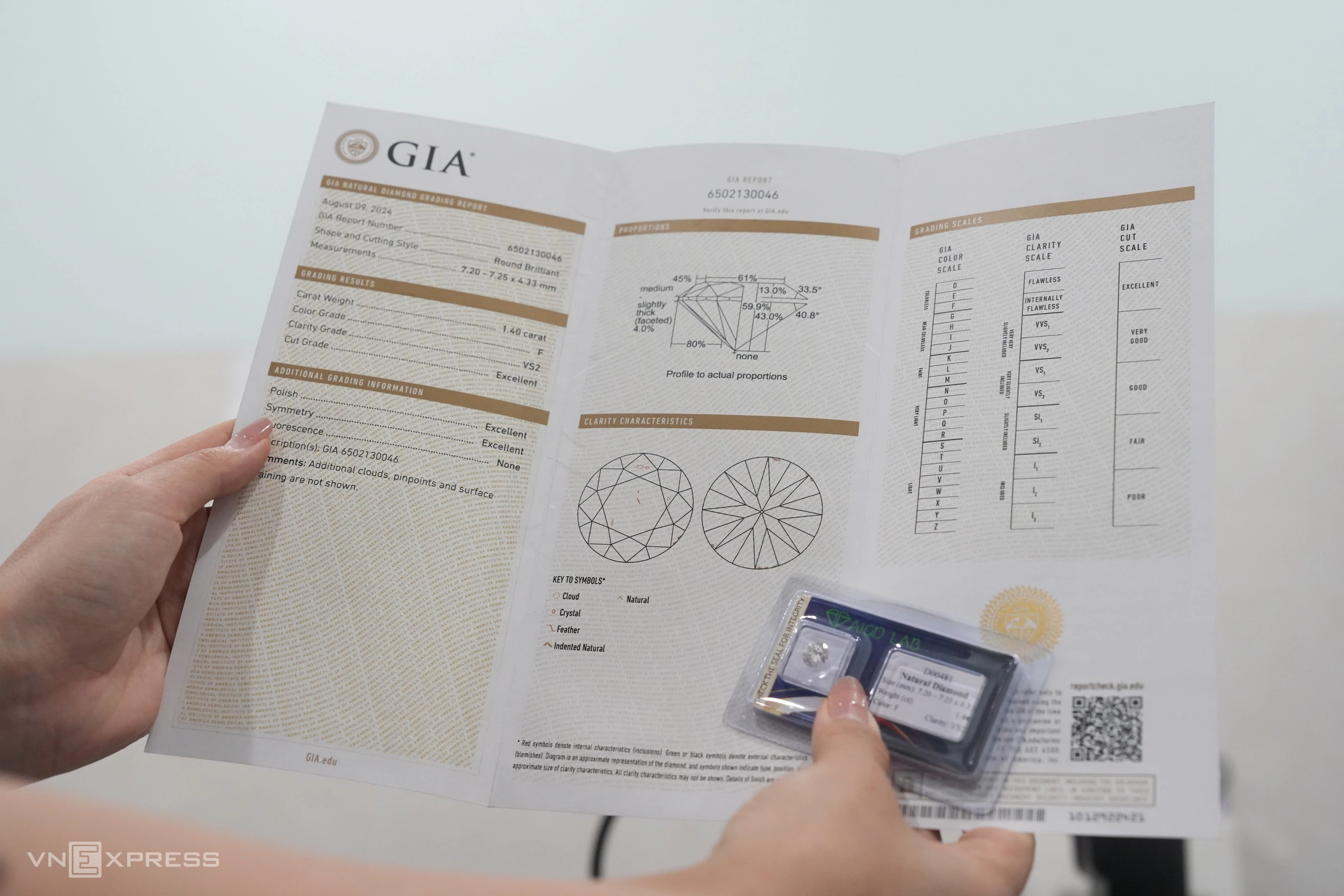 |
A GIA certificate, one of the common international verification documents accompanying diamonds 3,6mm or larger. Photo: Trinh Hoang |
However, international gem industry organizations have repeatedly warned in recent years about the forgery of laser codes engraved on the girdle of stones, the use of certificates that do not match the stone, or diamond swapping during transactions.
In 2023, the Gem-Tech laboratory in Italy discovered three lab-grown diamonds matched with genuine GIA certificates for natural diamonds with similar characteristics, simultaneously bearing fake GIA laser codes. GIA later reported an increase in cases of fake laser inscriptions on diamonds submitted to the organization in various locations.
According to Phan Thi Anh Thu, Director of the independent certification unit AIGD Lab, these cases show that laser codes and accompanying certificates are insufficient to conclude whether the stone in the buyer's hand matches its documentation.
Through interactions with customers, Thu noted a common belief that "a GIA-certified diamond is safe." However, all diamonds are imported and risks can arise during transportation. Independent labs in Vietnam are tasked with determining if the stone in the buyer's hand matches the GIA or IGI certificate, and also checking its actual condition after transportation and use.
What steps does a diamond undergo in the lab?
According to the recorded procedure at AIGD Lab, each diamond received is assigned an internal identification code. Information about the owner or the business submitting the sample is not displayed to the inspection team to ensure objectivity.
For diamonds with GIA or IGI certificates, specialists first check the authenticity and security features of the certificate. The QR code on the certificate is also scanned to cross-reference information between the paper document and the online data of the certifying organization.
After validating the certificate, the diamond is cleaned to remove dust or fingerprints that could affect observation.
Inspectors then use specialized equipment to determine if the stone is a natural diamond or a lab-grown diamond.
Parameters such as weight and dimensions are re-measured using scales and specialized equipment. Color is assessed visually by specialists, through comparison with a set of master samples.
These parameters help in cross-referencing with the certificate data, but according to the AIGD Lab Director, they are still insufficient to conclude whether the diamond in hand is truly the stone described in the accompanying certificate.
The decisive step in the entire process is comparing the "natural inclusion plot" of the diamond under a gemological microscope with 40x magnification.
Why is the "natural inclusion plot" important?
During their formation over millions of years underground, each diamond develops unique natural characteristics such as inclusions, tiny crystals, fractures, or growth lines. The combination of these traces is almost never identical between two stones.
"A diamond formed in nature will have its own unique traces, similar to a human's fingerprint. No two stones are exactly alike," Thu said.
According to her, the natural inclusion plot is the most important basis for determining whether the diamond in hand is truly the one documented in the certificate.
Many diamond buyers often only compare the laser code engraved on the girdle of the stone with the certificate. However, this is only an initial check.
The girdle code is laser-engraved by humans, so it can technically be altered or re-engraved. In contrast, natural traces are formed during the stone's crystallization process, making them unique and almost impossible to completely replicate.
In addition to verifying identity, the inclusion plot also helps record the actual condition of the diamond, such as chips or scratches that were present beforehand or occurred during use. This, according to Thu, helps limit disputes and avoid being "forced to accept a lower price" during trade-ins.
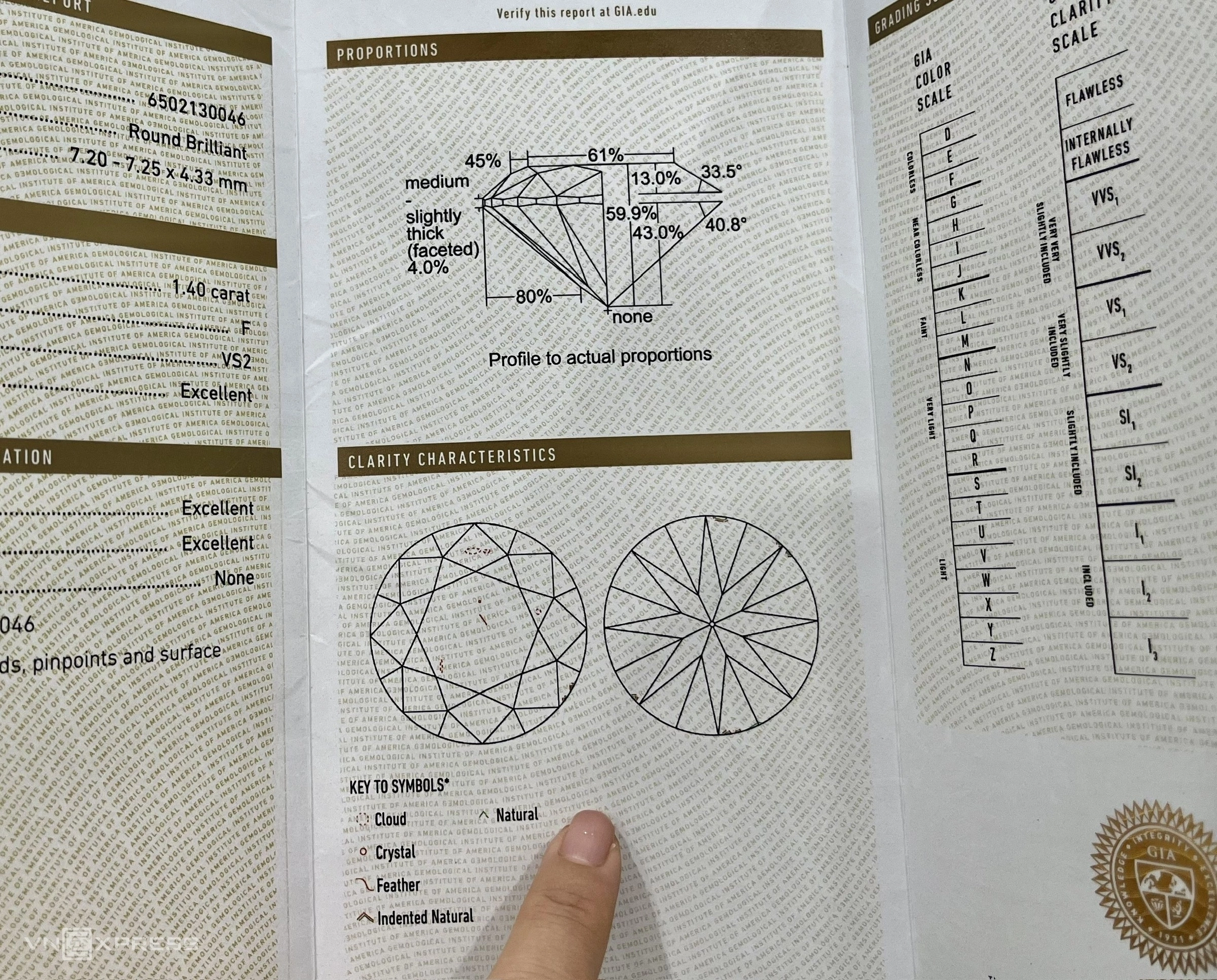 |
The natural inclusion plot is likened to the unique "fingerprint" of each natural diamond. Photo: Quynh Trang |
Following market fluctuations, a representative from AIGD Lab believes that certification units need to publicly disclose their processes and quality grading criteria, rather than just providing customers with a certificate. She also suggested that labs provide natural inclusion plots for smaller diamonds, giving customers more basis when trading them in.
Nguyen Van Dung, Chairman of the Ho Chi Minh City Jewelry and Gemstone Arts and Crafts Association (SJA), noted that for a long time, diamond buyers primarily relied on the seller's reputation and the accompanying international certificate. However, when reselling, the stone is often more thoroughly inspected, and the trade-in value may not meet expectations, leading to disputes.
According to Dung, domestic verification is an essential step. Labs currently register their operations with the Department of Science and Technology under various forms, while also applying national standards (TCVN) during the inspection process.
Despite this, the SJA Chairman assessed that this market remains quite "unclear," with few independent centers having established clear reputations. Some major businesses like PNJ, DOJI, and SJC still both sell and provide inspection services.
Quynh Trang