Nguyen Van Minh, Deputy General Director of BAF Agriculture Joint Stock Company, shared details about the company's first high-rise pig farm project in Ha Noi during a technology solutions for green agriculture and ESG workshop on 4/6.
"The high-rise pig farm project optimizes land use area, costs, and labor, but most importantly, it addresses environmental pollution," Minh stated. In terms of land use efficiency alone, this model is five to eight times more efficient than traditional pig farming methods.
The planned high-rise pig farm in Ha Noi marks BAF's second such venture, following a similar project in Tay Ninh. BAF's leadership indicated plans to implement three to five such projects, each designed to accommodate 8,400 sows and produce around 250,000 market pigs annually.
Additionally, the company aims to integrate the development of surrounding agricultural areas, creating a symbiotic relationship where "pigs feed fields and fields feed pigs." This means nearby agricultural zones will cultivate food crops to serve as feed for the farm. In turn, water and waste from the farm will be recycled for irrigation and fertilization of these cultivated areas.
Unlike traditional farming models that discharge waste into the environment, wastewater from the high-rise pig farm will be recycled for 25-30% of sanitation, cooling, and odor control activities within the farming area itself. The remaining wastewater and solid waste will be converted for irrigation, fertilization, and soil improvement. The company also intends to capture exhaust gases for electricity generation.
For the scale described, BAF estimates needing approximately 15-20 hectares for pig farming operations and an additional 200-250 hectares for agricultural development.
Last year, BAF's emissions totaled nearly 590,000 tons of CO2, a 30% increase from the previous year. The company has set a target of achieving net zero emissions by 2050.
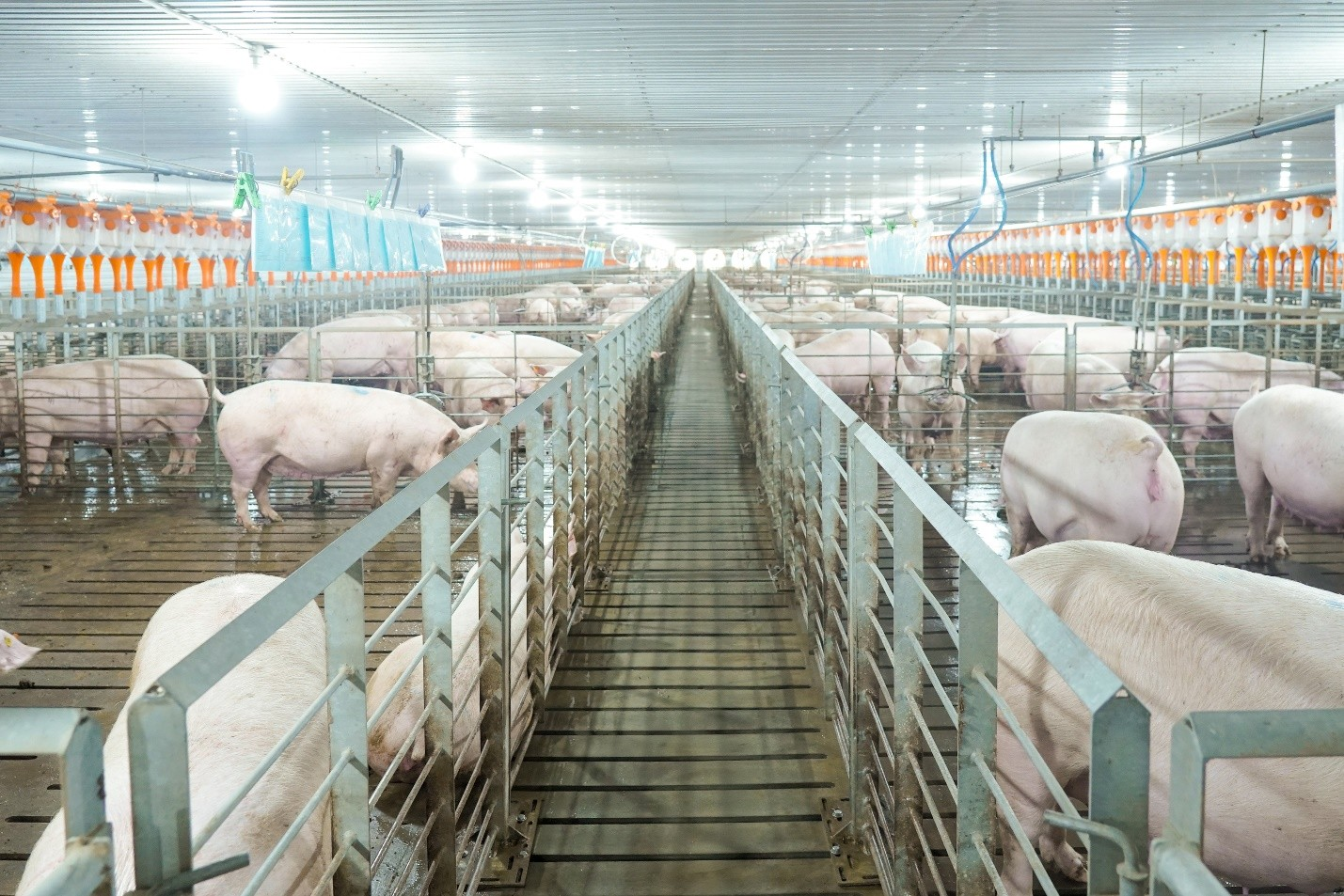 |
A sow farming area of BAF. Photo: BAF
Agricultural activities accounted for about 104 million tons of CO2 emissions in 2020, representing 20% of the country's total emissions. Pham Hoai Trung, Vice Chairman of the Vietnam Green Transformation Association, noted that these emissions are concentrated in production stages across fields, farms, harvesting, processing, and transportation. The primary greenhouse gases from livestock farming are methane (CH4) and N2O (from manure and wastewater).
Beyond reducing emissions, BAF's leadership emphasized that the high-rise pig farm model helps lower operational costs per unit of product.
BAF is the first enterprise in Vietnam to propose the high-rise pig farm model. Last year, the company received approval to develop its initial project in Tay Ninh, with an investment scale of 15,000 ty dong, in collaboration with Chinese livestock giant Muyuan. Minh stated that the company might break ground on the project this year.
In a submission to the government in 7/2025, seeking permission to implement this model, the Ministry of Agriculture and Environment recognized that this concentrated pig farming approach, automated and monitored by sensors, could provide early warnings for disease outbreaks. This is particularly crucial given the complex developments of African swine fever last year. The ministry suggested that, in the long term, small-scale farming activities should decrease, favoring the expansion of concentrated pig farming models.
Thuy Truong