According to a dispatch from the Ministry of Industry and Trade, provinces and cities must update the electricity demand, location, operational timing, and power supply plans for data centers in their areas.
Localities must also report development plans and electricity demand for vehicle charging stations, metros, high-speed railways, and development zones following the transit-oriented development (TOD) model.
These new electricity consumption groups are forecast for rapid growth. Electric vehicle charging infrastructure is a key focus, linked to transport electrification and green transition.
Currently, Vietnam has about 6,7 million oto, with 3% being electric oto, and 70 million moto, with 4,3% being electric. Most electric vehicles are in major urban areas, creating an urgent need for parking and charging infrastructure.
Following the strategic roadmap to achieve net-zero emissions by 2050, Vietnam aims for 50% of urban vehicles and all buses and taxis to be electric by 2030. All transport vehicles will convert to electric or green energy 20 years later. To establish an electric vehicle charging station network, the World Bank estimates Vietnam will need to spend 2,2 billion USD by 2030, increasing to nearly 14 billion USD by 2040 and 32,6 billion USD by 2050.
 |
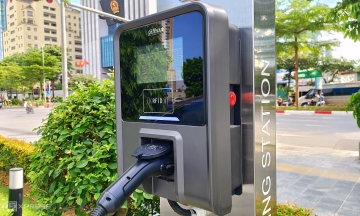
An electric vehicle charging station. *Photo: Luong Dung* |
In addition to updating electricity demand, the Ministry of Industry and Trade also requested localities to review and add to the plan power source and grid projects with existing transmission infrastructure, easy land clearance, low compensation, and quick implementation. Projects in particularly difficult areas or those that can be quickly put into operation in the northern region are also prioritized.
If proposing additional coal power plants, provinces must state the feasibility of land allocation, fuel supply, anticipated technology, plans for emission capture and treatment, and the location and scale of CO2 storage.
Specifically for provinces from Quang Tri northward, the Ministry requested a review of base-load power source and transmission grid projects that can be implemented under an emergency power facility mechanism. The goal is to select projects with infrastructure advantages to ensure operation in the 2027-2028 period.
The Ministry also requested an update of power source projects already in the plan until 2030 but currently lacking investors or investment proposals. Concurrently, the list of new constructions and upgrades for 500 kV and 220 kV substations and transmission lines also needs review.
The energy regulatory agency made this move because many power source and grid projects will not be operational by 2030 as planned. This impacts electricity supply and national energy security.
Therefore, the Ministry of Industry and Trade wants to promptly review and revise Power Development Plan VIII once more and establish a list of urgent projects for immediate implementation, especially base-load power sources in major consumption areas.
According to statistics, by the end of 2025, the total power capacity of the entire system will reach approximately 87,600 MW, an increase of about 6,400 MW compared to 2024. Under the revised Power Development Plan VIII, the total power capacity of the entire system is projected to reach approximately 183,000-236,000 MW by 2030. Regarding the grid, Vietnam plans to develop tens of thousands of kilometers of 500 kV and 220 kV transmission lines along with many large-scale substations to increase transmission capacity between regions.
Phuong Dung