Brent crude oil prices closed the week down 3.37% at USD 87.3 per barrel. This marks the lowest level since early March, driven by growing investor confidence in a potential peace agreement between the United States and Iran.
US West Texas Intermediate (WTI) crude oil also fell 3.2% to USD 84.8 per barrel, its lowest point since mid-April. John Kilduff, an analyst at Again Capital, attributed the market downturn primarily to Iran's announcement of a memorandum of understanding (MOU) with the US. However, Iranian Foreign Minister Abbas Araqchi stated on 12/6 that the MOU had not yet been signed and remained subject to change.
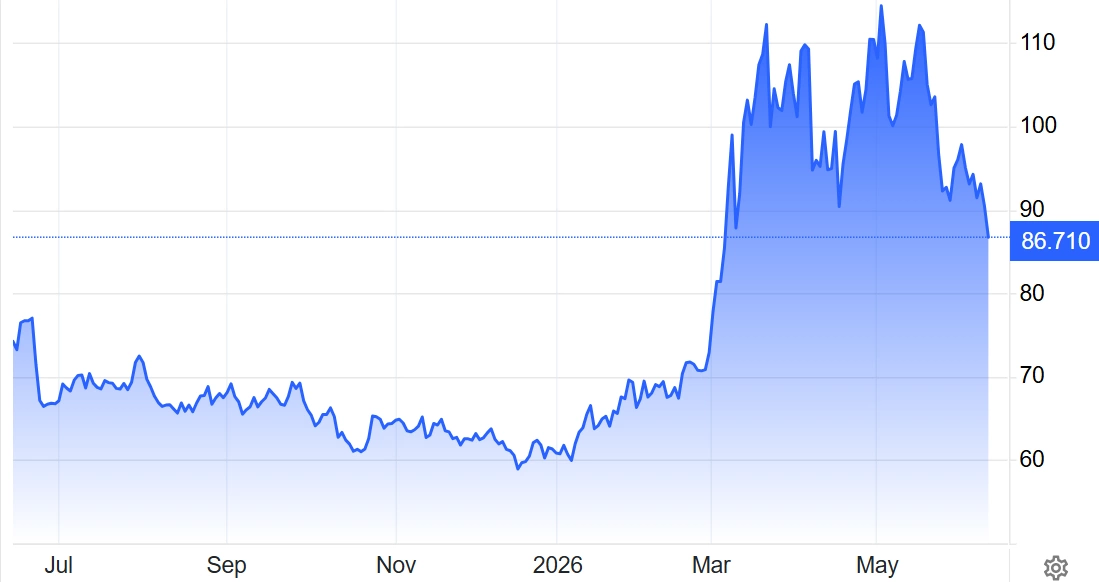 |
Brent crude oil price movements over the past year. *Chart: Trading Economics*. |
Reuters, citing Western sources, reported that an MOU aimed at ending hostilities in the Gulf could be signed by the US and Iran as early as 14/6. Geneva, Austria, is currently considered the most likely location for this signing.
US President Donald Trump canceled planned airstrikes on Iran on 12/6. Iran's Mehr news agency reported that final negotiations concerning the MOU would concentrate on nuclear and economic issues, specifically excluding Iran's missile program. Meanwhile, Iran's IRNA news agency indicated that nuclear talks would commence within 60 days following the MOU's signing.
Despite these developments, Tamas Varga, an analyst at PVM Oil Associates, cautioned that global and Middle Eastern oil inventories remain low and could continue to decline even if the two countries reach an agreement. He stressed that the world requires additional time to ensure the complete and uninterrupted restoration of oil flows.
Goldman Sachs has lowered its average 2027 Brent crude oil price forecast to USD 80 per barrel, attributing this adjustment to increased supply and weakened demand. This projected price, however, is still higher than the 2025 average due to commercial oil stockpiling by Organization for Economic Co-operation and Development (OECD) countries.
In the gold market, global spot gold prices experienced a modest increase of nearly USD 8, reaching USD 4,218 per ounce. This week witnessed significant price volatility; after two consecutive sessions of declines totaling almost USD 300, prices rebounded by nearly USD 200.
For the entire week, the precious metal decreased 2.3%, marking its second consecutive weekly decline. This downturn was largely influenced by investor expectations of higher global interest rates aimed at curbing inflation.
The CME FedWatch Tool currently shows investors pricing in a 57% probability of a US Federal Reserve (Fed) interest rate hike in December. Gold prices have been under consistent pressure since the Middle East conflict began in late February, as rising oil prices fueled inflation concerns and the prospect of increasing interest rates, thereby diminishing the appeal of the precious metal.
Ha Thu (*according to Reuters*).