Le Hoang Minh, Executive Director of Production and Head of Vinamilk's Net Zero Project, shared this information at the National Forum on Environment and Climate 2026. The program, themed "From Policy to Action," was co-organized by the Ministry of Agriculture and Environment and the People's Committee of Nghe An province on 5/6.
At the event, Nguyen Tuan Quang, Deputy Director of the Department of Climate Change (Ministry of Agriculture and Environment), stated that Vietnam is gradually realizing its commitment to net zero emissions by 2050. This is achieved through an increasingly comprehensive legal framework and specific projects from central to local levels. Many businesses have proactively inventoried, planned, and implemented greenhouse gas emission reduction measures.
 |
The seminar "Actions against air pollution and greenhouse gas emission reduction" took place within the framework of the National Forum on Environment and Climate 2026. *Photo: Vi Nam*
Vinamilk is cited as a pioneering entity pursuing sustainable development goals in Vietnam. According to Minh, the company's objectives are built on the SBTi (Science Based Targets initiative) methodology and international standards, encompassing both short-term plans and long-term orientations towards net zero.
"Vinamilk's net zero target has been published on the SBTi system. Participating in this initiative helps us set emission reduction goals and action orientations based on scientific principles, aligning with international standards", Minh said.
 |
Le Hoang Minh, Executive Director of Production and Head of Vinamilk's Net Zero Project, shared insights at the forum. *Photo: Vi Nam*
Currently, Vinamilk is gradually implementing specific activities in production and livestock farming. The company has achieved carbon neutrality for scope one and two emissions at its first facilities, certified under the international standard ISO 14068-1. Notably, both the first certified factory and farm are located in Nghe An, the host province for this year's forum.
To fulfill its commitments, Vinamilk has adopted a data-driven approach. Operating on the principle of "what cannot be measured cannot be managed," the company began greenhouse gas inventories across its factory and farm systems several years ago. This inventory activity helps identify key emission sources, enabling the design of substantive reduction solutions rather than merely qualitative commitments. This approach also aligns with the directives of the 2020 Law on Environmental Protection and Decree 06/2022/ND-CP, laying the groundwork for future emission management and participation in the carbon market.
As Vietnam prepares to pilot a carbon exchange, proactive inventory and emission management are becoming crucial requirements for businesses. Currently, there are 2,166 facilities nationwide mandated to report greenhouse gas emissions, with 110 of the largest emitters already allocated quotas, accounting for approximately 40% of total direct emissions.
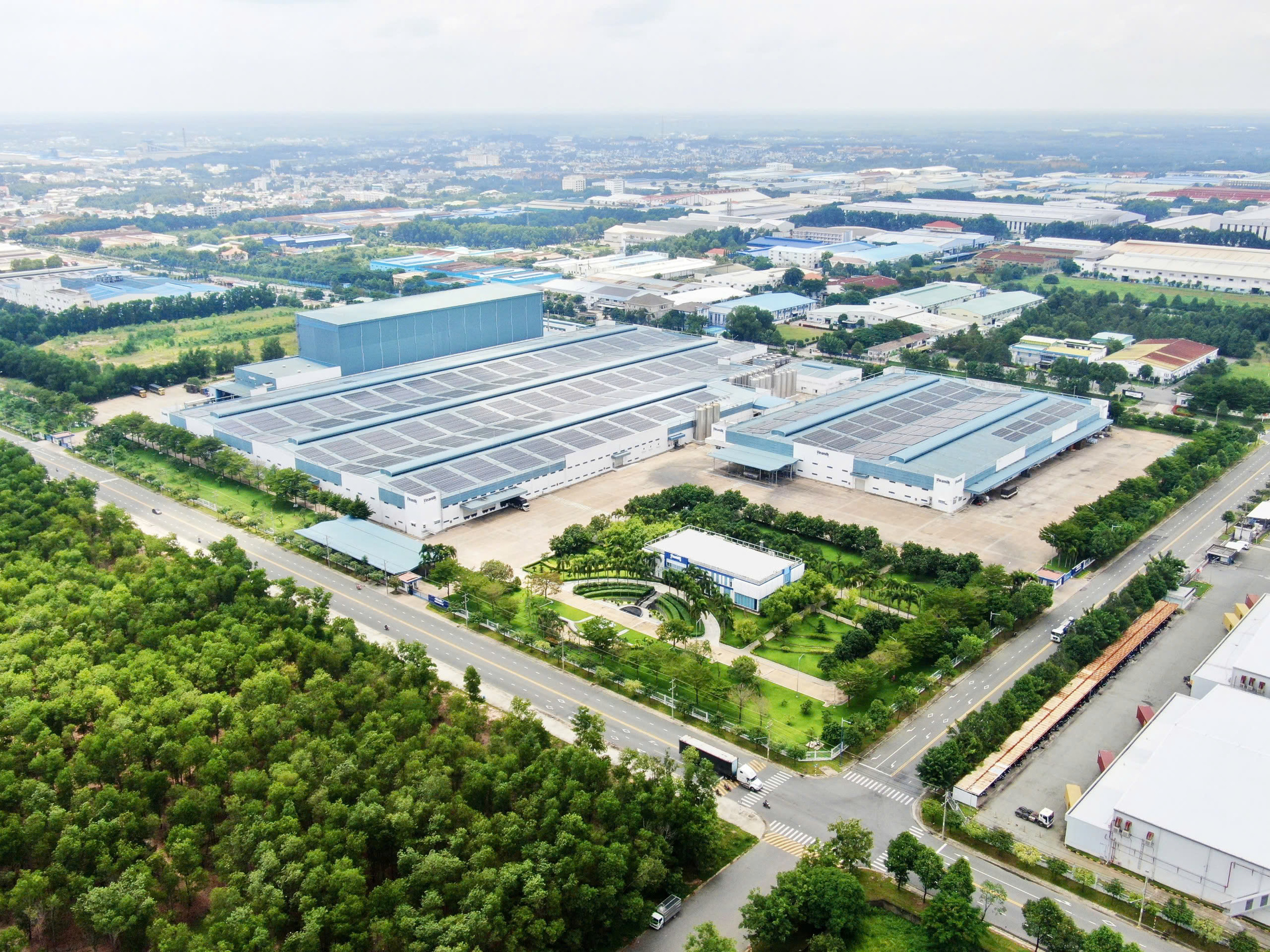 |
Vinamilk's farm and factory systems are implementing greenhouse gas inventories to identify key emission points. *Photo: Vi Nam*
According to Minh, proactive compliance and taking a step ahead help Vinamilk reduce pressure once the quota and carbon trading mechanisms become operational, allowing the company to optimize costs during the transition. Based on collected data, Vinamilk implements various solutions to enhance resource and energy efficiency: four automated smart warehouses help reduce nearly 1,900 tons of CO2 annually, while also saving approximately 70% of energy compared to diesel-powered operations and traditional warehouse management. At the farms, solar energy systems are used to provide hot water for sanitation, contributing to a reduction of about 278 tons of CO2e per year and cutting electricity costs.
Additionally, the company has implemented various improvements in packaging design to use materials more efficiently. Reducing the thickness of Probi drinking yogurt bottle shells, optimizing plastic straw designs, and changing the structure of export bottle caps help reduce approximately 135 tons of CO2e, while also saving about 48 tons of virgin plastic annually.
According to Vinamilk's representative, these initiatives may stem from minor changes in operations or product design, but they yield significant cumulative benefits in terms of both environmental impact and production costs. This also forms the basis for the company to continue expanding its emission reduction solutions in the future.
"We hope these practical experiences will further motivate the business community to accompany the government in achieving the net zero target by 2050", Minh said.
Hoang Dan