This information was shared at the conference "Enhancing Access to Credit Capital for Small and Medium Enterprises" held on 18/9. The State Bank of Vietnam collaborated with the Vietnam Association of Small and Medium Enterprises to organize the event.
According to data from the State Bank of Vietnam, as of 28/8, the outstanding credit balance for the entire economy reached nearly 20.5 quadrillion dong, marking a 10.24% increase compared to the end of 2025. Of this, the outstanding credit for small and medium enterprises (SMEs) exceeded 4.1 trillion dong, an increase of approximately 12.4%, accounting for nearly 20% of the total outstanding credit.
Over 100 credit institutions are currently lending to the SME sector. Cumulative disbursements during the first 8 months of the year surpassed 3.8 trillion dong. The trade and services sector represents 70.48% of the outstanding credit structure. Specifically, four state-owned commercial banks hold an outstanding credit balance of approximately 1.3 trillion dong, equivalent to 32.6% of the total outstanding credit designated for SMEs.
In addition to existing capital flows, banks continue to roll out credit programs aimed at SMEs and key economic growth drivers. These include agriculture, rural development, supporting industries, high technology, exports, the digital economy, artificial intelligence, the semiconductor industry, processing and manufacturing, and green projects.
 |
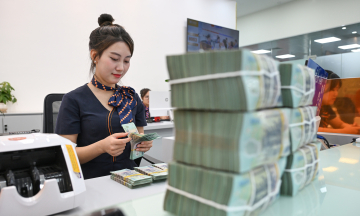
Transactions at a bank. Photo: Thanh Tung |
Statistics from the State Bank indicate that after one month of implementation, the number of banks participating in the program has increased from 4 to 19 entities. The total announced credit limit has reached over 407 trillion dong, exceeding the initial registered amount of 220 trillion dong. Preferential interest rates are 1-2% lower per year compared to the average lending rates of the participating banks for the same tenor.
It is important to note that this figure represents the total scale of programs announced by banks, not the amount already disbursed. Businesses must still meet the conditions of each product and undergo an appraisal process before capital is approved.
Beyond traditional lending, banks are expanding financial services to include guarantees, factoring, financial leasing, supply chain finance, and digital financial products. This diversification of funding options provides businesses with more choices tailored to their production and business activities. The loan approval process adheres to credit safety regulations. Banks assess capital utilization plans, repayment capacity, cash flow, credit history, management capabilities, and operational data of businesses. Collateral is evaluated according to each credit institution's policies.
Businesses seeking loans need to prepare financial statements, tax records, revenue documents, and a capital utilization plan. The business plan must clearly articulate the loan requirement, projected cash flow, and repayment sources. This information forms the basis for banks to determine credit limits, loan terms, and interest rates.
The State Bank of Vietnam advises that each program has distinct target groups and conditions. Therefore, businesses should carefully review the information published by banks before applying. Key details to verify include the funding needs, interest rate reductions, preferential periods, service fees, credit limits, and collateral requirements.
Hoang Dan