Ngo Manh Ha, Deputy Director of the Water Resources Management Department (Ministry of Agriculture and Environment), announced this information at a press conference on 16/9.
According to the Water Resources Management Department, since May, water sources in most rivers and streams have been affected by El Nino, trending lower than the multi-year average. From June to August, river flow in most rivers and streams across 12 major basins was 10-75% lower, with the exception of the Red River basin and the main branch of the Ma River.
Previously, in June, the Hydrology Department stated that the 2026 El Nino could be the strongest in over 70 years. If a very strong El Nino scenario occurs, Vietnam could face higher-than-average temperatures, a reduction in cold air spells, and widespread rainfall deficits, particularly in the Central, Central Highlands, and Southern regions.
With the projected flow deficit during the flood season, over 700 hydropower reservoirs are at risk of not accumulating enough water, especially in the Central region, Central Highlands, and the Dong Nai River basin. According to Ha, the risk of reservoirs lacking sufficient water for production and business during the 2026-2027 dry season is quite high.
Specifically, all 43 large hydropower reservoirs, which operate under inter-reservoir procedures across 11 river basins, are at risk of not reaching their designed water storage capacity, with a total deficit of approximately 7,73-11 billion cubic meters. Among these, 32 reservoirs, or 74%, could face a deficit of 15-80% of their designed capacity, concentrated in the Red River, Ma, Ca, Vu Gia - Thu Bon, Ba, Se San, and Dong Nai river basins.
Low water levels at the end of the flood season also reduce the available storage for power generation during the dry season. For small and medium-sized hydropower reservoirs, limited regulation capacity means output could significantly decrease as inflow to the reservoirs declines.
 |
Ngo Manh Ha provided information at the press conference on the morning of 16/9. Photo: Gia Chinh |
According to the Water Resources Management Department, hydropower reservoirs in basins at risk of water shortages account for approximately 46,1% of the country's total power generation capacity. This group of facilities also plays a vital role in ensuring energy security and the safe operation of the power system.
Notably, reservoirs in the Red River basin, including large facilities such as Hoa Binh, Son La, Lai Chau, and Tuyen Quang, are crucial for frequency regulation, voltage regulation, capacity reserve, and supporting the stable operation of the national power system. When water inflow to these reservoirs is low, hydropower mobilization must balance power generation needs with the requirement to maintain water levels for other operational purposes.
The Dong Nai basin accounts for approximately 13,8% of the country's total hydropower capacity, with major projects like Ham Thuan - Da Mi, Tri An, and Thac Mo. A decrease in water resources in this basin, according to a representative from the Water Resources Management Department, could impact power generation capacity and increase the need for power source coordination during the dry season.
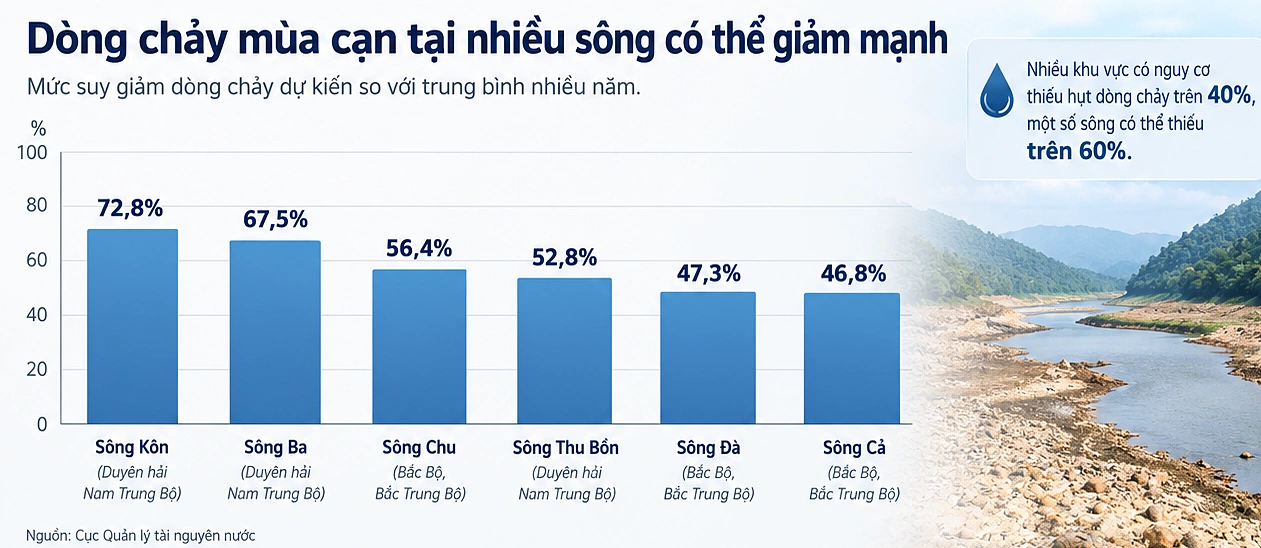 |
Risk of flow deficit due to El Nino. Graphics: Gia Chinh (AI supported) |
Hydropower currently accounts for over 28% of the national power system's total capacity, serving as the second-largest power source in actual mobilization, after coal power. By the end of June, according to data from Vietnam Electricity Group (EVN), hydropower generation reached over 36 billion kWh, accounting for over 21% of the total electricity produced and imported by the entire system.
Given the risk of water shortages affecting power generation in the upcoming dry season, the Water Resources Management Department has urged localities and reservoir management units to proactively store water during the flood season and operate flexibly according to water resource developments. The electricity sector is encouraged to develop plans for mobilizing other power sources to reduce pressure on hydropower, especially if water must be conserved for downstream areas during the 2027 dry season.
"Only by storing water during the flood season will there be enough for the dry season. If water levels are lowered too much during the flood season or operations are unreasonable, the subsequent dry season will face a complete water shortage", Ha stated.
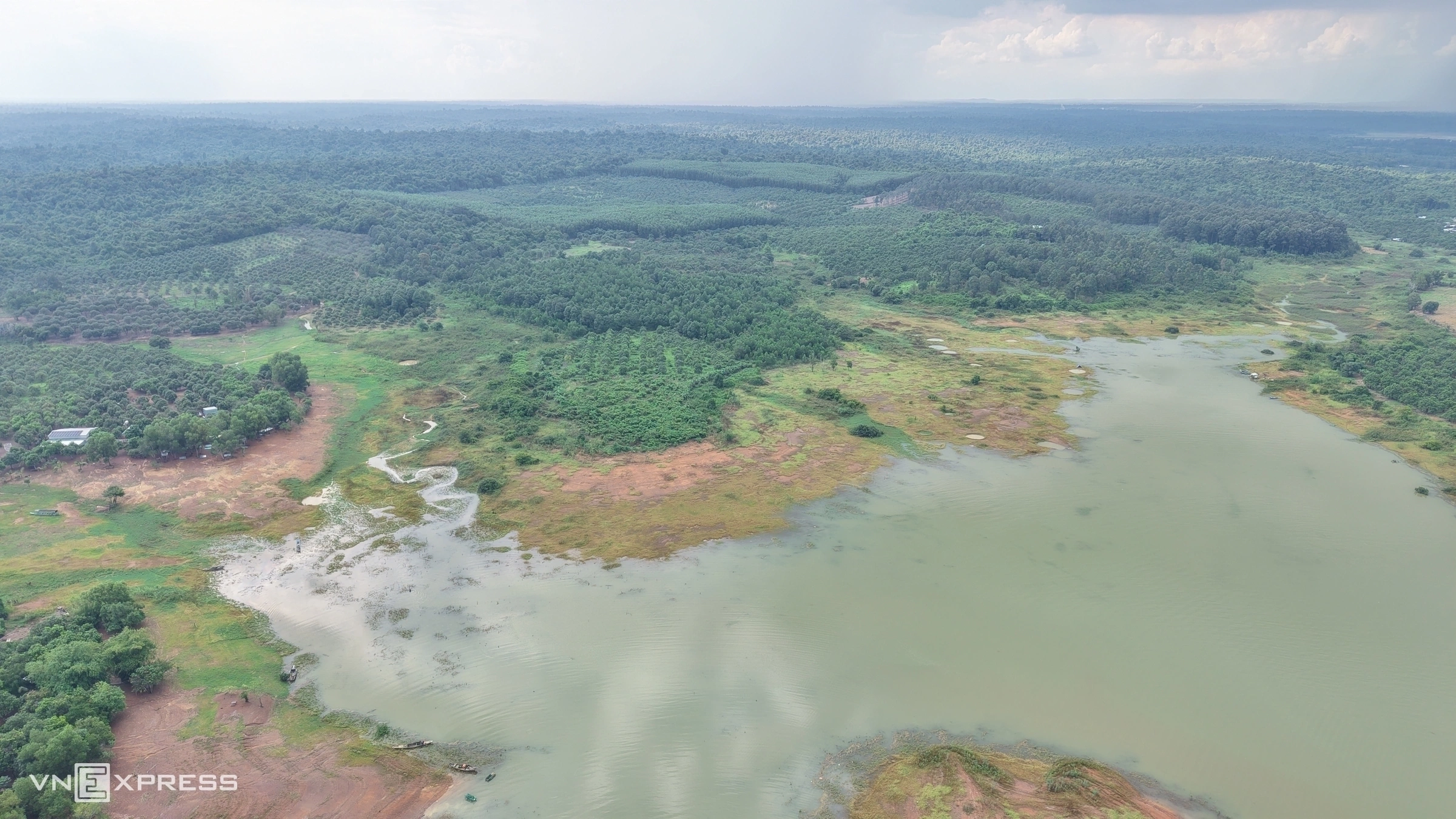 |
The reservoir area through Trang B - a water reservoir serving the Tri An hydropower plant - dried up in September 2026. Photo: Phuoc Tuan |
Gia Chinh