Early this week, Iran-backed Houthi forces declared a "maritime embargo" against Saudi Arabia. They specifically targeted vessels transiting the Bab el-Mandeb strait, also known as the "Gate of Tears," which connects the Red Sea and the Gulf of Aden.
The Suez Canal, Red Sea, and Bab el-Mandeb strait represent the world's second most important energy shipping route, surpassed only by the Hormuz strait. Annually, approximately 10-12% of global goods trade passes through this area, connecting Europe with Asia and the Pacific.
This year, the Red Sea has become even more critical as the Hormuz strait faces blockades amid the Middle East conflict. Saudi Arabia, OPEC's largest producer, fully utilized its East-West pipeline to transport most of its oil exports from Abqaiq in the east to Yanbu port on the Red Sea.
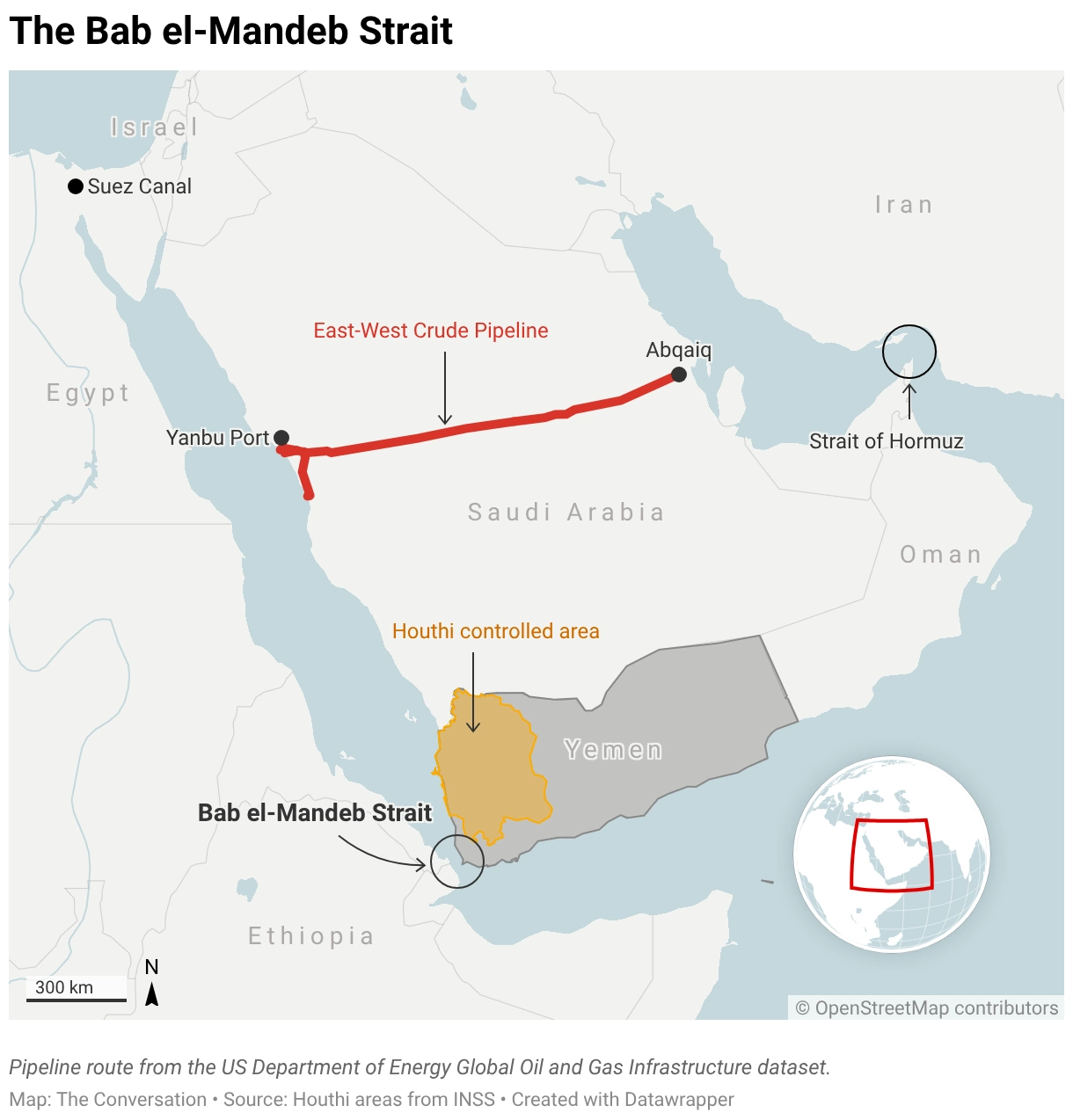 |
The Red Sea and Bab el-Mandeb strait, with areas controlled by Houthi in yellow. *Source: The Conversation* |
Kpler analysis data showed only one oil tanker transited the Hormuz strait on 23/7, the lowest level since 7/5. Meanwhile, Yanbu port is reportedly handling over 70% of Saudi Arabia's crude oil exports.
Experts believe that if Houthi forces successfully block the Bab el-Mandeb strait, a new oil price surge will emerge. This would disrupt fuel supplies and increase pressure on the global economy.
Richard Bronze, an expert at Energy Aspects consultancy, noted that after oil prices surged due to escalating US-Iran tensions and reduced vessel traffic through Hormuz, traders sought a catalyst strong enough to push prices to a new level. "Houthi resuming maritime attacks and effectively blocking the Bab el-Mandeb strait would certainly be such a factor," he stated.
In recent days, following the announcement, Houthi forces attacked several Saudi ships. This pushed Brent oil prices to nearly 102 USD per barrel on thursday (23/7) before settling around 97 USD per barrel. For the entire week, Brent and WTI oils increased by approximately 11% and 8,5% respectively. According to John Evans, an expert at PVM Oil Associates, major oil production centers and critical energy transportation routes are surrounded by conflict. "The short-term outlook leans towards a bullish trend," he said.
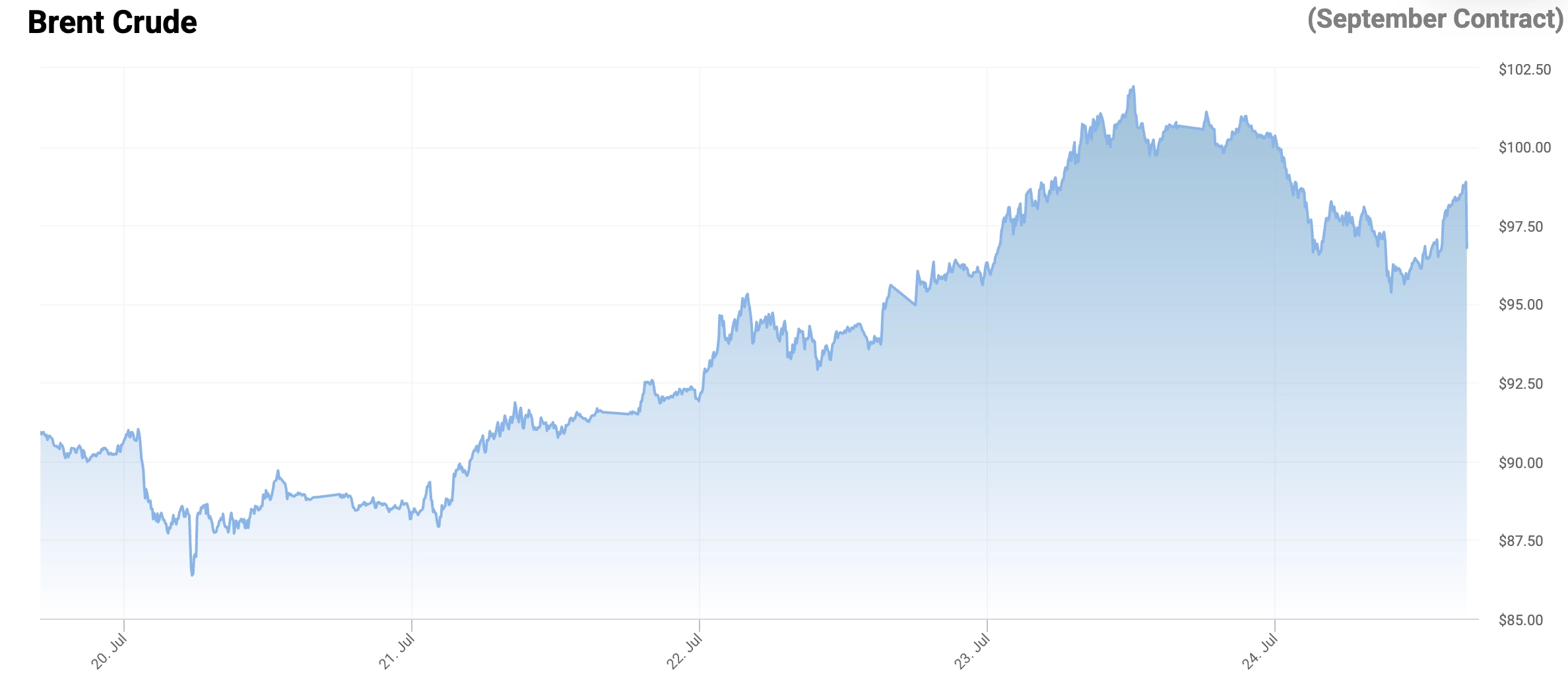 |
Brent oil price movements (USD/barrel) last week. *Chart: OilPrice* |
In the future, if Bab el-Mandeb is completely blocked, the largest impact will be on Saudi Arabia's oil exports from Yanbu port on the Red Sea. Richard Bronze warned that over 3 million barrels of oil transported daily through the Red Sea to Asia might have to take a detour around South Africa's Cape of Good Hope, a much longer and more expensive route. According to Matt Smith, Kpler's commodity research director, this scenario could force Asian refineries to wait an additional month. "The impact in the first month will be substantial," he predicted.
This disruption would also create logistics bottlenecks. Very large crude carriers (VLCCs) fully loaded would be unable to transit the Suez Canal, and the capacity of Egypt's SUMED pipeline, connecting the Red Sea to the Mediterranean, cannot be expanded further. John Paisie, president of Stratas Advisors consultancy, warned that oil prices could return to the 115-120 USD per barrel range. Shipping and insurance costs would also rise as vessels reroute around Africa. According to Sanjoy Paul, associate professor of operations and supply chain management at the UTS Business School, University of Technology Sydney (Australia), shipping insurance premiums for Red Sea transits are likely to increase following the Houthi announcement. "Higher shipping insurance costs are typically passed on to consumers. This could exacerbate inflationary pressures worldwide," he noted.
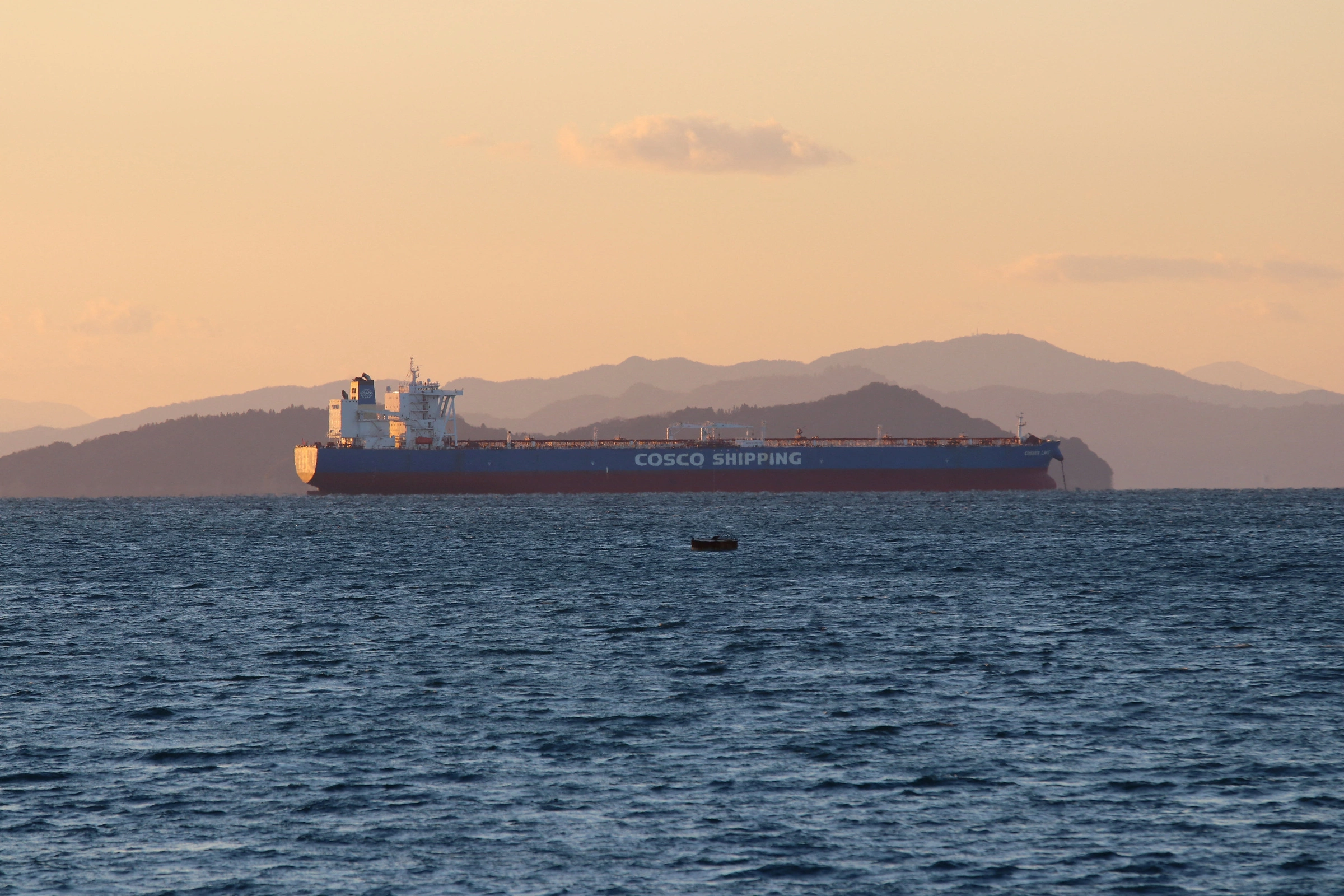 |
A VLCC supertanker in the Red Sea. *Photo: Reuters* |
Red Sea instability also poses a greater risk. John Paisie, president of Stratas Advisors consultancy, suggested that if Houthi truly severely obstructs oil transit through the Red Sea, both crude oil and refined product prices would rise. "This would weaken the entire global economy. At some point, the world could face a recession," he warned.
Associate Professor Sanjoy Paul at the University of Technology Sydney (Australia) stated it remains unclear how effective the Houthi blockade against Saudi ships in the Red Sea will be and whether the situation will escalate further. "For many countries, this new maritime blockade may have diminished hopes that economic disruptions due to the Middle East conflict would soon end," he observed.
Currently, Houthi is only blocking Saudi ships, not all traffic in the Red Sea. "If the action expands to vessels of other nations, global trade in manufactured goods, retail products, electronics, and machinery could be severely impacted," Paul added.
President Trump warned that if Houthi continues to attack vessels in the Red Sea, the US would hold Iran accountable. According to him, the Yemeni armed group acts as a proxy for Tehran, so "heavy military sanctions" would be imposed on both Iran and Houthi if the situation persists.
Associate Professor Sanjoy Paul recommended that businesses and governments continuously assess supply chain resilience and consider long-term alternatives for sourcing and transporting essential goods. "In the future, reducing reliance on fossil fuels and continuing the transition to renewable energy for transportation, logistics, and manufacturing is crucial," he stated.
Phien An (according to Reuters, CNBC, The Conversation)