As one of the largest, longest, and most important rivers in Germany and Europe, the Rhine river is experiencing weeks of historic drought. Typically, low water levels on this river occur from september to november each year.
At Kaub, one of the shallowest sections of the river, the water level at noon on 10/8 was only about 16 cm, according to the German Federal Waterways and Shipping Administration (WSV). This marks a record low since measurements began in 1880. The previous lowest recorded level was 25 cm in 10/2018.
In the waterway industry, a water level of 40 cm at Kaub is considered the minimum threshold for standard commercial vessels to operate, though the actual shipping channel on the river is about one meter deeper than the measured level at this point.
Beyond Kaub, water levels in areas around Cologne, Düsseldorf, Duisburg-Ruhrort, and Emmerich are also reaching historic lows. Jens Schwanen, managing director of the German Inland Waterways Association (BDB), expressed concern.
"Commercial transport cannot ship goods in the region at such low water levels. The same applies to day trips and tourist transport," he said. "Goods transported on the Rhine are primarily bulk cargo such as iron ore, coal, sand, and petroleum products."
Measuring 1,320 km long with a basin of 224,000 km2, the Rhine river originates in the Swiss Alps, primarily flows through Germany (over 860 km) before entering the Netherlands and emptying into the North Sea. This year, the river's water levels have reached record lows at a challenging time for the German economy, which is grappling with weak growth, high energy costs, and declining industrial competitiveness.
According to Dutch investment bank ING, the Rhine river alone accounts for 6% of the country's total freight transport volume. However, the issue extends beyond mere transport output. Factories have been constructed along the river since the 19th century to leverage barge transport and water resources for production.
This infrastructure remains critical today. The Rhine river corridor directly connects the port of Rotterdam (Netherlands) with Germany's three largest industrial clusters: the Rhine-Ruhr steel industry, the Rhine-Main region, and the Ludwigshafen chemical complex.
"Therefore, when Rhine water levels drop, the impact is not limited to supply chains but strikes at the heart of German industry," stated Carsten Brzeski, head of global macroeconomics at ING Research.
A 2020 study by the Kiel Institute for the World Economy indicated that low water levels on the Rhine, particularly during the 2018 drought, affected the German economy through both transport and production.
Specifically, one month of low water led to a 25% decrease in inland waterway transport volume and an approximately 1% drop in industrial output. Overall, the 2018 drought reduced Germany's GDP growth by about 0,3 percentage points.
"Given an economy that has seen almost no growth for the past two years, even a temporary 1% industrial reduction could cause significant damage," DW news agency commented on this year's situation.
Carsten Brzeski expressed concern that this economic impact could be even greater this time. The low water levels in early august are an unprecedented phenomenon and fall outside the scope of Kiel's research data. Some other experts predict third quarter industrial output losses could reach 1-2 billion euro. Among these, the steel, chemical, and energy sectors are expected to be most affected.
In early august, the German Economic Institute (IW) forecast that low water levels could reduce the country's GDP by 0,4%, essentially erasing the 0,5% economic growth anticipated this year. "A prolonged disruption to navigation on the Rhine could completely stifle the small shoots of growth we are currently experiencing," stated IW economist Thilo Schäfer.
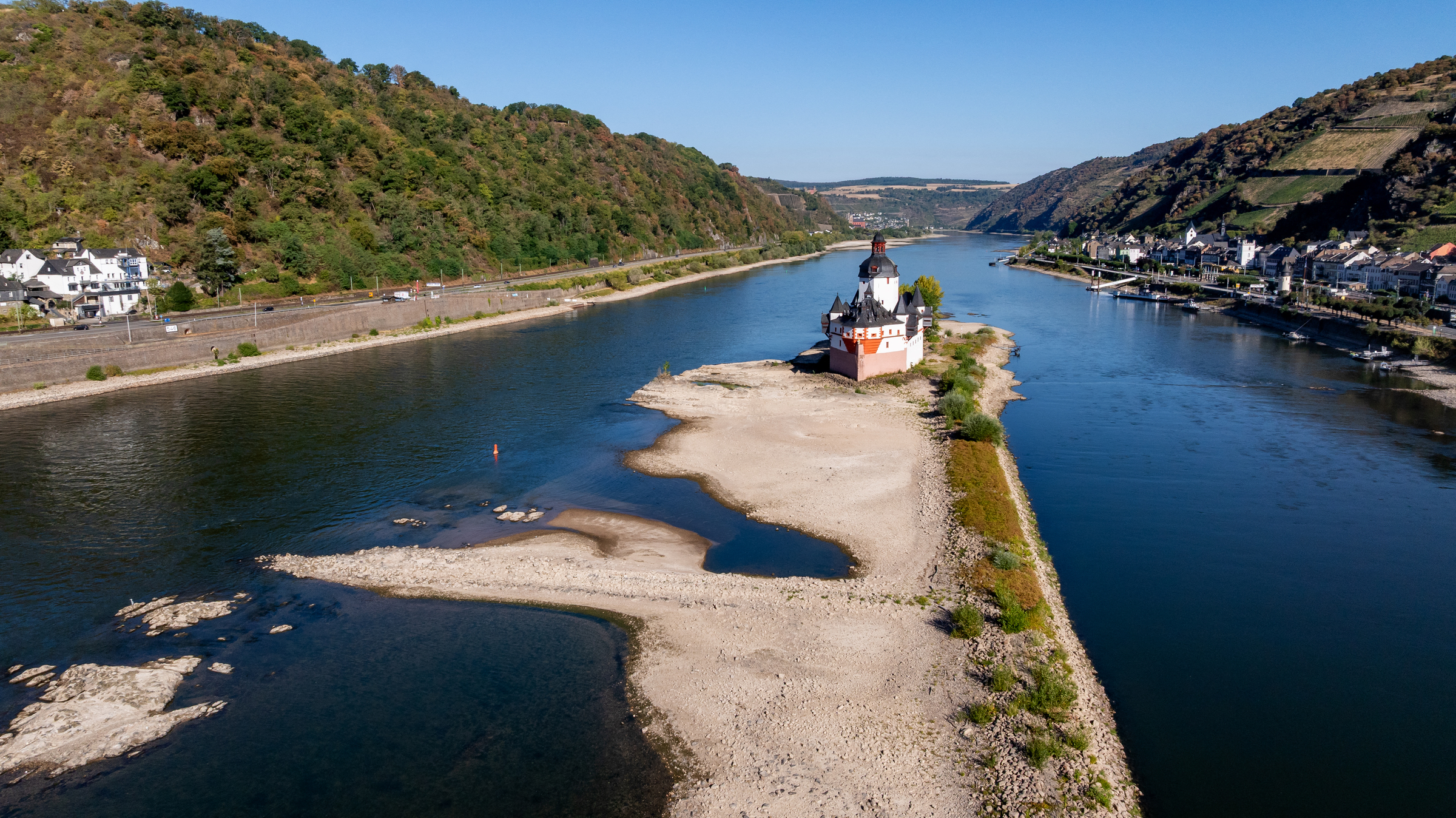 |
Pfalzgrafenstein castle on an island in the dried-up Rhine river at Kaub, Germany on 14/8. Photo: AFP
According to the EU's Copernicus Climate Change Agency, western europe recently experienced its hottest june and july on record, while unusually low rainfall has caused water levels on the Rhine, Danube, and Seine rivers to drop significantly below average. The current crisis marks the third severe low water event in eight years, following those in 2018 and 2022.
During dry summer months, the Rhine river is typically replenished by melting snow and glaciers in the Alps. However, today, shrinking glaciers and reduced snow cover are progressively weakening this water supply.
Carsten Brzeski suggested that unless the German government finds a reliable way to "make it rain", europe's economic powerhouse should prepare for a scenario similar to 2018, with GDP growth reduced by at least 0,3 percentage points. This would be a significant obstacle given that the German economy has grown for three consecutive quarters.
"Low river water is a blow to the recovery, but not enough to raise recession concerns," he commented.
Phien An (according to Reuters, DW)