Spiny lobster prices in the TP HCM market have steadily increased since the beginning of the year due to a sharp decline in supply. Previously, to purchase one to 1,5 kg spiny lobster, Ms. Hoa would pay 1,5-2 million dong per kg. However, since early this year, the common price has risen to 2-2,8 million dong per kg, an increase of about 20-35% compared to the same period last year, depending on the store.
A survey of numerous seafood stores and supermarkets in TP HCM indicates rapidly rising prices and decreasing stock. At a seafood supermarket on Ly Tu Trong Street, Ben Nghe Ward, spiny lobster weighing over one kg was listed at nearly 2,8 million dong per kg, while those under one kg were priced at about 2,5 million dong per kg. A store employee stated that each shipment only brings in a few dozen kg, a reduction of about 30% compared to previous months, with many times insufficient stock to meet large orders.
This scarcity is also evident at other stores. At a seafood store on Phan Dang Luu Street, Binh Thanh Ward, the display tank held only a few spiny lobsters, with those weighing over one kg significantly rarer than before. Due to limited supply, prices at this store have increased by about 15% compared to last month.
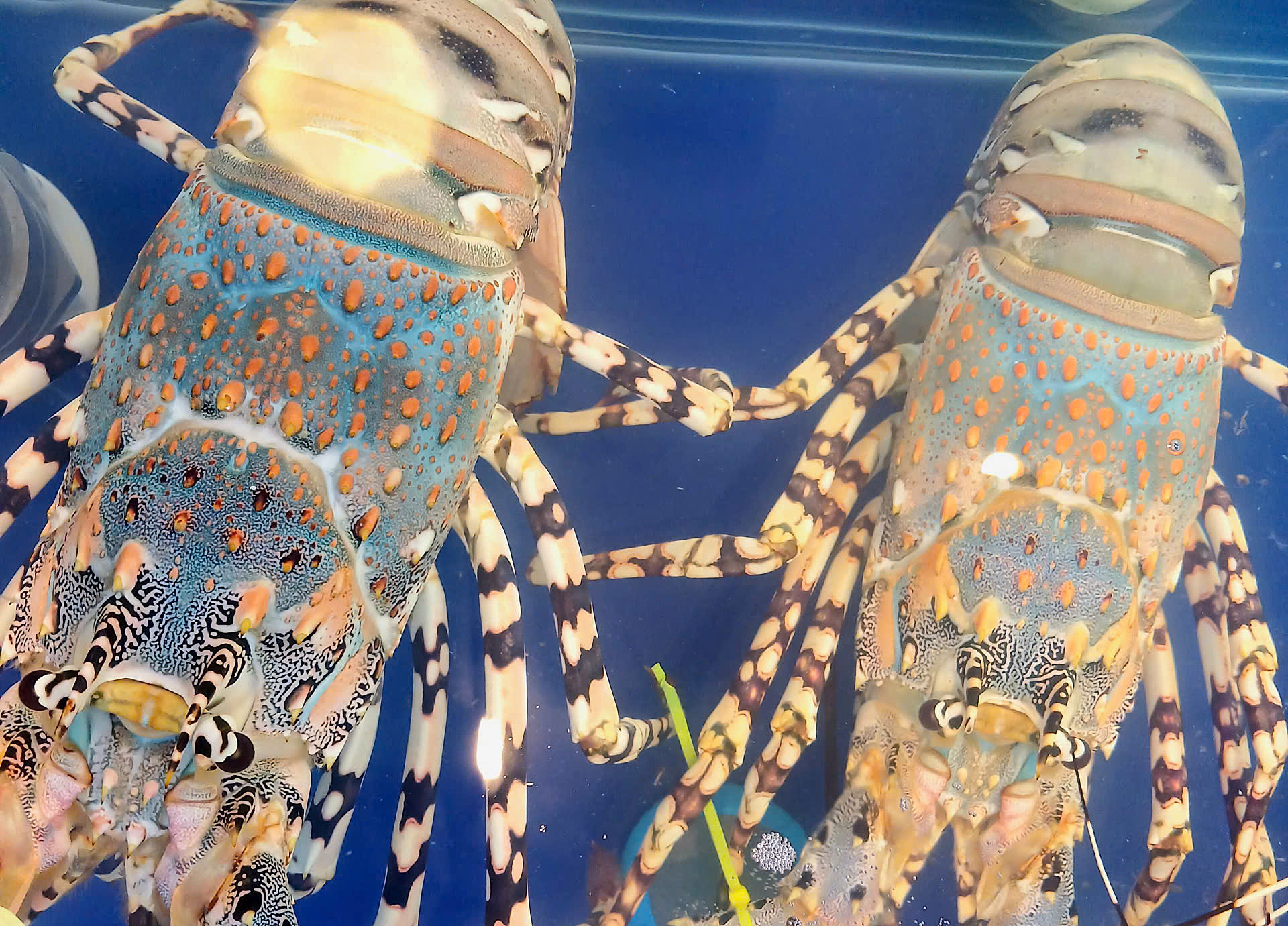 |
Spiny lobster at a seafood store on Ly Tu Trong Street, Ben Thanh Ward (TP HCM). Photo: Thi Ha
The sharp increase in spiny lobster prices stems from a decline in supply from key farming regions. In late November 2025, the former Phu Yen area, now part of Dak Lak province, particularly Xuan Dai Bay, suffered severe damage from prolonged floods. The sudden influx of freshwater caused mass mortality among lobsters. Many farming households lost nearly all their cages and were forced to sell off remaining lobsters at half price due to inadequate preservation facilities. With over 27,000 farming cages, this region is one of the country's largest lobster suppliers, so the damage directly impacted the market.
Beyond weather factors, the structure of domestic lobster farming has also changed significantly recently. Mr. Hung, a lobster farmer in Khanh Hoa, noted that he stopped farming spiny lobster early this year. According to him, since 2024, China has primarily imported lobsters weighing under 0,3 kg and reduced purchases of larger sizes, making it difficult to sell spiny lobster. Due to this shift, many farmers have switched to green lobster for easier consumption.
Similarly, Mr. Doan Van Quang, Director of Song Cau Spiny Lobster General Service Cooperative (former Phu Yen), stated that cooperative members now rarely farm spiny lobster. Many have even reduced their green lobster output after recent floods. Mr. Quang predicts that in the coming period, both spiny and green lobster prices may continue to rise due to shrinking supply.
In the distribution sector, Mr. Tran Van Truong, CEO of Hoang Gia seafood chain, reported that reduced supply makes sourcing increasingly difficult. "Sometimes, the store doesn't receive a single spiny lobster for an entire week", Mr. Truong said. He explained that as farmed spiny lobster prices rise, the already rare wild-caught spiny lobster, especially those weighing one kg or more, sees its price pushed up significantly.
Not only is the domestic market affected, but imported supply is also limited. Wild-caught spiny lobster from Australia currently costs up to about 3,5 million dong per kg, a 20% increase compared to the same period last year. Mr. Truong noted that Australia enters a closed fishing season in December, ending its harvesting period, which sharply reduces imported quantities. Meanwhile, China also favors Australian spiny lobster, keeping its price among the highest for imported lobster.
Amid tight supply, Vietnam's lobster exports have still seen strong growth. According to Customs Department data, lobster export turnover in October 2025 reached 93 million USD, a 75% increase compared to the same period last year. Cumulatively over 10 months, turnover hit 712 million USD, 135% higher than the same period in 2024, a rare growth rate for a single seafood product group.
Within the product structure, green lobster accounted for 98% of total export turnover, valued at approximately 700 million USD, an increase of 141%. Conversely, spiny lobster and other varieties saw a slight decrease, reflecting a market trend focused on the highest-demand segment. China and Hong Kong continue to be the main drivers of growth, with 10-month turnover reaching 702 million USD, accounting for nearly all of the industry's export value.
The Vietnam Association of Seafood Exporters and Producers (VASEP) anticipates that China's import demand will likely remain high through the end of the year and before the Lunar New Year. However, increasingly stringent requirements for inspection, testing, and traceability could become barriers if they prolong customs clearance times or increase costs for businesses.
Overall, lobster continues to be a highlight for Vietnam's seafood industry in 2025 due to strong demand from the Chinese market. However, to sustain this growth momentum, the industry needs to stabilize farming areas, restore supply, and enhance its capacity to meet quality standards amid increasing natural disaster risks and trade policies.