On 11/12, with nearly 90% of delegates in favor, the National Assembly approved the national energy development resolution for the 2026-2030 period. The Government is tasked with issuing mechanisms for investing in small modular nuclear reactors (SMRs) periodically, based on demand and the commercialization status of the technology.
Both state and private enterprises are encouraged to research and invest in small modular nuclear power. This development must ensure nuclear security and safety.
Earlier, many delegates expressed that developing small modular nuclear power is a new issue and proposed adding investment incentive mechanisms and criteria for selecting enterprises.
In its explanatory and acquisition report, the Government stated that SMR technology is currently in the research and testing phase globally and has not yet been widely commercialized. Consequently, investment and operational costs, along with safety requirements, lack a fully verified basis. Additionally, the legal framework related to small modular nuclear power is incomplete.
As SMRs represent a new field without commercial projects for reference, the Government cannot immediately establish specific incentive mechanisms. Once this technology is commercialized, proven safe, and suitable for conditions in Vietnam, the Government will report to the National Assembly to consider support policies based on investor proposals.
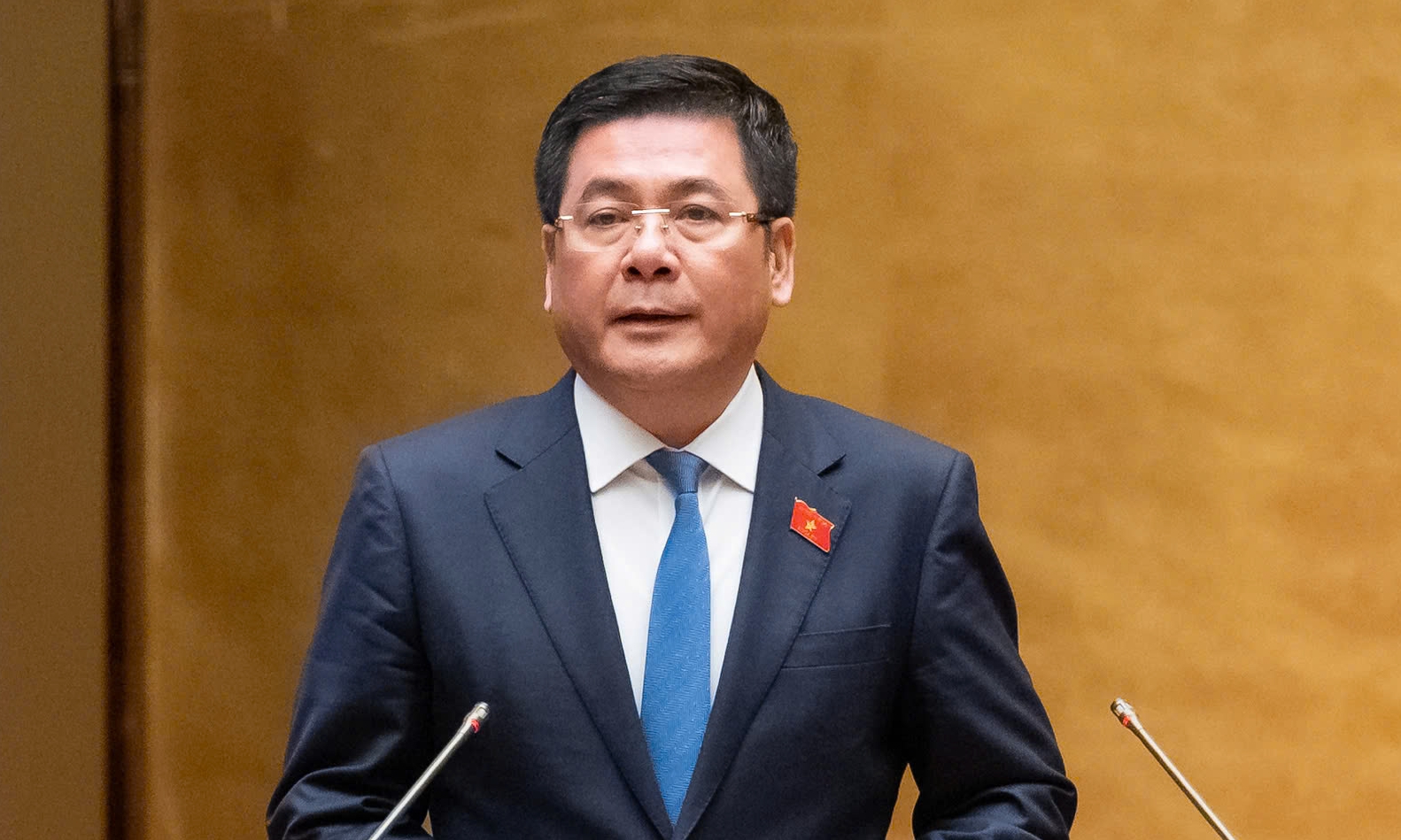 |
Minister of Industry and Trade Nguyen Hong Dien reported on 11/12. Photo: National Assembly Media
Late last year, the National Assembly resolved to continue investing in the Ninh Thuan nuclear power project after an 8-year halt. Concurrently, Vietnam plans to develop small-scale nuclear power nationwide. Small modular reactors are advanced nuclear reactors with a capacity of up to 300 MW per unit, which is one-third the capacity of traditional nuclear power reactors.
SMR modules can be prefabricated at factories and transported as individual units to installation sites. This process reduces construction costs and time while ensuring safety through passive safety features. The estimated investment cost per kW for SMRs ranges from 7,000-12,000 USD, translating to 2.1-3.6 billion USD for one 300 MW plant built in two to three years. In contrast, a standard nuclear power plant costs approximately 6-9 billion USD to build and requires over five years, with some projects taking more than ten years.
Regarding offshore wind power development, the National Assembly's resolution allows enterprises to use funds for project surveys, which can be accounted as costs if no investor wins the bid. The Prime Minister will decide on investment policies for offshore wind projects until 2030, without requiring land use right auctions or competitive bidding for investor selection. For the 2030-2035 period, the authority to approve investment policies will rest with the Chair of the provincial People's Committee.
Offshore wind projects must meet specific conditions, including national defense, security, national sovereignty, and marine environmental protection. They must also be included in the power development plan and be projected to operate during the 2025-2030 period.
The resolution also expands the group of participants eligible for direct power purchase agreements (DPPA) to include electricity retailers in industrial parks, high-tech agricultural zones, and urban or free trade zones. The electricity price under DPPA contracts, whether through a dedicated grid connection or the national grid, will be determined through negotiation between the buyer and seller.
Critical national oil, gas, and coal projects are exempt from investment policy approval procedures. For projects currently underway, compensation and site clearance can continue concurrently, even if there are adjustments to related plans.
The national energy development resolution is effective from 1/3/2026 until the end of 2030.
Anh Tu