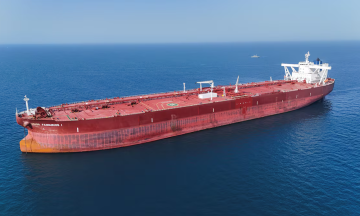
Large-scale airstrikes by the US and Israel, along with retaliation from Iran last weekend, disrupted shipping activities through the Strait of Hormuz. This strait accounts for nearly 20% of global oil supply.
While the strait has not been officially blockaded, about 150 ships anchored and halted movement in the area after at least three vessels were attacked. Typically, about 15 million barrels of crude oil and over 4 million barrels of refined products (gasoline, diesel, jet fuel) pass through this region daily.
Oil prices on 2/3 surged over 10% at one point, reaching above 82 USD a barrel—the highest in over one year—before settling around 79 USD. By noon on 3/3, prices again exceeded the 80 USD mark. Experts suggest that if the disruption to oil flow through the Strait of Hormuz lasts only a few days, the global market can absorb this shock due to ample supply and major consuming nations releasing strategic reserves.
However, if the conflict prolongs and the strait faces a longer blockade, the impact could be significant. A recent analysis by JP Morgan notes that the global economy still depends on Middle Eastern oil and gas, despite its decreasing proportion in recent years.
 |
The location of the Strait of Hormuz and surrounding countries. Graphic: NASA
JP Morgan assesses that oil prices would only reach 100 USD a barrel if supply fell by 4 million barrels a day—an unprecedented scenario. Therefore, the US bank's experts believe the likelihood of prices escalating to this level is "low".
Heng Koon How, head of market strategy at UOB (Singapore), shares this view, stating that "expecting prices to reach 100 USD is premature."
This is because a critical "red line" remains intact, as Iran has not directly attacked oil tankers or energy facilities in the Gulf region. Furthermore, OPEC retains capacity due to previous production cuts implemented since 2023.
According to How, there are signs that Iran is exercising a degree of restraint, fearing further isolation amid the spreading regional conflict. If necessary, Gulf nations and the US could deploy armed escorts for oil tankers to reduce risks when transiting the Strait of Hormuz.
The more probable scenario is that Brent crude oil will trade around 80 USD a barrel in QII and QIII, according to UOB (Singapore) forecasts.
Meanwhile, JP Morgan notes that at this price level, even without supply disruptions, high risk premiums could persist due to political pressure and increased insurance and logistics costs.
 |
Brent crude oil price movements (USD/barrel) from 26/2 to 3/3. Source: OilPrice
The largest US bank forecasts that if Brent crude oil prices remain around 80 USD until june, coupled with prolonged risk premiums, some asian countries risk significant impact.
According to ING Bank (Netherlands), the region heavily relies on crude oil flows from the Middle East. For example, Japan and the Philippines depend on it for nearly 90% of their needs, while China and India import about 38% and 46% of their demand, respectively.
"Any disruption in the Strait of Hormuz would restrict supply, potentially causing shortages, slowing business activity, and pressuring manufacturing across Asia," said Deepali Bhargava, ING's head of Asia-Pacific research.
Even if supply is not short, rising oil prices exacerbate trade balances and increase inflationary pressure. A mere 10% increase in oil prices can reduce the current account balance by 40-60 basis points. If this trend persists, the deficit will deepen. Thailand, South Korea, Vietnam, and the Philippines are the most vulnerable nations, according to ING.
In addition to bearing increased oil costs, exports from some asian economies could also be affected. In recent years, many countries have diversified export markets, reducing reliance on the US market, with the Middle East emerging as a promising alternative. Therefore, prolonged instability in this region risks slowing growth that has just begun.
Moreover, energy constitutes a relatively large proportion of the consumer price index (CPI) basket in developing asian countries. Theoretically, higher oil prices can drive up overall inflation, especially as rising fuel costs often lead to escalating food prices.
Food accounts for 25-45% of the CPI basket in developing countries. This is why economies like India and the Philippines could face major impacts, where a 10% increase in oil prices could boost inflation by 0,4 percentage points. Conversely, Australia benefits as a major oil and gas exporter.
Deepali Bhargava forecasts that inflation in Asia will rise but largely remain within most central banks' control targets. "However, if the oil price shock is prolonged, combined with currency depreciation, inflation will be pushed higher. This creates significant pressure, forcing monetary authorities to maintain interest rates rather than implementing further cuts," she noted.
For the global economy, supply chain disruptions due to a Strait of Hormuz closure could reduce GDP by 0,6 percentage points in the first half of the year compared to the baseline scenario, while inflation could increase by over one percentage point.
"This is a moderate macroeconomic shock, unlikely to threaten economic expansion or significantly alter the global monetary policy trajectory," JP Morgan stated. Nevertheless, the Middle East conflict could still interrupt the ongoing improvement in global business confidence.
Phien An