The Abu Dhabi Media Office announced on 15/5 the details of a previously undisclosed West-East pipeline project.
Crown Prince Sheikh Khaled bin Mohamed bin Zayed directed the Abu Dhabi National Oil Company (ADNOC) to accelerate the project, with operations expected to begin next year.
Iran closed the Hormuz strait in late February following attacks by the US and Israel. This vital waterway handles one-fifth of global crude oil trade. The resulting maritime congestion has caused energy prices to soar, leading to fuel crises in many countries and raising concerns about inflation and economic recession.
The new oil pipeline will enable the UAE to bypass the strait, boosting oil exports from the Gulf of Oman coast, which lies outside Hormuz. This will be the country's second pipeline, complementing the existing Habshan-Fujairah route. It is projected to double the UAE's export capacity to 3,6 million barrels per day.
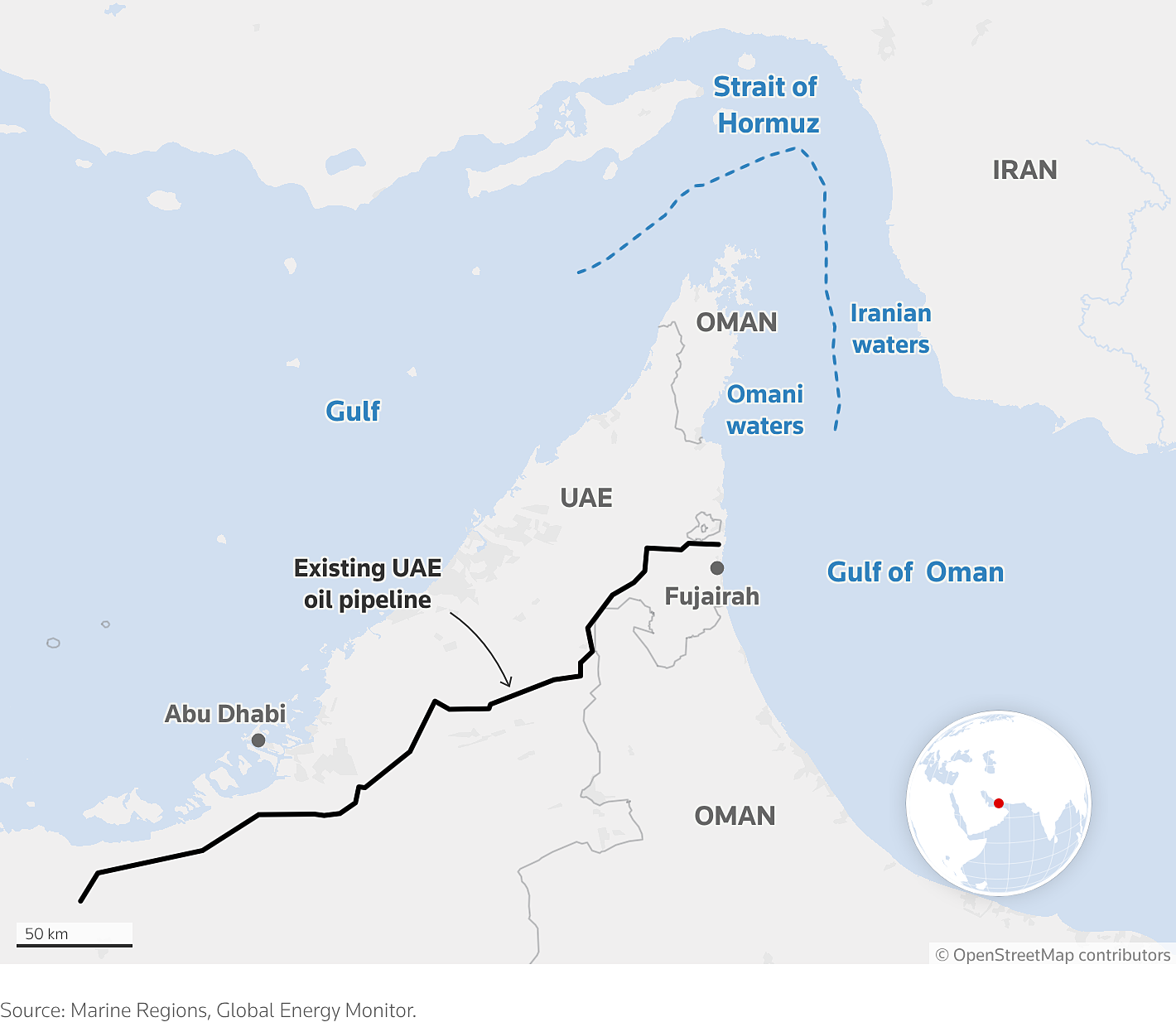 |
The UAE's current oil pipeline. *Graphics: Reuters*
The UAE will become the second Middle Eastern nation, alongside Saudi Arabia, to have this alternative oil export method. Oman also possesses a long coastline distant from Hormuz. In contrast, Kuwait, Iraq, Qatar, and Bahrain remain largely dependent on the Hormuz strait for their maritime trade.
This decision to fast-track the pipeline's completion comes two weeks after the UAE withdrew from the Organization of the Petroleum Exporting Countries (OPEC). Exiting OPEC frees the UAE from production quotas, allowing it to pump more oil than other members once Middle East conflicts subside and oil trade normalizes.
The new pipeline allows the UAE to pursue its export ambitions, irrespective of ongoing conflicts and Hormuz strait congestion. This move also positions the UAE's oil exports closer to Saudi Arabia's capacity, which sells up to 5 million barrels per day globally.
Last year, the UAE Energy Minister stated the country could increase production capacity to 6 million barrels per day if necessary. Earlier this year, the UAE produced nearly 3,4 million barrels per day, but this volume more than halved after the Hormuz strait closure forced ADNOC to halt some production. ADNOC now targets a capacity of 5 million barrels per day next year, three years ahead of schedule.
Bao Bao (according to Reuters, The Guardian)