Reuters reported on 2/8 that Japanese Finance Minister Satsuki Katayama is expected to announce joint action by Tokyo and Washington in currency markets to stem the depreciation of the yen to its lowest level in 40 years. The finance ministries of Japan and the US have not yet responded to this information.
The last time the US directly supported the yen was in 2011, when it coordinated with other G7 member nations to stabilize markets following the earthquake and tsunami disaster in Japan.
On 31/7, the US Treasury Department authorized several banks to intervene in the yen market. Finance Secretary Scott Bessent expressed the view that the Japanese yen is "significantly undervalued," revealing a note in his notebook during a cabinet meeting stating, "to do: buy 5-10 billion USD in yen."
The Japanese government sold USD to buy yen during weekend trading in New York. Data from the Bank of Japan shows it spent nearly 60 billion USD to support the yen. Meanwhile, the Federal Reserve Bank of New York sold euros to buy yen on behalf of the US Treasury Department.
Earlier, the Japanese Ministry of Finance posted on Instagram, stating it has "a range of tools to address market liquidity needs," including access to the Federal Reserve's (Fed) repurchase agreement facility to provide temporary USD liquidity.
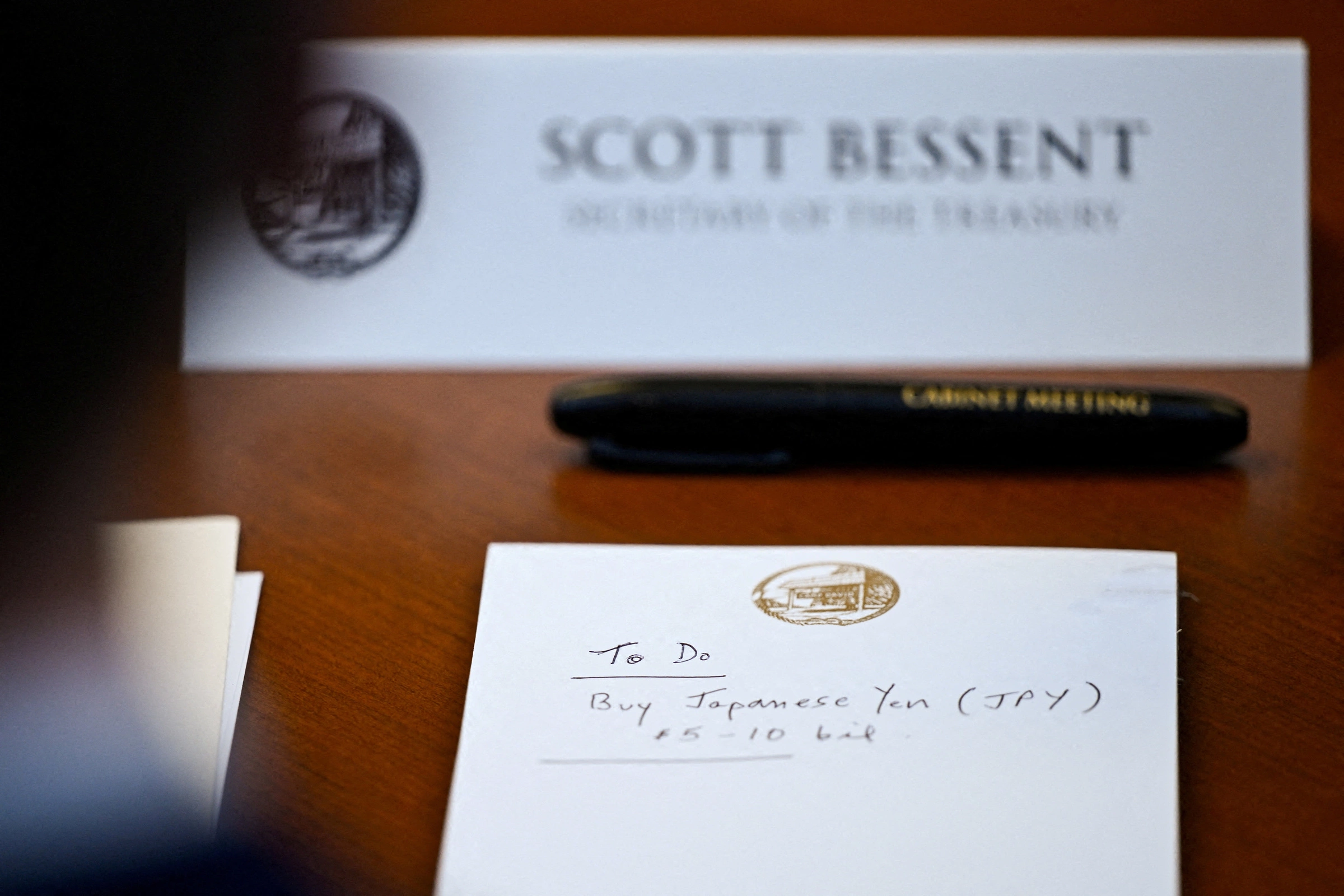 |
Notebook in front of US Finance Secretary Scott Bessent at a cabinet meeting, Maryland, US, 31/7. Photo: Reuters |
According to Bloomberg, the yen's depreciation provides an advantage for Japan in trade with the US, a situation that displeases President Donald Trump.
If Japan has to manage on its own to defend the yen, Tokyo could sell off its massive holdings of US Treasury bonds to finance currency intervention. This could trigger a sell-off of US debt, causing a surge in US government bond yields.
Some experts believe the signs of cooperation between Japan and the US stem from Washington's concern over rising treasury bond yields. This situation could worsen if Tokyo fails to prevent a sell-off of the yen and Japanese government bonds.
Nobuyasu Atago, a former Bank of Japan (BOJ) official, stated that the situation poses a risk of rising inflation for both the US and Japan. Therefore, cooperation to stem the yen's decline benefits both sides.
Bao Bao (according to Reuters, Bloomberg)