VIMC announced its investment in the Can Gio International Transshipment Port project during its annual general meeting on 15/4. The corporation approved its investment and capital contribution plans for key projects this year, notably the formation of a joint venture to develop the international transshipment port in Can Gio district, Ho Chi Minh City.
The project spans approximately 571 hectares with a main quay length of 7,5 km. Its design capacity targets 4,8 million TEU by 2030, increasing to 16,9 million TEU by 2047. Initially, the port will feature two to four berths, capable of accommodating vessels up to 250,000 tons deadweight. It has the potential for expansion to 13 berths in the long term.
The total investment exceeds 128,872 billion VND. Investor capital accounts for 15%, with the remainder sourced from other channels. The Vietnamese side will hold a 51% stake in the joint venture's charter capital. VIMC will contribute 36%, equivalent to about 6,959 billion VND, while Sai Gon Port will contribute 15%, approximately 2,900 billion VND. Terminal Investment Limited (TiL), part of the MSC Group, holds the remaining 49%. The project is located at Go Con Cho islet in Thanh An commune, Ho Chi Minh City.
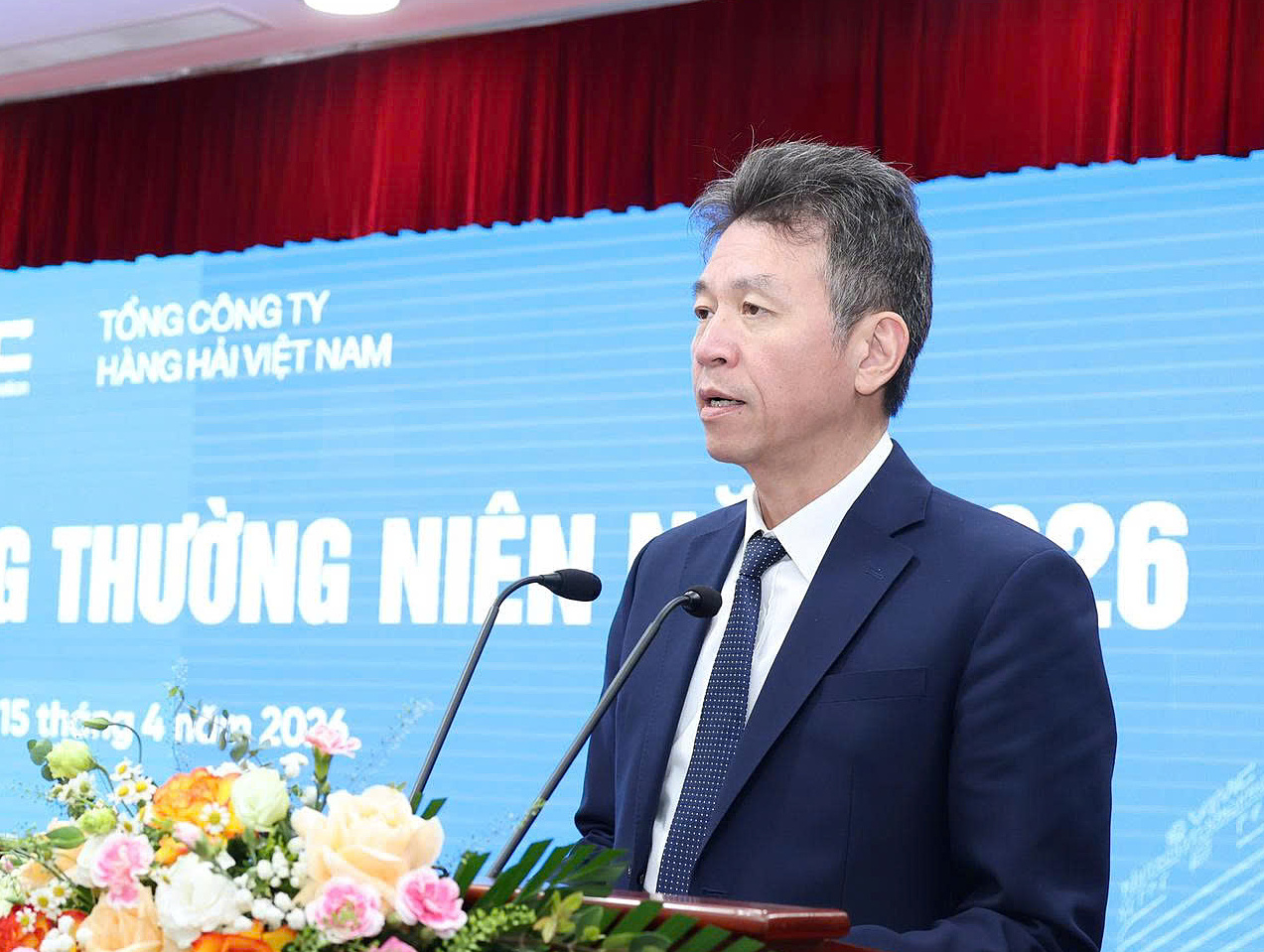 |
VIMC General Director Le Anh Son at the annual general meeting. Photo: Anh Duy |
Responding to shareholders about Can Gio port's competitiveness, General Director Le Anh Son clarified that Can Gio is envisioned as an international transshipment port to directly compete with ports in Singapore, not with regional ports such as the Cai Mep - Thi Vai cluster. He stated that international shipping lines often select transshipment ports based on safety, efficiency, and green initiatives, and VIMC will develop the port according to these criteria.
"We will ensure optimal productivity and reasonable prices. We strive to build Can Gio port into a '5-star port' with high competitiveness", Son said.
Son explained that in the coming years, as the global fleet of large container ships tends towards oversupply, shipping lines will shift from smaller vessels to larger ones for higher transport efficiency and reduced costs. This trend necessitates deep-water ports capable of accommodating these larger vessels.
Nguyen Canh Tinh, Chairman of VIMC's Board of Directors, noted that with increasing cargo volumes through Vietnamese seaports, investing in additional deep-water ports in key areas is a necessary trend. This initiative aims to anticipate the shift from river ports to seaports.
Beyond the Can Gio project, VIMC is investing in air cargo transport services and researching the acquisition of a shipbuilding or ship repair facility to expand its fleet. The corporation also allocated capital for investment in Quy Nhon Port.
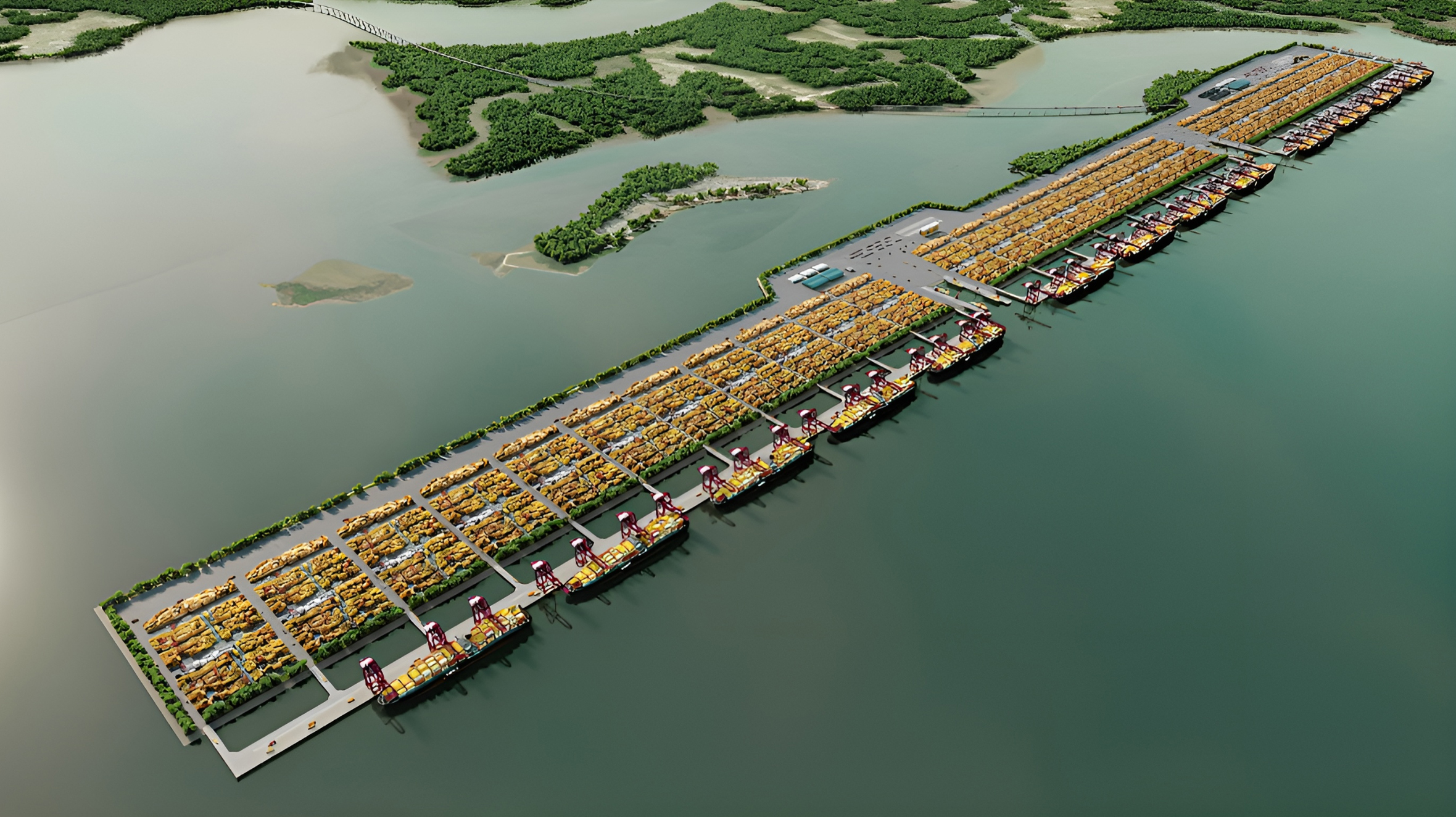 |
Rendered view of the Can Gio international transshipment port project. Photo: Portcoast |
At the meeting, VIMC leaders also assessed the international maritime transport situation in 2026. According to Le Anh Son, recent conflicts in the Middle East have caused a sharp rise in fuel prices, significantly impacting the operating costs of the shipping fleet. This trend is expected to continue into Quarter II.
Fuel costs currently represent about 20-30% of sea vessel operating expenses. Rapid increases in oil prices affect business performance if freight rates do not adjust quickly. Additionally, costs such as war insurance, risk surcharges, security, and route diversion expenses have also increased, adding pressure across the logistics chain. Port and logistics service providers reported a 40-51% increase in fuel costs, leading to higher transport expenses. If the conflict persists, unchecked costs will become a long-term burden for VIMC's fleet.
To address this, the corporation is implementing solutions such as identifying efficient operating routes, seeking more feasible contracts, maintaining flexibility between direct operation and chartering, and controlling costs.
"Sea transport revenue typically accounts for one-third of the group's revenue. Therefore, cost control and operational flexibility are crucial. This year, we aim for profitability in sea transport, but it cannot match 2025", Son remarked.
For 2026, the corporation targets stable growth. Sea transport volume is projected to reach 23,7 million tons, a 10% increase, while port throughput is expected to hit 180 million tons, an 11% rise. Consolidated revenue is forecast at 22,186 billion VND, up 8%, with pre-tax profit at 3,236 billion VND, comparable to 2025. After-tax profit is projected at 2,589 billion VND, a 2% decrease.
The parent company's 2026 plan projects a volume of 4,2 million tons, a 17% increase, and revenue of 6,432 billion VND, up 10%. After-tax profit is expected to reach 739 billion VND, also a 10% increase.
In 2025, VIMC's parent company achieved a sea transport volume of approximately 3,5 million tons, meeting 109% of its annual target. Total revenue reached 5,848 billion VND, an increase of 185% compared to the same period and 152% of the plan. Total costs amounted to 5,176 billion VND, about 1,736 billion VND higher than planned, primarily due to increased commercial operating expenses and external vessel chartering. The parent company's pre-tax profit was approximately 672 billion VND, exceeding the set target by 263 billion VND.
Doan Loan