In 2022, FIFA recorded nearly 5.8 billion USD in revenue after the World Cup in Qatar, an achievement it hailed as "unprecedented financial success". All revenue streams, including commercial partnerships, ticket sales, and television rights, surged. At that time, the global football governing body found it difficult to imagine that the new revenue record for the 2026 World Cup could reach an 11-digit figure.
FIFA President Gianni Infantino publicly forecasted that the 2026 World Cup's revenue would be "double Qatar's". This event is set to become the first in history to generate revenue exceeding 10 billion USD.
According to The Athletic, no other sports event currently generates value comparable to the World Cup. Historically, the Summer Olympics were often the largest benchmark; however, the Paris Olympics two years ago only generated just over 5 billion USD. In football, Euro 2024 recorded revenues of 2.9 billion USD.
The tournament's five-week duration provides FIFA with an opportunity to capitalize on the lucrative North American market. While Canada and Mexico are co-hosting, the 2026 World Cup will primarily take place in the US, with 78 of the 104 matches held there. From the round of 16 onwards, all matches will be organized in the US, presenting a golden opportunity for FIFA to generate significant income.
Beyond increased ticket sales and premium hospitality services, a World Cup with 75% of its matches on US soil brings clear commercial benefits. A senior executive familiar with FIFA's commercial operations stated, "Some markets like Russia and Qatar were difficult to exploit commercially. In contrast, brands targeted the World Cup in the US from the outset."
This World Cup marks the first time FIFA has innovated its commercial structure, dividing sponsors into three tiers: global, tournament-specific, and national. FIFA's partner categories include global corporations sponsoring the entire event, sponsors exclusive to specific tournaments, and entities with presence in individual countries.
Official FIFA commercial partners such as Adidas, Coca-Cola, Visa, Aramco, and Hyundai typically spend 80-100 million USD annually on long-term contracts. For this World Cup, FIFA has also welcomed new sponsors, including Bank of America and McDonald's, which are paying up to 100 million USD to associate their brands with the tournament. Fourteen other businesses are collaborating with lower sponsorship packages, including Home Depot and American Airlines, with contracts worth approximately 40 million USD.
Phil Carling, Chief Executive Officer of Football at Octagon, commented, "They do not want their home market to be represented by a rival, or to benefit foreign businesses." According to Carling, many brands that previously showed little interest in football are now partnering with the World Cup because the tournament is taking place in the US, coinciding with the nation's 250th national day.
FIFA has nearly sold out its sponsorship inventory and anticipates generating its highest revenue ever from a single sports event. Ampere Analysis projects this figure could reach 2.4 billion USD, a 37% increase compared to the 2022 World Cup.
To ensure a successful tournament, viewership remains a key factor. Over 6 million spectators are expected to attend the 104 World Cup matches in person.
Revenue from ticket sales and hospitality is projected at 3 billion USD, more than three times that of the 2022 World Cup. Analysts agree that ticket prices have been pushed to an unprecedented level in North America, a market accustomed to spending substantial amounts on sports events.
Due to FIFA's flexible pricing mechanism, calculating the average ticket price for this year's World Cup is challenging. However, in a complaint filed with the European Commission last month, the advocacy group Football Supporters Europe reported that a disabled fan wishing to follow their national team from the first match to the final would have to pay at least 6,900 USD for tickets, five times higher than at the Qatar World Cup.
For the final match on 19/7 at MetLife Stadium alone, the highest ticket price reached 10,990 USD. This price is seven times higher than the top-tier ticket for the final four years prior.
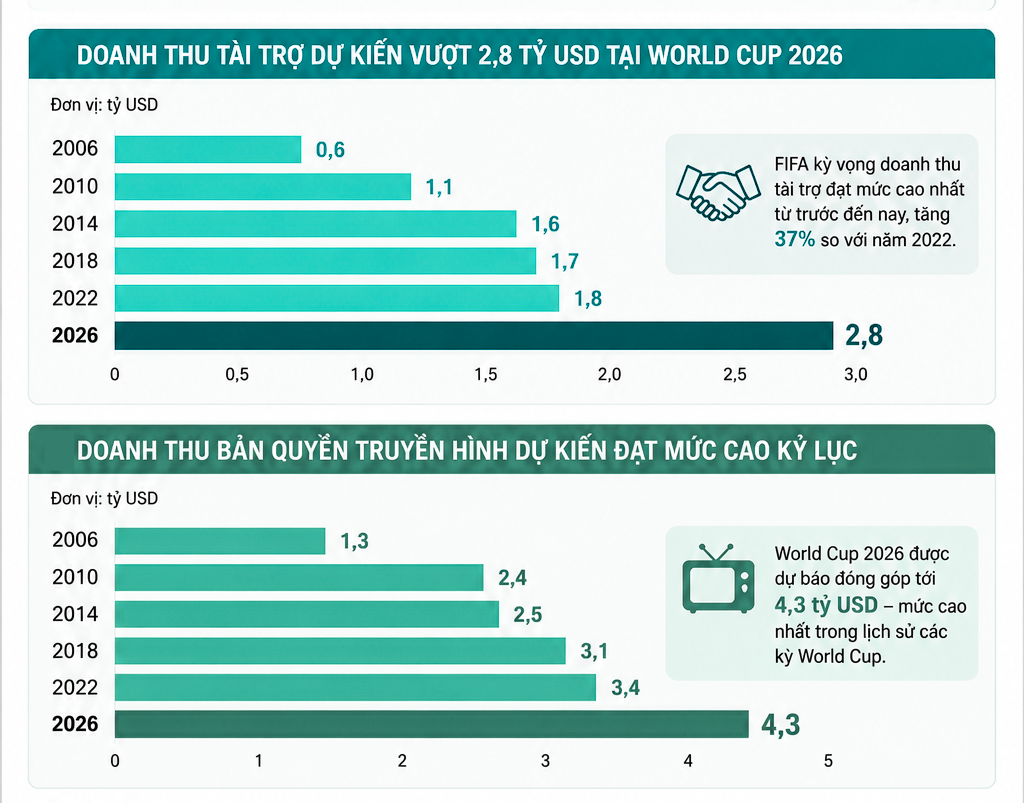 |
Projected revenue from sponsorship and TV rights for the 2026 World Cup compared to previous tournaments. *Source: The Guardian*.
FIFA also estimates approximately 6 billion people will follow this year's tournament globally. While this figure may be difficult to measure precisely, data from broadcasters consistently shows the World Cup's enduring and expanding appeal.
The World Cup has "awakened" several television markets that previously did not consider football a mainstream sport. In the US, the match between the national team and Belgium in the round of 16 attracted a record 30 million viewers on Fox. In Canada, Bell Media recorded an average of 5.4 million viewers for Canada's match against Morocco. This is also considered the highest television viewership for a Canadian national team match in history. In Europe, countries like Portugal and Norway saw viewership equivalent to nearly half their populations.
This widespread appeal will enable FIFA to record a record revenue of 5.2 billion USD from television rights for the 2023-2026 business cycle. Of this, the 2026 World Cup is projected to contribute 3.9-4.3 billion USD. For the two previous tournaments in Russia and Qatar, broadcasting rights revenue reached 3.1 billion and 3.4 billion USD, respectively.
FIFA's controversial decision to increase the number of participating teams from 32 to 48 plays a crucial role in the growth of television rights revenue. This expansion increases the total number of World Cup matches from 64 to 104, meaning FIFA has more content for broadcasters to leverage.
Conversely, the organization spent 7.6 billion USD to host tournaments over the past four years. About half of this, nearly 3.8 billion USD, was allocated to the 2026 World Cup. Operational costs for the tournament account for 30%, exceeding 1.12 billion USD. Prize money and welfare programs for participating teams also consume a significant portion of FIFA's total expenses, exceeding 1 billion USD, or 26%.
Tu Anh (according to The Athletic/The Guardian/Sportspro)