World spot gold prices experienced a sharp decline, shedding 188 USD to settle at 4,070 USD per ounce at the close of trading on 10/6. The market continued its downward trend, opening on 11/6 and reaching 4,045 USD, marking its lowest point since March. This significant drop saw gold lose nearly 200 USD in a single session.
The downturn is primarily driven by escalating concerns among investors that a prolonged Middle East conflict will compel nations to raise interest rates, thereby curbing inflation. This week, market attention is keenly focused on key US economic data, which is expected to provide insights into the US Federal Reserve's (Fed) upcoming monetary policy decisions.
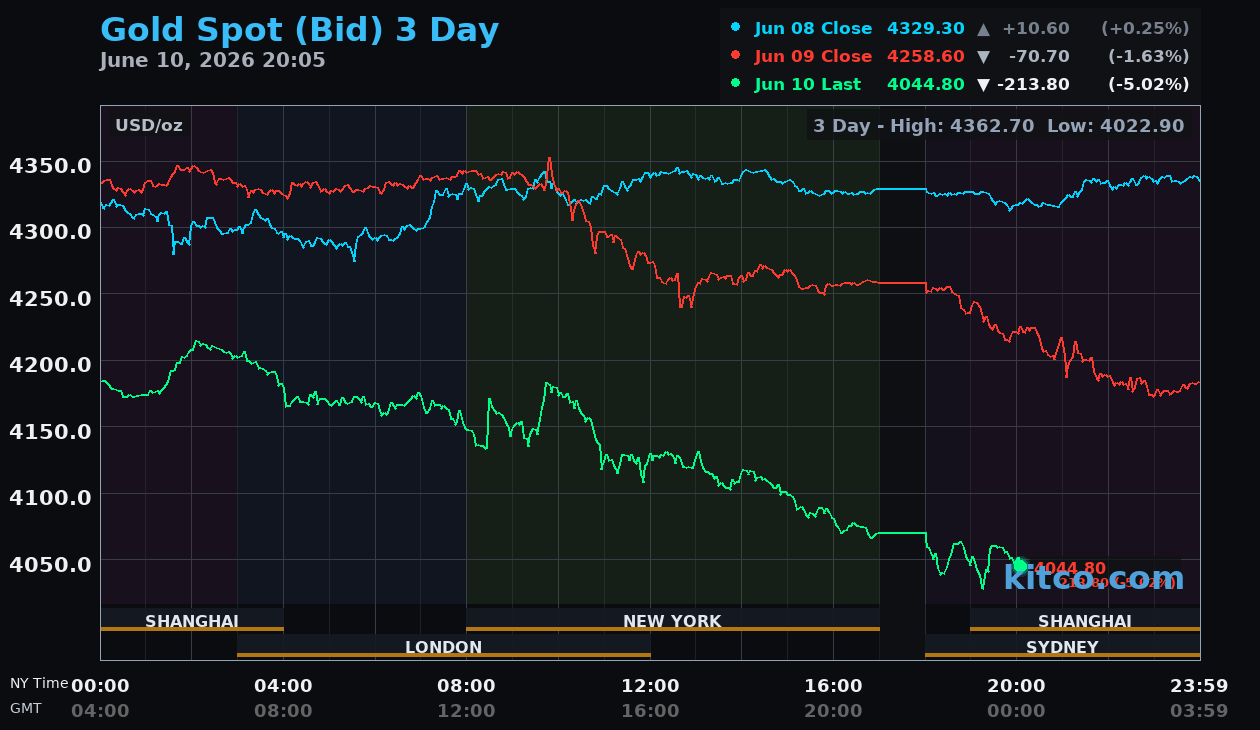 |
World gold prices dropped sharply for two consecutive sessions. *Chart: Kitco* |
Geopolitical tensions in the Middle East have intensified, with President Donald Trump declaring that the US would attack Iran "very severely" if a peace agreement is not finalized. The US military reported striking multiple targets in Iran in response to "unjustified and continuous aggressions" from Tehran. A day prior, the US conducted airstrikes on numerous coastal targets in Iran, while Tehran retaliated by targeting Washington's bases in Gulf countries such as Bahrain and Jordan.
Gold prices have been under pressure since the conflict erupted at the end of February. Rising oil prices have fueled inflation risks and subsequent interest rate increases, making the precious metal less attractive as it does not offer fixed interest returns.
"Markets are desperate for some good news, after the US released a strong jobs report last week and President Donald Trump warned Iran would pay a price for prolonging peace talks," commented Tai Wong, an independent precious metals investor.
The CME FedWatch tool indicates that investors currently assign a 67% probability that the US will raise interest rates in December. The US Federal Reserve will hold a meeting next week.
Adding to the economic landscape, the US Labor Department reported that the country's Consumer Price Index (CPI) for May rose 4.2% compared to last year. While this matched forecasts, it is the first time the figure has exceeded 4% since 4/2023, largely due to increasing energy prices. The US is also scheduled to release its Producer Price Index (PPI) this week.
Despite the recent sharp price correction, central bank buying and fears of currency devaluation are still supporting gold, noted Paul Wong, a market strategist at Sprott Asset Management.
Beyond gold, prices of other precious metals also saw declines. Silver prices fell nearly 5% to 62 USD, while platinum and palladium lost 5% and 1.1% respectively.
By Ha Thu (Reuters, Kitco)