On 8/9, a team of mathematicians at OpenAI announced their autonomous artificial intelligence (AI) agents discovered a "singularity" within the three-dimensional Navier-Stokes equations, effectively solving this 200-year-old mathematical problem. This achievement addresses one of the seven Millennium Prize Problems, established by the Clay Mathematics Institute in 2000, each offering a 1 million USD reward. If independently verified, this would represent the most significant mathematical proof generated by an AI model to date, signaling a fundamental shift in how complex problems are approached. "This is an exciting day, as we witness great strides in human understanding of mathematics," Martin Bridson, President of the Clay Mathematics Institute, told Nature.
The Navier-Stokes equations describe fluid movement in space, such as air over an airplane wing or water from a tap, as reported by New Scientist. The Clay Mathematics Institute's core question was whether these equations consistently operate smoothly or if they can lose control, leading to "blow-ups"—meaningless results. This challenge involves differential equations, a method for showing relationships between changing quantities. While such equations are often simple to formulate, finding their solutions is typically difficult. "This problem has remained unsolved for 200 years due to the complexity of the Navier-Stokes equations," stated Venkat Chandrasekaran, an OpenAI researcher, during a press conference. "Solving it with traditional paper and pen methods is incredibly complicated."
While the Navier-Stokes solution was highly anticipated, OpenAI's announcement quickly sparked controversy, as reported by The Guardian. Mathematician Tristan Buckmaster of New York University claimed he and a researcher at Anthropic, an OpenAI competitor, were nearing publication of their own related breakthrough. Buckmaster suggested OpenAI expedited its solution after learning of their progress. He also expressed concern that both groups' ongoing work might have been accessible within OpenAI's Codex model, used for computer programming, potentially allowing the OpenAI team to view it.
Sebastien Bubeck, an OpenAI researcher, denied these claims. He explained that OpenAI tasked 1,000 AI agents with solving the Euler problem, a similar challenge that serves as a crucial step toward a complete Navier-Stokes solution. This initial AI group identified the "blow-up" phenomenon in 50 hours. Following this, OpenAI deployed 10,000 additional AI agents to extend this finding to the full Navier-Stokes equations, reaching their final conclusion in a total of 88 hours.
Of the seven Millennium Prize Problems from the Clay Institute, only one had been previously solved. However, its author, mathematician Grigori Perelman, declined the 1 million USD prize. OpenAI has also stated it does not intend to accept the reward. Despite this, the prize evaluation process will proceed carefully, "ensuring absolute rigor," Bridson informed New Scientist in an email.
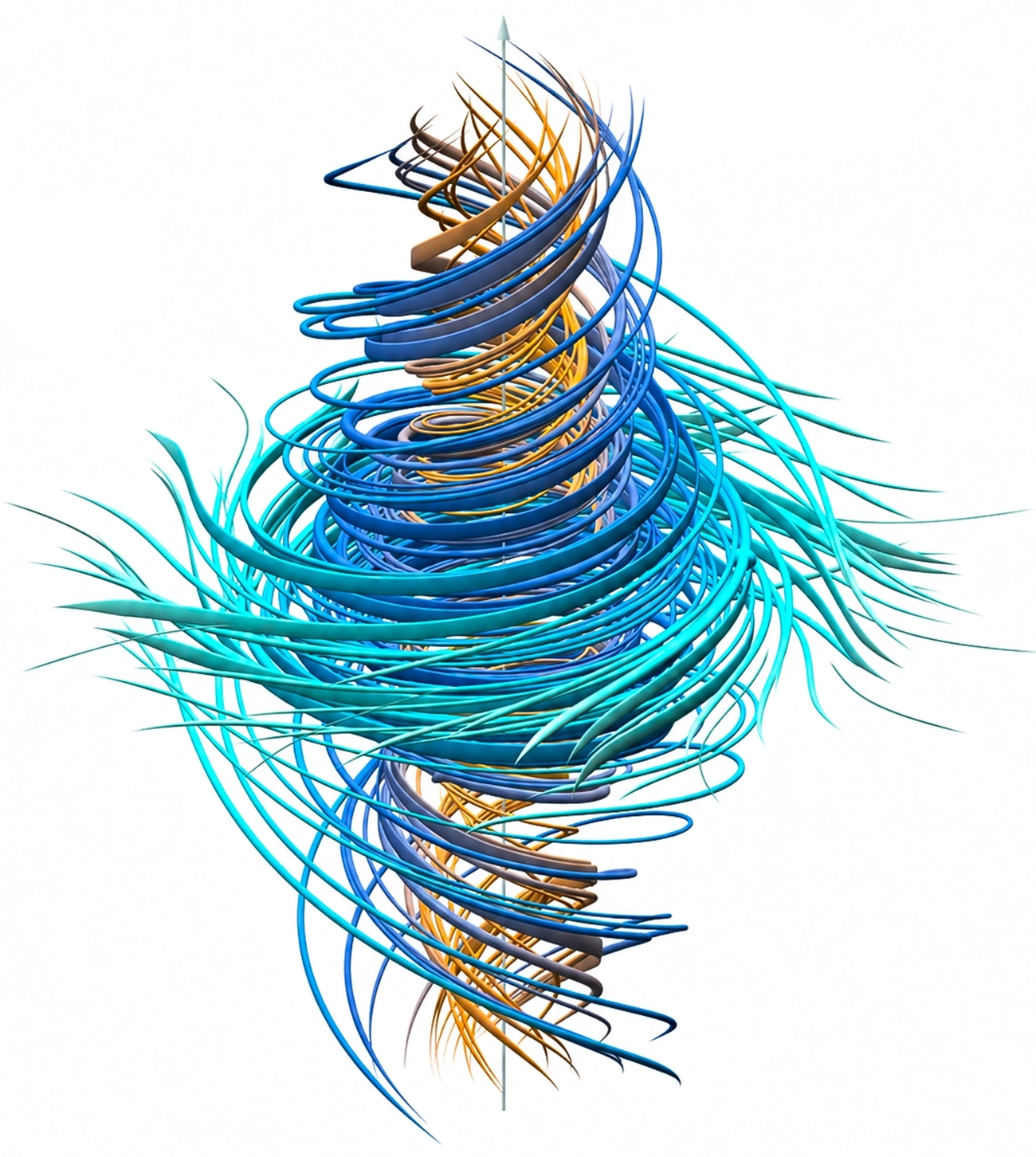 |
A swirling vortex related to the solution for the Navier-Stokes equations. Photo: OpenAI |
Compiled by Khanh Linh.