The Organisation for Economic Co-operation and Development (OECD) announced the results of its Program for International Student Assessment (PISA) 2025 on 8/9. This year's assessment saw the largest participation ever, with over 760,000 15-year-old students from 91 countries and economies taking the tests.
Despite the overall decline, some educational systems recorded progress. For example, Thailand, Turkey, and UAE were among the countries that saw an increase in science scores. Slovakia and Qatar managed to both increase their proportion of high-achieving students and reduce the number of low-achieving students in science.
China, which includes four mainland provinces/cities (Beijing, Shanghai, Jiangsu, Zhejiang) and some territories, has reclaimed the top spot after missing the 2022 assessment, surpassing Singapore. As with most assessments since 2000, Asian educational systems continue to dominate, according to The Economist. China, Estonia, Japan, South Korea, Singapore, and the United Kingdom consistently ranked in the top 10 across all three fields: science, mathematics, and reading comprehension.
However, the scores of students in OECD member countries continued to decline. The average scores for both math and reading comprehension reached historic lows, dropping by nearly 20 points compared to the previous PISA assessment in 2022. Specifically for math, the average scores of students both within and outside the OECD bloc decreased by 22 and 8 points, respectively, compared to 2015.
| No. | Country, Territory | Science | Reading | Math | Computational Thinking |
| 1 | China (Beijing, Shanghai, Jiangsu, Zhejiang) | 597 | 527 | 612 | 560 |
| 2 | Singapore | 560 | 535 | 563 | 563 |
| 3 | Macao (China) | 541 | 501 | 549 | 572 |
| 4 | Taiwan (China) | 540 | 508 | 546 | 551 |
| 5 | Japan | 538 | 503 | 525 | 557 |
| 6 | Estonia | 527 | 499 | 508 | 541 |
| 7 | South Korea | 526 | 501 | 522 | 538 |
| 8 | United Kingdom | 511 | 494 | 488 | 523 |
| 9 | Canada | 510 | 490 | 485 | 525 |
| 10 | New Zealand | 509 | 497 | 480 | 531 |
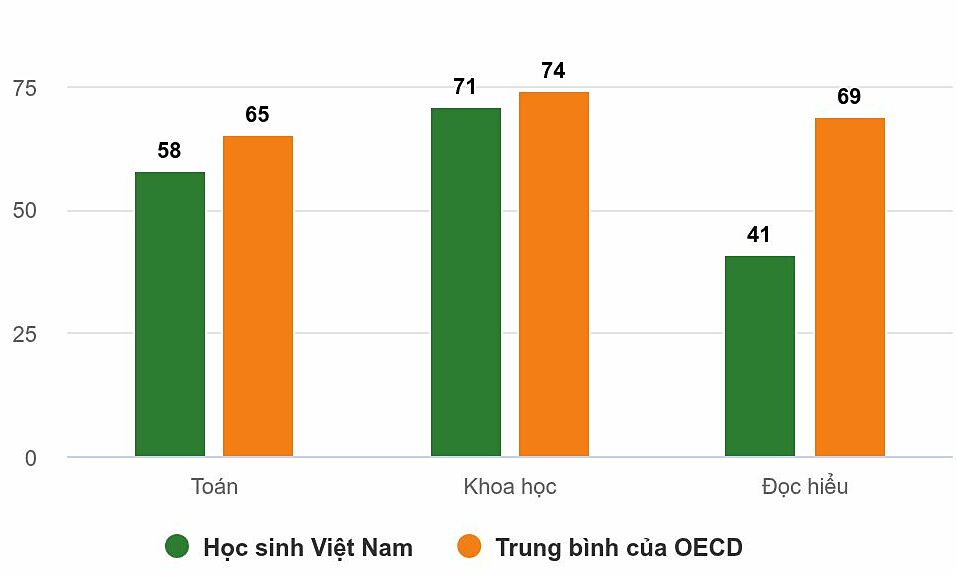
Vietnamese students achieved an average of 457 points in science, 443 in math, 392 in reading comprehension, and 461 in computational thinking. These scores are approximately 15 to 70 points lower than those recorded in the 2022 assessment.
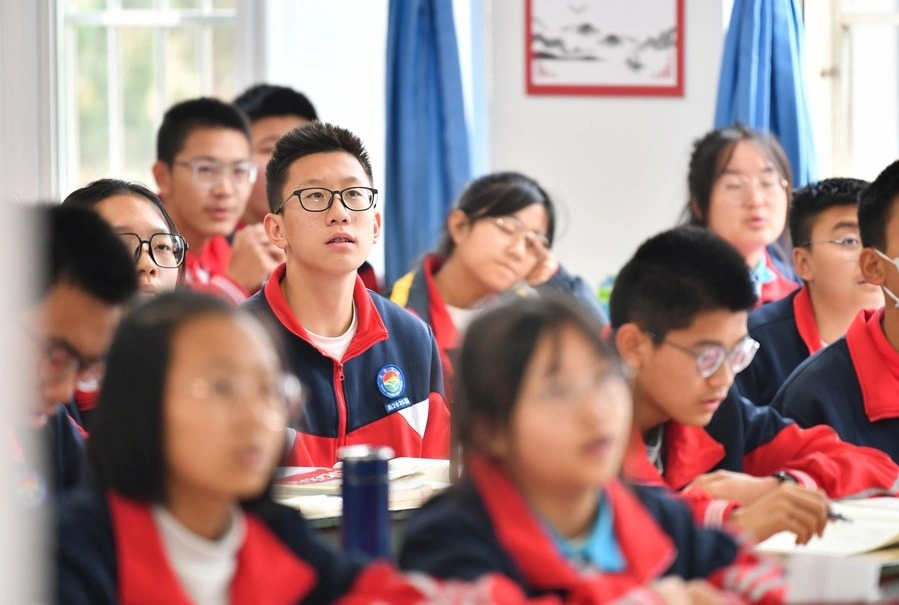 |
High school students in Shaanxi, China. Photo: Xinhua |
Khanh Linh