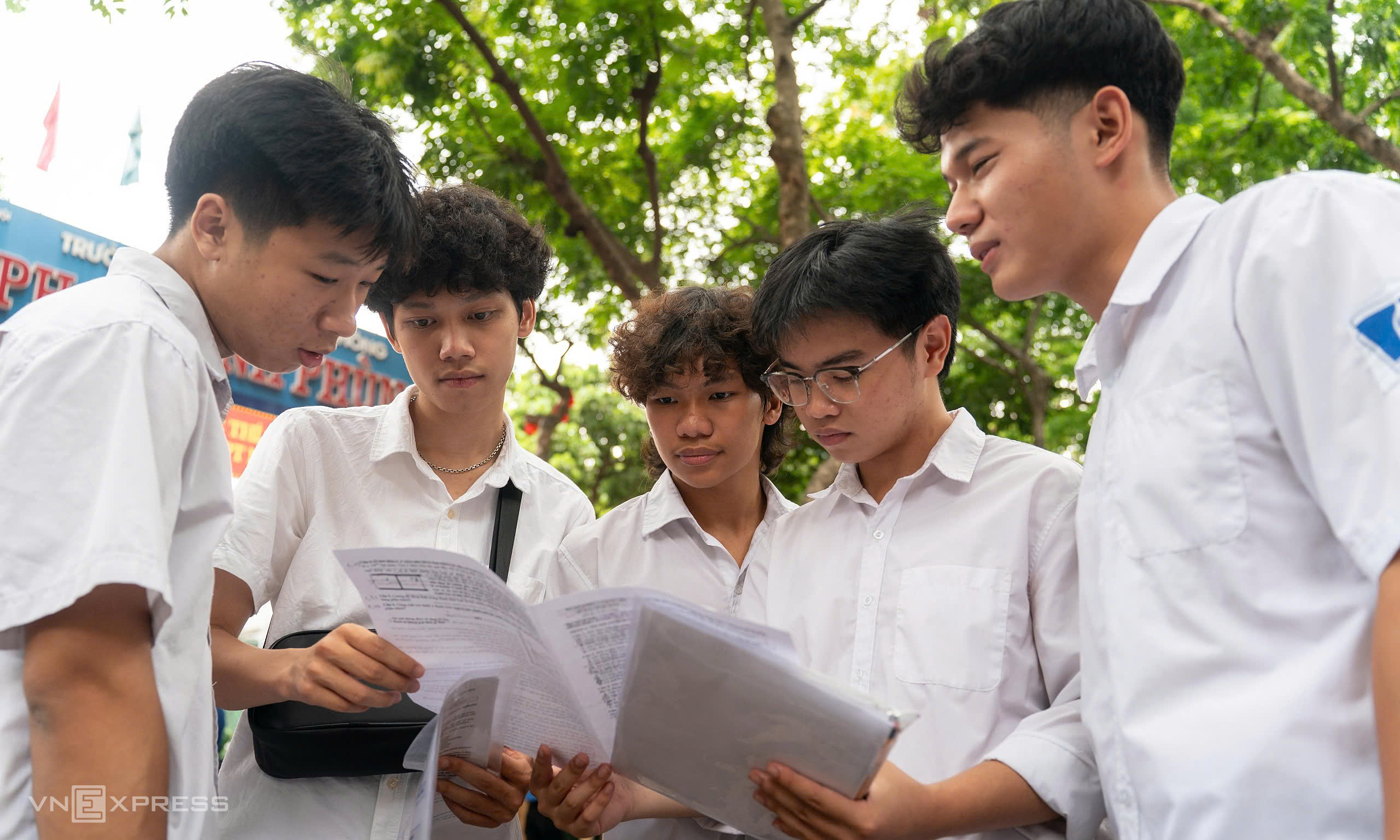
Teachers observe that current high school graduation English exams, especially high-level questions, thoroughly assess students' reading comprehension, analytical, inferential, and language processing abilities, rather than relying on trick questions about knowledge.
Huong Fiona (Nguyen Thanh Huong), a teacher at the HOCMAI education system, notes that highly differentiating questions often appear in the 10-question reading comprehension section. These sections feature current affairs topics or issues unfamiliar to students.
Notably, questions summarizing the entire text, with lengthy options containing complex information and vocabulary, or inference questions, pose challenges. An example is the group of three final questions in the "greenwashing" reading passage from the 2025 graduation exam.
Regarding this section, Tran Ngoc Huu Phuoc, an English teacher at Bui Thi Xuan High School in TP HCM, points out that many students tend to look for exact words in the passage and then choose an answer. However, high-level questions often rephrase ideas completely. Students need to focus on the meaning rather than the exact wording.
For inference questions, the answer is rarely found verbatim in one line of the reading passage. Candidates must connect scattered pieces of information to draw the most logical conclusion. For main idea questions, a common error is selecting an option that reflects only a minor detail or adds information the author did not mention.
Another challenging question type for students is filling phrases or sentences into a paragraph. Huong cites questions 3, 5 in code 1101 from last year, where options were designed with long, intricate phrasing.
According to Phuoc, this is the most difficult section on the exam, as it synthesizes many skills: grammar, vocabulary, reading comprehension, and understanding text flow. Many students diligently study grammar but still make mistakes because they focus only on the blank, neglecting to read the entire passage.
He advises students not to rush to look at the four options. Instead, read the entire passage to grasp the author's topic and the argument's development. Then, analyze the blank's function: whether it explains, supplements, provides an example, or indicates contrast.
After eliminating grammatically incorrect options, candidates should try reading the preceding sentence, the chosen answer, and the following sentence together. If the flow is smooth and natural, it is likely the correct answer.
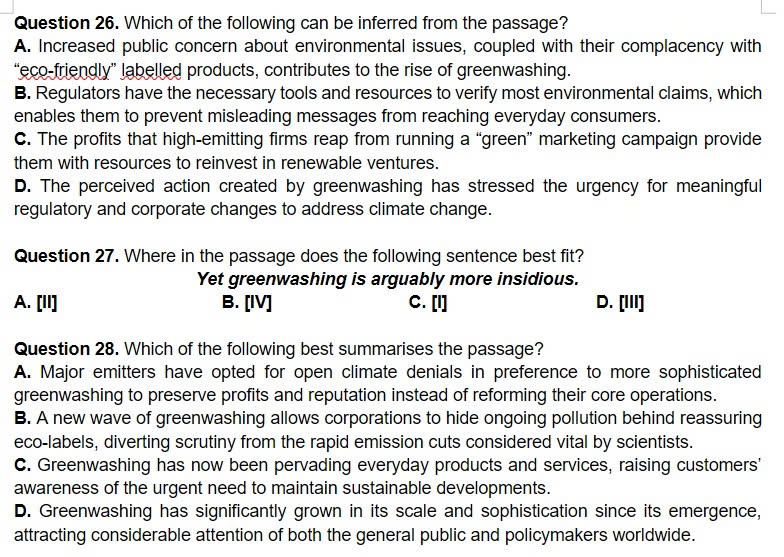 |
Three questions requiring inference and reading comprehension summary, code 1101, 2025 high school graduation English exam. Photo: Provided by teacher.
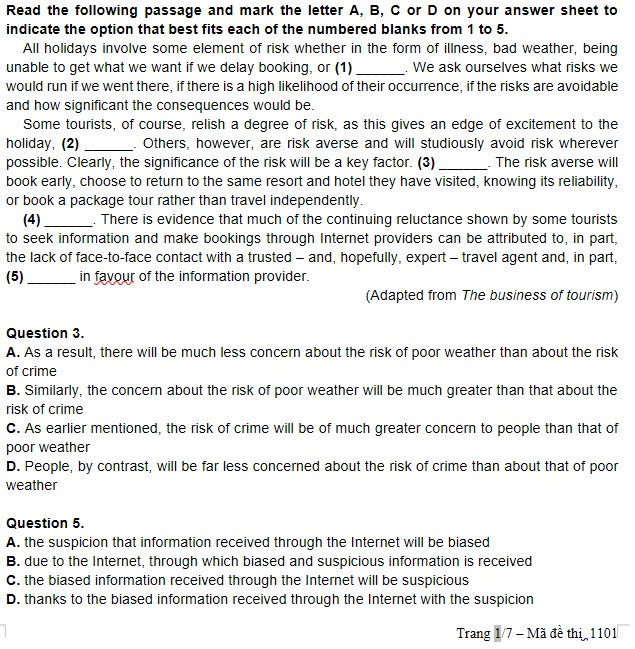 |
Two difficult questions in the paragraph completion section, code 1101. Photo: Provided by teacher.
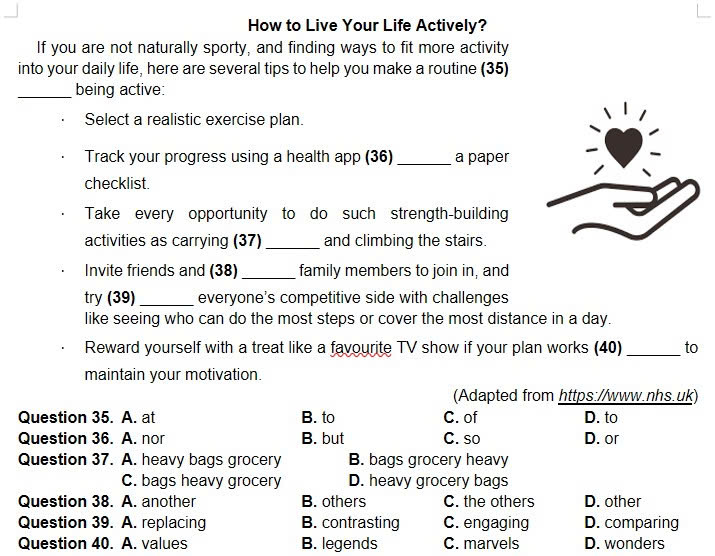 |
Difficult vocabulary question (question 40), code 1101. Photo: Provided by teacher.
The next type that can cause many proficient students to lose points involves arranging dialogues, emails, or paragraphs. Phuoc states that many students see familiar content and arrange it intuitively, while the exam sets subtle "traps" in conjunctions or the semantic relationships between sentences. Misplacing just one sentence can disrupt the entire paragraph's logical flow.
When encountering this type, Phuoc emphasizes that the most important step is to identify the opening and closing sentences. Then, follow linking cues such as however, therefore, instead, then, finally... Often, a pronoun like this, these, or that is enough to determine which sentence must come first.
Finally, direct questions on vocabulary, fixed phrases, prepositions, or difficult idioms are common. According to Huong, candidates need a bit of "luck" to have encountered, learned, and remembered these words, or to accurately predict and complete their exam "perfectly." These could be questions like number 40 in code 1101.
Encountering unfamiliar or difficult words on the exam is frequent. Candidates do not need to worry excessively if the word does not significantly impact the question. However, if it is a crucial part of the question or passage, Huong advises candidates to remain calm and try to understand or guess its meaning.
Typically, reading passages offer hints, explanations, or illustrative examples to help candidates grasp the meaning of difficult and uncommon words. The approach is to trace and connect "clues," especially information or examples written immediately after unfamiliar words, while also placing the word within the overall context of the paragraph and passage to infer its meaning.
Phuoc concurs, noting that current exam questions do not require students to know the meaning of every word. In many cases, simply understanding the context, determining if the passage has a positive or negative tone, and confidently eliminating unsuitable options can lead to the correct answer.
Ultimately, composure is key for candidates to succeed in the exam. Through the preparation process, Phuoc has observed that high-scoring students often do not possess significantly superior vocabulary or grammar compared to others.
"A student who achieves a perfect 10 is not someone who never encounters difficult questions. Their strength lies in maintaining composure, knowing how to analyze, and not allowing one question to affect their entire exam performance," Phuoc concludes.
 |
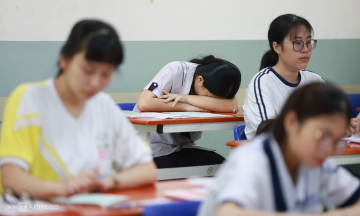
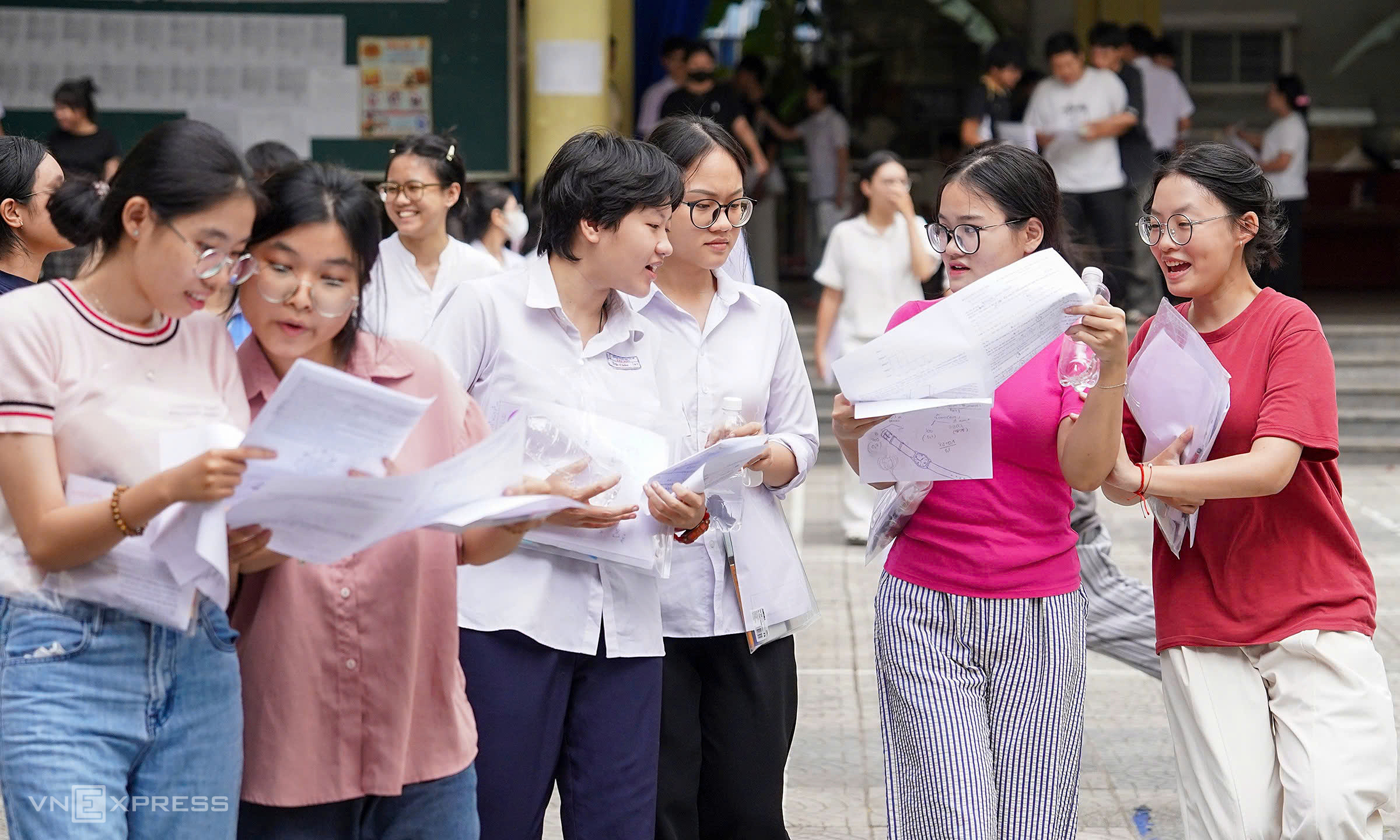
TP HCM candidates taking the 2025 high school graduation exam. Photo: Quynh Tran.
The 2026 High School Graduation Exam will take place on 11-12/6, with over 1,22 million candidates, a record number. Candidates take four subjects: mandatory Math and Literature, along with two elective subjects.
More than 347,000 candidates registered for the English graduation exam, about 17,000 fewer than last year. In last year's exam, 141 candidates nationwide achieved perfect 10s in English. The average score for this subject was 5,38, and the median score was 5,25.
Khanh Linh