


This initiative is part of Hanoi's 100-year master plan, approved by the Chairman of the Hanoi City People's Committee on 13/5.
Specifically, Hanoi will implement a roadmap to relocate higher education and vocational training institutions from the historical inner city to growth poles in suburban areas. This will lead to the formation of a university and research urban area, alongside three specialized training zones.
The Hoa Lac university and research urban area will be located in the western growth pole (Hoa Lac). The three specialized training zones will be situated in the southwestern growth pole (Xuan Mai - former Chuong My), northwestern growth pole (Son Tay - former Ba Vi), and northern growth pole (Dong Anh - Me Linh - former Soc Son).
The scale and development orientation for the university training zones are as follows:
| Zone | Scale | Orientation |
| Hoa Lac university and research urban area | 1,000-1,500 ha | A center for high-level human resource training and multidisciplinary research, focusing on core technology integrated with Hoa Lac Hi-Tech Park. |
| Southwestern specialized training zone | 100-150 ha | Focuses on training in culture, tourism, medicine and pharmacy, administration, pedagogy, and forestry. |
| Northwestern specialized training zone | 220-250 ha | Focuses on specialized training institutions in security, national defense, and specific cultural and artistic fields. |
| Northern specialized training zone | 120-180 ha | Focuses on training aviation technical personnel, logistics management, and modern aviation support services, connected to Noi Bai International Airport. |
Hanoi currently hosts over one-third of the nation's universities, including more than 50 public institutions. By 2030, the capital is projected to have approximately 650,000-700,000 students. This number is significantly higher compared to some Asian countries. For example, in South Korea, only one-fifth of universities are located in the capital.
Previously, the relocation of universities to satellite urban areas was outlined in the Adjusted General Master Plan for Hanoi up to 2045, with a vision to 2065.
While Hanoi has not yet announced the criteria or list of universities to be relocated under the 100-year master plan, the city will prioritize converting the land use of old sites for schools, public facilities, and green spaces for institutions requiring full relocation. Concurrently, the city will support these universities in developing integrated infrastructure at their new locations.
For institutions not subject to full relocation, Hanoi encourages expansion at new campuses. The inner-city areas will be restructured, prioritizing scientific research, technology transfer, innovation, postgraduate education, and high-quality vocational training.
Currently, many universities are expanding their footprint by establishing branch campuses in neighboring provinces. For example, Hanoi Medical University, Foreign Trade University, Hanoi Law University, and Hanoi University of Pharmacy have chosen Bac Ninh; Banking Academy, National Economics University, and Hanoi University of Civil Engineering are building facilities in Ninh Binh (formerly Ha Nam province); and Hanoi University of Science and Technology is developing a campus in Hung Yen.
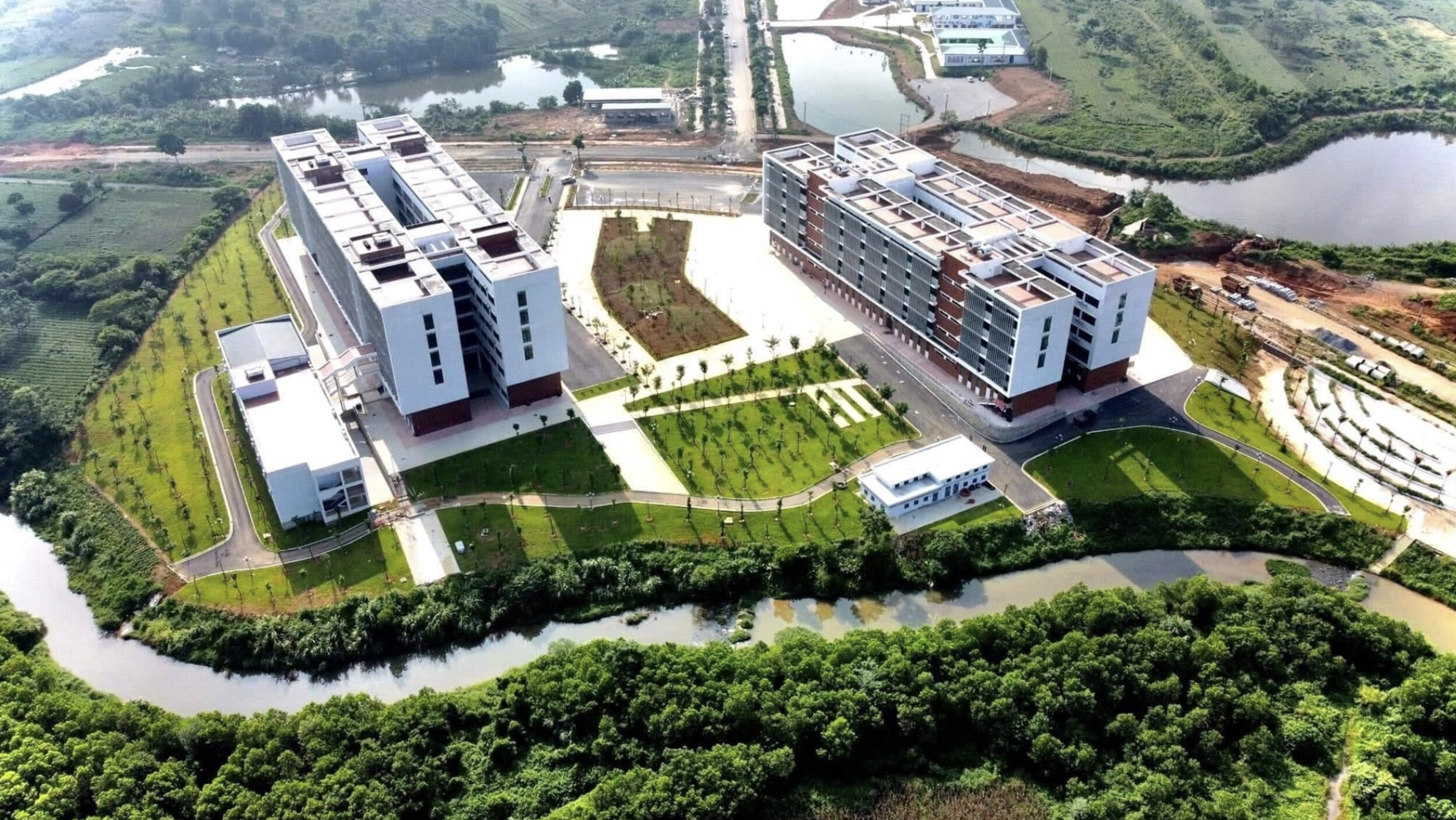 |
A view of Vietnam National University, Hanoi in Hoa Lac. *Photo: VNU*
Duong Tam


