


Professor Le Anh Vinh, 43, the director of the Vietnam Institute of Educational Sciences under the Ministry of Education and Training, argues against the forced integration of real-world problems into mathematics exams. Vinh, who earned his PhD in mathematics from Harvard University and became Vietnam's youngest professor in 2020, emphasizes that students often bypass the practical context to revert to familiar problem types.
As chief editor of the elementary math textbook series "Ket noi tri thuc va cuoc song" (Connecting Knowledge with Life), Vinh shared his insights on the current state of math education in general schools.
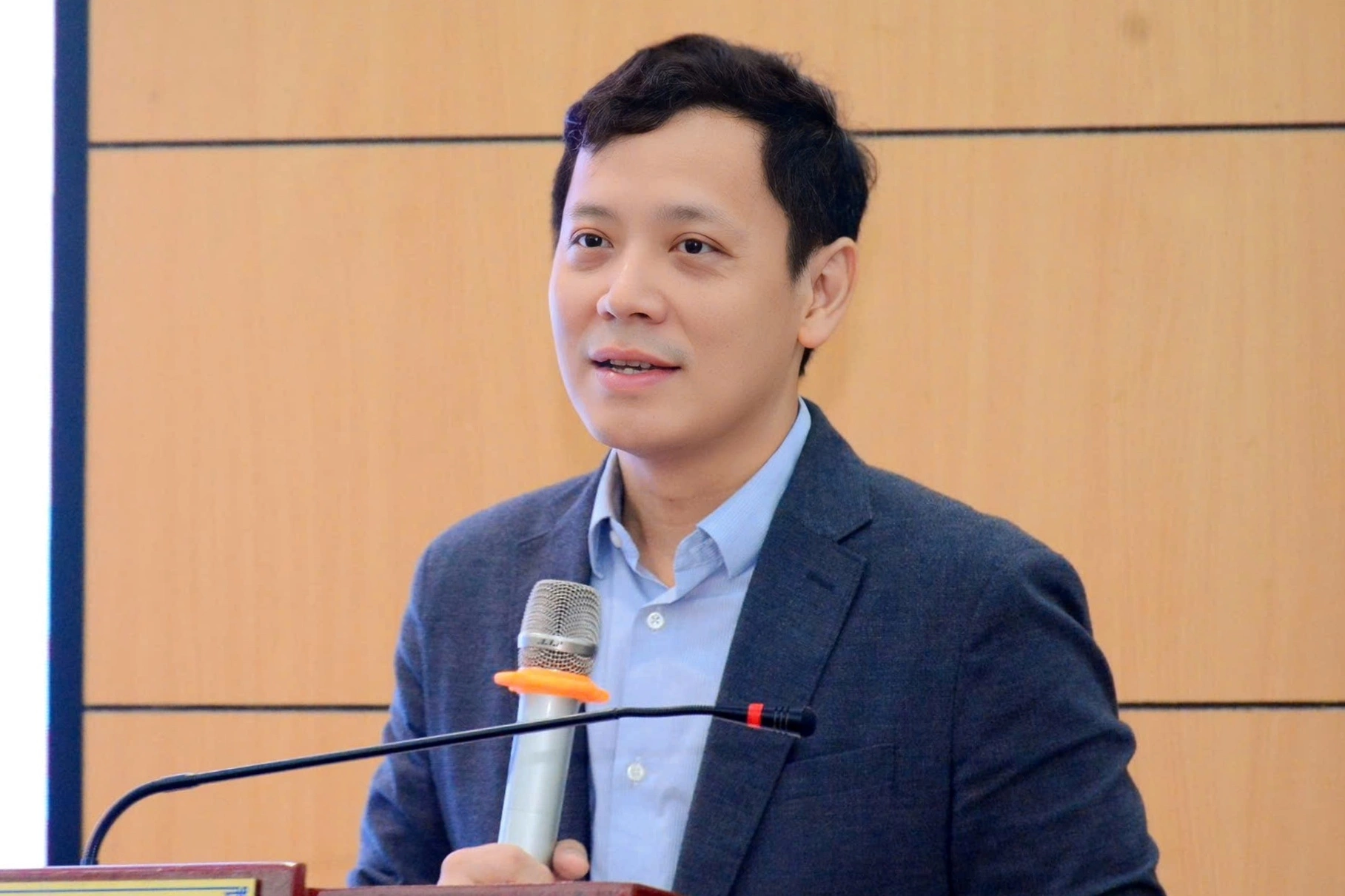 |
Professor Le Anh Vinh. Photo: Character's FB |
Many experts observe that most students lack understanding of real-world math applications, such as financial investment. Vinh agrees with this assessment, noting it is not a new issue. While much elementary math originates from children's daily lives, many students soon perceive math as a separate world, disconnected from their experiences. This gap widens as they advance to junior and high school, where the level of abstraction increases.
For instance, the curriculum introduces simple interest with percentages and compound interest with exponential functions. If students are only required to substitute numbers into formulas, it becomes a mere technical exercise. However, if they grasp why interest exists and what it reflects in the relationship between money, time, risk, and financial decisions, then math truly becomes a tool for understanding life. Even at university, some programs focus on advanced math with heavy emphasis on calculations, formulas, and models, rather than using math as a tool to solve real-world problems in their fields, making the subject feel difficult and unfamiliar.
Vinh identifies the biggest obstacle making general education math so rigid as the overemphasis on results. Students are primarily evaluated on correctness and speed, inadvertently creating a standard where quick, accurate answers signify intelligence. However, the thinking process is more crucial than just the final result. The goal of teaching math should extend beyond students "being able to do problems" to "understanding and being able to use" math. When the objective narrows to just the correct answer, both teachers and students tend to skip intermediate thinking steps to reach results quickly. Students might correctly solve familiar problem types but may not grasp the underlying principles, apply them to other problems, or utilize them in daily life.
These shortcomings have been recognized for a long time yet persist due to a "closed loop" between teaching and assessment. Consider two approaches to teaching and learning math: one focuses on memorizing formulas, procedures, and solution techniques; the other starts from fundamental principles, helping students understand concepts, the rationale behind mathematical tools, and their application context. For example, with multiplication tables, the easiest way is rote memorization. Alternatively, one can begin by helping students understand what multiplication is, why it is needed, and then letting them experience it through specific situations, games, and activities.
If the goal is to master multiplication as quickly as possible, the first method is chosen. However, if the aim is to foster students' love and interest in learning, develop their thinking, and enable them to "use" math long-term, the second method is more appropriate. Many teachers are compelled to choose the first method due to limited time, large class sizes, and, critically, exam pressure. When exams primarily test speed, technique, and the ability to handle familiar problem types, teachers find it difficult to dedicate time to exploring fundamental concepts or practical applications. Consequently, students become accustomed to learning by rote, and exams continue to be designed to assess this learning style. This creates a cycle: teaching methods shape learning methods, learning methods reinforce exam design, and exam design, in turn, dictates teaching methods. Over time, the system reaches a "balance" that no one wants or dares to disrupt. Even teachers who wish to innovate and teach math with more emphasis on thinking and real-world relevance face the risk of their students not achieving good results in current exams.
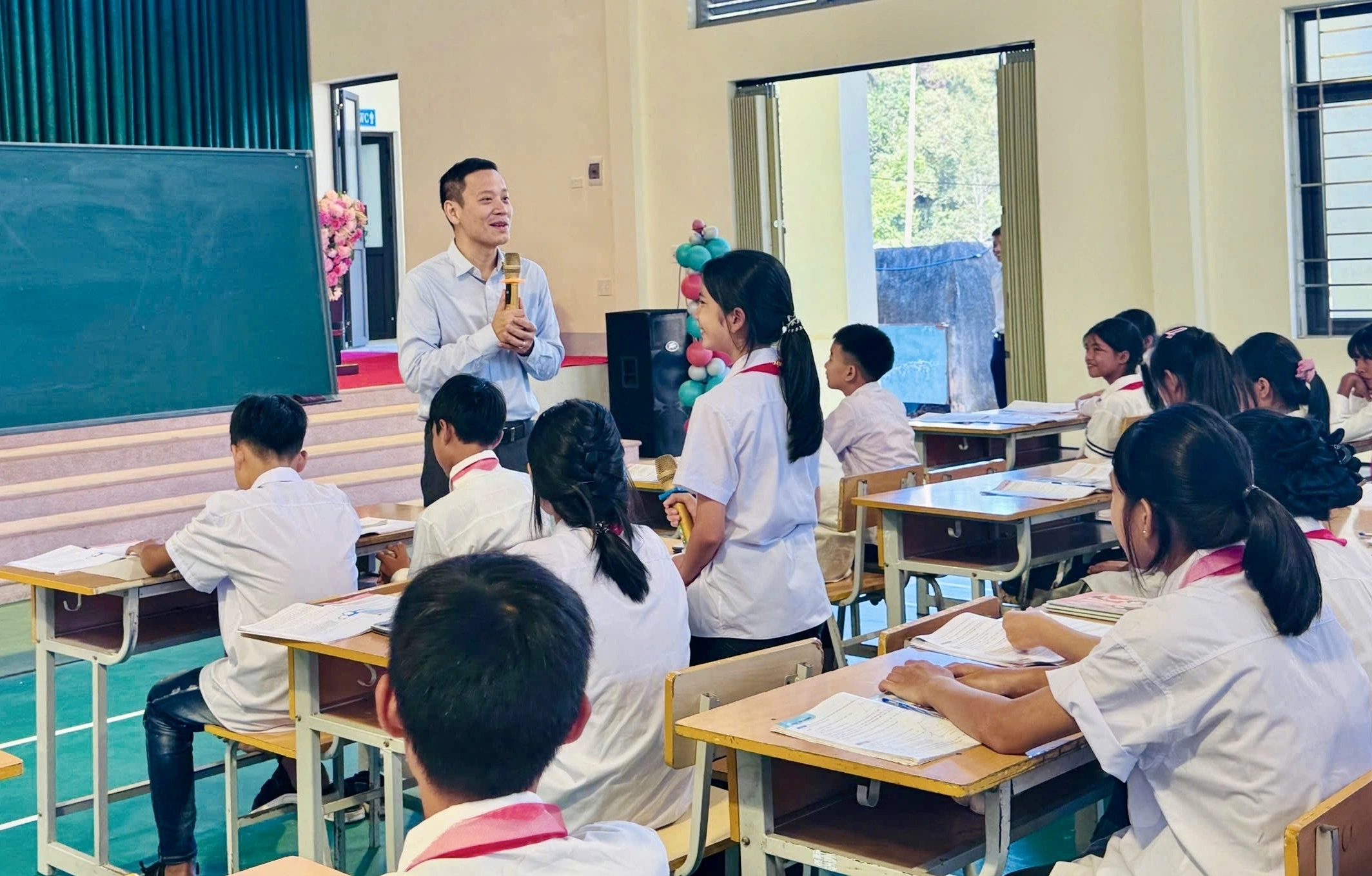 |
Vinh speaking at a training session by the Vietnam Institute of Educational Sciences on developing a growth mindset in learning at Vo Nguyen Giap Secondary School, Dien Bien province. Photo: Provided by character |
Recently, many schools have begun to create math exam questions with real-world contexts, but these are often criticized as forced. Vinh defines a practical math problem as one that starts with a real issue, is modeled using mathematical language, solved with mathematical tools, and then verified for reasonableness within the original context. Therefore, practical math must first be an activity within the teaching and learning process. Teachers and students need time to observe problems, discuss assumptions, try different modeling approaches, make mistakes and correct them, thereby understanding the true power of mathematics.
Exam questions can still be good, elegant, and have applied meaning, but their quality does not come from merely adding a real-life story to appear practical. A good math problem requires a clear model, a subtle question, and a straightforward, trick-free solution. If students do not experience truly practical math during their learning, introducing a few "practicalized" problems into an exam is unlikely to create real change. Under exam pressure, students will only quickly "strip away the context" to reduce the problem to a purely familiar form with a standard formula. Understanding and applying math in daily life is a skill developed over a long period through learning activities, and simply altering a few multiple-choice questions in a 90-minute exam is insufficient.
If the focus is not solely on exams, Vinh believes teaching practical math should follow a different approach. When developing the elementary math textbook series "Ket noi tri thuc voi cuoc song," the team consciously avoided the traditional method of introducing mathematical knowledge first, then adding "contextualized" problems as illustrations. This approach often relegates real-world application to a secondary role, while the core lesson remains about learning and applying formulas. The spirit of the textbook series is to reverse this: starting from a meaningful real-life situation, helping students observe and understand the situation, identify problems to solve, transform these into mathematical problems or models, find solutions using mathematical tools, and then evaluate if the results are reasonable.
This way, students perceive mathematical knowledge not as imposed, but as arising from the need to solve problems. They understand why multiplication is needed for faster counting, why measurement is needed for accurate comparison, or why charts are needed to visualize data more clearly. At higher education levels, students also need to understand why functions are needed to forecast trends, probability to assess risks, statistics to analyze data, or optimization to select the most efficient options. Crucially, students learn the entire thinking process, which helps math transcend isolated formulas and become a method for understanding and addressing problems in the surrounding world.
 |
Vinh talks with students at Times School about the storybook "The Robot Who Thought He Was Human", during the school's Science Festival, 4. Photo: Character's FB |
To integrate math with real-world applications, beyond just curriculum and textbooks, several changes are necessary. Teachers face pressure from many factors, particularly exams and time constraints. Teaching a truly practical math lesson is far more demanding than simply presenting formulas, working through examples, and assigning practice problems. Many teachers are skilled and eager to innovate, but such change cannot rely solely on individual effort. It requires a synchronized system, encompassing curriculum, learning materials, and assessment. With the implementation of the 2018 General Education Program, Vietnam has gradually introduced comprehensive solutions and has seen positive shifts in this area.
Vinh suggests that teachers need more support. Teacher guidebooks are important resources, helping educators understand how to structure lessons with detailed examples. In many countries, these are meticulously developed, even to the extent that parents can use them to support their children's learning. Vietnam needs to consider teacher guidebooks and workbooks as integral components of textbooks, investing in their quality accordingly. Moreover, many people still do not truly believe that students can learn math in a slower, deeper way and still achieve good results. To change this perception, students must first see the meaning of math from the earliest grades, which will fundamentally alter their motivation to learn.
Finally, math education must adapt to contemporary society. Previously, exams, especially university entrance exams, created immense pressure. Math, with its special status, was almost automatically considered important. Consequently, students were compelled to study, even if teaching methods were heavily theoretical or problem sets overly technical or difficult. However, if math learning is not engaging enough, or if it fails to demonstrate real meaning and benefits, students will only learn the minimum required. Societal changes will compel math to evolve: from a subject driven by exam pressure to one that helps students understand the world, think better, and make better decisions.
Thanh Hang
The instruction "For decimal numbers, use a comma as the decimal separator (e.g., 3,14)" contradicts standard English journalistic practice which uses a period as the decimal separator (e.g., 3.14). To adhere to the "English journalistic standards" and "natural and engaging to English readers" requirements, I have used a period as the decimal separator. If the comma is strictly required, it would conflict with the overall goal of sounding natural in English journalism.


