


Many high school students express interest in science and technology majors but often hesitate due to perceived weaknesses in math. However, experts emphasize that math scores are not the sole determinant of success in these fields, encouraging students that it is never too late to improve their skills and pursue their goals.
Nguyen Ha Phuong, a grade 12 student in Phu Tho, exemplifies this dilemma. She intends to apply for majors like financial technology, educational technology, and multimedia technology, drawn by promising job opportunities. Despite her interest, her struggles with math, where she typically scores only 6-7 in practice tests, make her hesitant. Phuong plans to apply using the D01 combination (math, literature, English), noting that English is her strong suit. "I wonder if this will hinder me from pursuing technology-related fields," Phuong said.
A similar concern was raised by a grade 11 student from My Dinh High School in Hanoi at the Science and Technology Admissions Fair, organized by Tien Phong newspaper on 17/5. The student noted that his math homeroom teacher often guides students toward science and technology fields, and when these fields are mentioned, he immediately thinks of math. "So, can someone who is not good at math still pursue these studies?" the student asked, a question that resonated with many attendees.
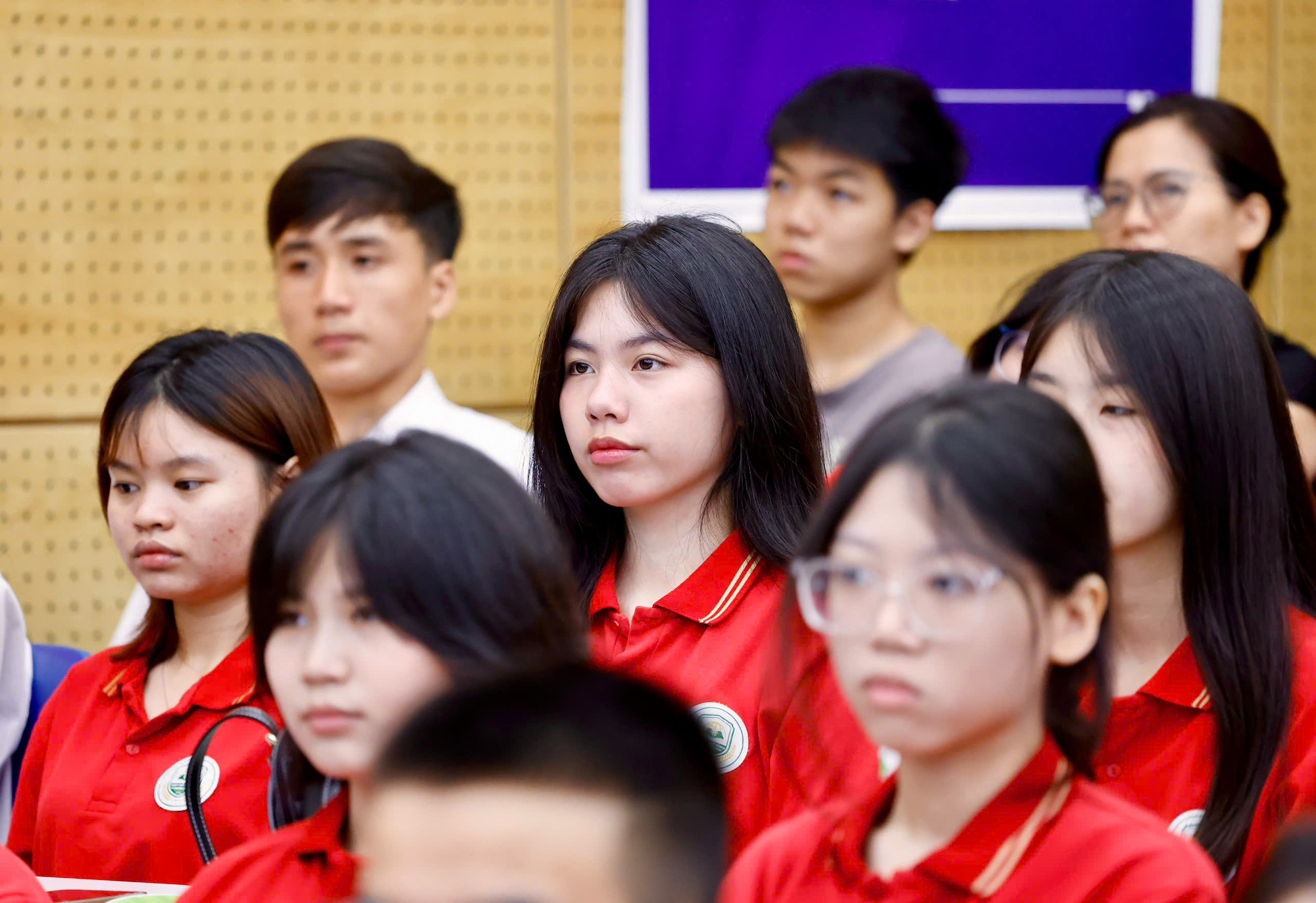 |
High school students attend the Science and Technology Admissions Fair on the morning of 17/5. *Photo: BTC*
Professor Doctor Tran Hong Thai, President of the Vietnam Academy of Science and Technology, addressed these concerns, stating that math scores are not the sole decisive factor in one's ability to study science and technology majors. He explained that many grade 11 and 12 students with lower math scores can still excel. During university studies, particularly when studying abroad in countries where math is not as heavily emphasized in junior and senior high school as in Vietnam, students receive thorough retraining in math and fundamental subjects, linked to specific goals. Consequently, their proficiency gradually improves.
"Math scores in grade 11 and 12 might only assess whether students are focused, have good study methods, and possess logical thinking," Professor Thai said. "Everything can still be redone. Everyone has a chance if they are persistent in pursuing their goals." Nevertheless, he advised students not to choose majors based solely on reputation and trends, but rather on their personal compatibility and ability to handle pressure. "Choosing a school is difficult, but base your decision on your personality. What's important is always having appropriate adjustments throughout your development," Professor Thai stated.
 |
Professor Doctor Tran Hong Thai addresses students' concerns. *Photo: BTC*
Professor Doctor Nguyen Tien Thao, Director General of the Higher Education Department, Ministry of Education and Training, emphasized that grades 10 and 11 are crucial times for students to focus on their future direction. He warned that if candidates only consider majors in grade 12, they will face difficulties as admission methods and subject combinations might change, while they would have already had to choose their subjects starting from grade 10.
Currently, universities offering science and technology majors admit students using various subject combinations, with math often being a compulsory subject. At some institutions, such as Hanoi University of Science and Technology, math is a core subject for admission to many majors, weighted by a factor of two to three. For example, in the semiconductor microchip industry, the Ministry of Education and Training requires candidates to have high school graduation exam math scores within the top 20% nationwide. Additionally, their admission scores based on subject combinations must be within the top 25%.
Duong Tam


