


On 14/5, PTIT announced that its Hanoi campus will enroll students in six new training programs this year. These include: innovation management and entrepreneurship, low-altitude logistics in the economy, digital cultural industry technology (film-oriented), game graphic design, aerospace communication engineering, and unmanned aerial vehicles (UAVs) and autonomous mobile robots. Each program has an enrollment quota of 50 students.
Admission to these programs will be through five methods: talent-based admission, scores from SAT or ACT certificates, competency and critical thinking assessment scores from Vietnam National University and Hanoi University of Science and Technology, a combination of international English certificates and academic transcripts, and high school graduation exam scores.
The Posts and Telecommunications Institute of Technology views these as pioneering training directions in Vietnam. They align with strategic technology fields and the digital cultural industry — areas prioritized in national science and technology development, innovation, and digital transformation.
For example, low-altitude logistics in the economy is rapidly expanding as many countries begin commercializing drone delivery, autonomous transport, and urban airspace management. In Vietnam, experts predict this could be a high-potential new profession within the next 5 to 10 years.
The UAV and autonomous mobile robot program focuses on navigation and coordinated control systems for unmanned vehicles, meeting the human resource demands of smart cities and automated economies.
"This demonstrates PTIT's clear direction in shifting from traditional technology training models to strategic, interdisciplinary, and future technology fields," a PTIT representative stated.
PTIT's enrollment targets for each major in 2026.
PTIT stands as a key national higher education institution for engineering and technology, aiming to become a high-quality human resource training center for national digital transformation and innovation.
The institution was also among the first to offer training in multimedia technology, financial technology, and game design and development.
In 2026, the Posts and Telecommunications Institute of Technology will enroll nearly 8,000 students across its Hanoi and TP HCM campuses. Tuition for the upcoming academic year is projected to average from 35,9 to 67,2 million VND, depending on the major and program. The majority of these are general programs, with tuition ranging from 35,9 to 40,7 million VND.
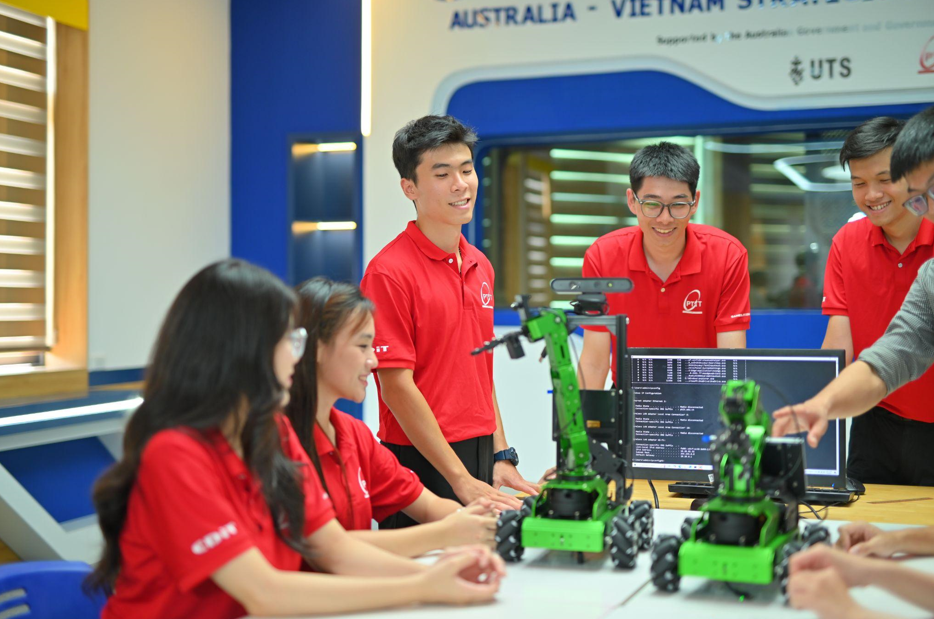 |
Students of the Posts and Telecommunications Institute of Technology in the Australia-Vietnam strategic technology research lab. Photo: *PTIT*. |
Duong Tam


