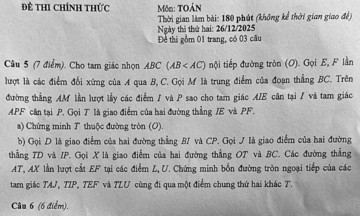
This year's national math Olympiad exam has sparked widespread disappointment among experts and educators, with many deeming its quality to be low and its structure unsuited for identifying top mathematical talent. The controversy centers on the inclusion of "unrealistic" physics elements and a perceived lack of depth in the questions.
The national student excellent exam took place on 25-26/12, with nearly 680 candidates taking the math test. The exam consisted of 7 problems, with a total time of 360 minutes over two days, and a maximum score of 40.
Tran Nam Dung, Vice Principal of the Gifted High School, Vietnam National University, Ho Chi Minh City, noted the exam's structure deviated from the typical six problems seen in previous years and at the International Mathematical Olympiad (IMO). He found the exam relatively easy, with only problem 7 presenting a medium level of difficulty.
However, Nguyen Song Minh, an experienced national excellent student coach in Hanoi, described this year's exam as "extremely disappointing." This sentiment was echoed by another math coach for specialized schools in the Northern region. On various math forums, the national student excellent exam attracted an unusual surge in interaction, with the majority of comments pointing to the low professional quality of the questions.
A key point of contention was question 2, worth 5 points, which involved satellite coordinates and was criticized for forcing real-world elements into the problem. The question provided information on using satellites for space exploration, asking candidates to calculate the distance between two points on a coordinate axis. However, Nguyen Song Minh argued that the physics element was "unrealistic," as the given data would imply the satellite would crash into Earth.
Another IMO preparation expert observed that this problem was heavily focused on physics simulation with minimal mathematical structure. Despite its context of "satellite - observation - minimum distance," its essence was merely optimizing the distance from a point to an ellipse in space. "I understand the intention to incorporate real-world math, but this goes against the spirit of the IMO," Nguyen Song Minh stated. "Lengthy descriptions only create linguistic noise, confusing students. Mathematics should be expressed clearly and concisely."
The "real-world" element also appeared in question 7, which referenced the game character Mario. While Nguyen Song Minh found the premise of a person jumping 6 or 14 meters to be "inadequate," he still considered this problem the "most stable" in terms of its mathematical content and difficulty. Overall, there was a consensus that question 2 was the "worst problem on the exam."
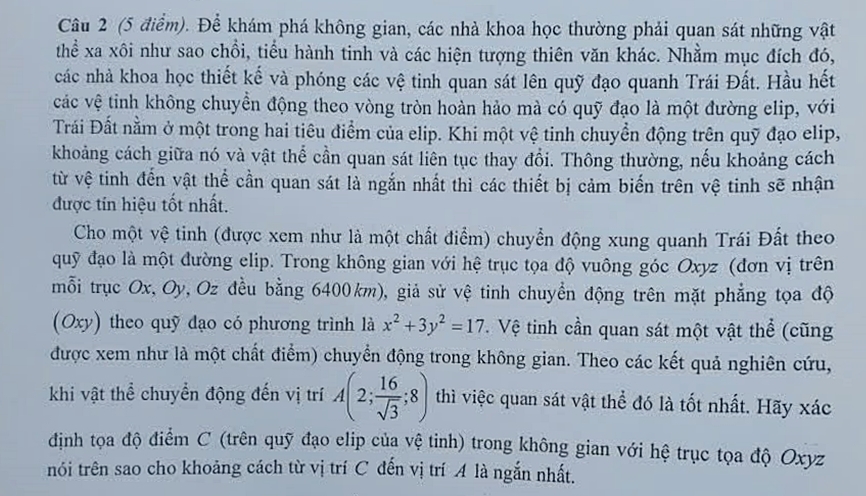 |
Question 2, worth 5 points, from the 2025 national math Olympiad exam.
Many teachers also criticized the exam for being "superficial in knowledge," citing unclear requirements or the reuse of material from international problems. A math team coach from a specialized school in the Northern region pointed out that question 3 was an old arithmetic problem from the junior high curriculum, which had previously appeared in the 2002 Saint Petersburg city exam in Russia. "Even if it's just using existing material, reusing old problems poses a risk of unfairness to candidates," he said. Question 4 also drew criticism for its convoluted phrasing, presenting a triplet of numbers (x, y, z) but then asking for proofs involving (a, b, c, d).
 |
Ultimately, educators expressed concerns that the exam structure risks overlooking truly gifted students. "I call this an exam that eliminates excellent students," Nguyen Song Minh remarked, referencing problem 2. He explained that while the problem itself was not difficult, it fell outside the typical curriculum for national and international Olympiad preparation.
Tran Nam Dung added that problem 2, framed as spatial analytic geometry, resembled a high-level problem from a high school graduation exam more than an Olympiad challenge. Consequently, 10th and 11th-grade students, despite their potential and aspirations for international math competitions, could easily lose points because they had not yet covered such topics. Another specialized school team coach shared this concern, worrying that students adept at problem-solving would be eliminated at the national round, while those accustomed to solving exercises would have an advantage. "This is detrimental and inappropriate for our goal of identifying talent to represent Vietnam at the IMO," he stated.
Offering a slightly more optimistic perspective, the aforementioned IMO preparation teacher acknowledged that the exam was still challenging enough for differentiation. However, he questioned whether it adequately reflected "IMO-style" mathematical ability or was "up to par" for selecting talent for the prestigious competition.
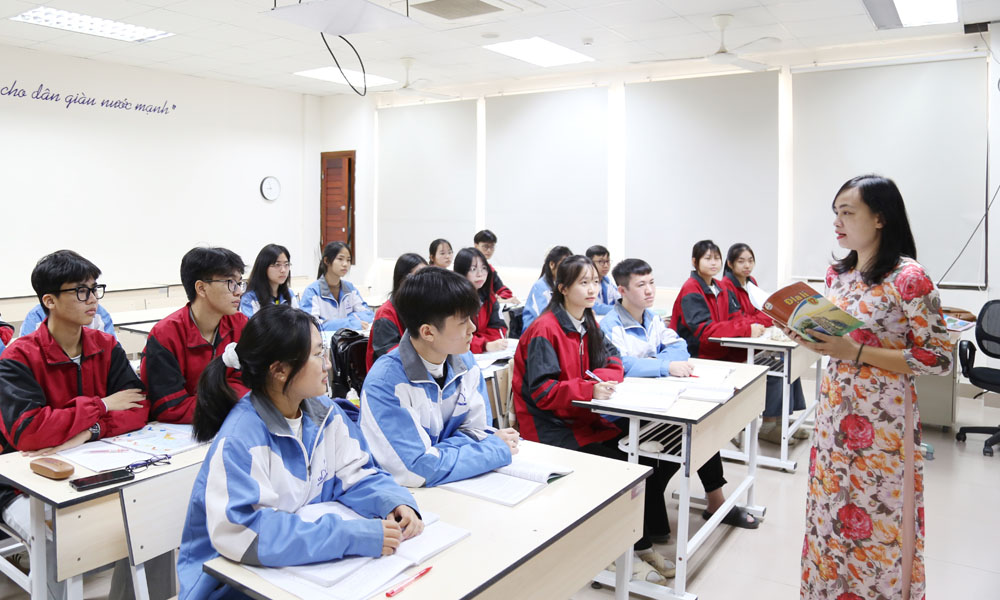 |
Students in Bac Ninh preparing for the 2025 national student exam. Illustration: Bac Ninh Newspaper
Educators urged the Ministry of Education and Training to adopt an exam structure similar to the IMO, comprising six problems over two days. They suggested that each exam should include at least one "standard IMO" problem, such as pure geometry or clearly structured algebra. They also recommended limiting or eliminating science-physics simulation problems, emphasizing that "context should merely serve, not dominate mathematical thinking." Furthermore, many hoped the Ministry would engage experts and mathematicians experienced in international exam development and IMO team coaching to ensure alignment between domestic and global standards.
Results of the national student excellent exam are typically announced in mid-January. Approximately 40 students with the highest scores will proceed to round 2 to select the team for the IMO, scheduled for July.
By Thanh Hang