The Ministry of Education and Training announced a draft standard for doctoral training programs in the semiconductor microchip field on the afternoon of 26/12.
Professor Doctor Chu Duc Trinh, head of the drafting committee and rector of the University of Technology, Vietnam National University, Hanoi, stated that doctoral candidates in this field must dedicate all their time to studying and researching at the university, participating in scientific projects. In return, they will receive tuition fee waivers, scholarships, living allowances, and research funding.
"Doctoral candidates must be prepared to sacrifice about three years of employment to fully concentrate on their studies. This approach has been thoroughly implemented in the US and Nordic countries," Trinh noted. For example, a lecturer at university A pursuing doctoral studies at university B would need to temporarily suspend their work. The same applies to employees in other organizations and businesses.
The University of Technology has already implemented this mechanism, offering tuition fee exemptions and a monthly living allowance of 7 million dong. For excellent research outcomes, the payment can increase to 9-12 million dong.
Trinh explained that these conditions and standards align with the quality of doctoral training in the US, Japan, and Europe, thus exceeding current general standards in Vietnam. If successful, this initiative will represent a significant leap in higher education quality.
 |
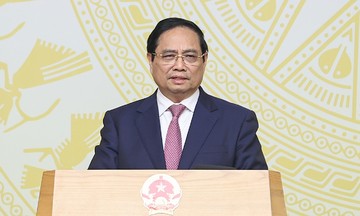
Professor Doctor Chu Duc Trinh provided information on the draft standard for doctoral training programs in the semiconductor microchip field on the afternoon of 26/12. Photo: Le Nguyen. |
Regarding admission standards, prospective doctoral candidates are expected to hold an excellent bachelor's or master's degree in a field relevant to semiconductor microchips, possess research experience, and achieve a foreign language proficiency of level 4/6 (equivalent to B2).
For graduation, they must meet knowledge and skill standards and publish at least two scientific articles on semiconductor microchips in international journals listed in ISI/Scopus, with a preference for Q1 and Q2 groups (the most prestigious).
"Doctoral training in semiconductors must be linked to scientific innovations with global significance," Trinh observed.
Training institutions may only admit doctoral candidates if they have scientific projects relevant to the semiconductor microchip field and guaranteed financial resources. The criteria for determining this will be discussed in more detail during the draft's public consultation process.
According to Trinh, the standards outlined in the draft are not mandatory for all higher education institutions. However, participating universities will receive prioritized state investment and be assigned research projects related to semiconductor microchips.
The total number of doctoral admission quotas nationwide is approximately 5,000-7,000 annually, but typically no more than 50% are filled, according to statistics from the Ministry of Education and Training.
At the undergraduate level, this year over 137,200 students were admitted to 38 training programs related to the semiconductor microchip field.
Le Nguyen