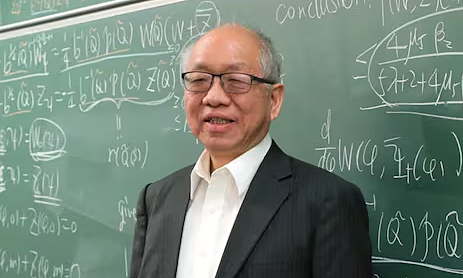
According to an announcement by Hanoi Medical University last weekend, Nguyen Duc Anh Quan scored 24,91 out of 30 points. This is considered the university's most rigorous exam, designed to select top talents for a specialized, elite medical program. Each doctor is only allowed to take this exam once in their lifetime.
The exam's intensity is also due to the fact that a candidate's score ranking determines their opportunity to choose a specialty; higher-scoring candidates select first until all quotas are filled.
"Because of this, I aimed for the top 30-50, so becoming the top scorer truly surprised me," the 24-year-old shared.
Previously, he graduated with high honors in Medicine from the same university, achieving a GPA of 8,21/10 and ranking 17th in his cohort.
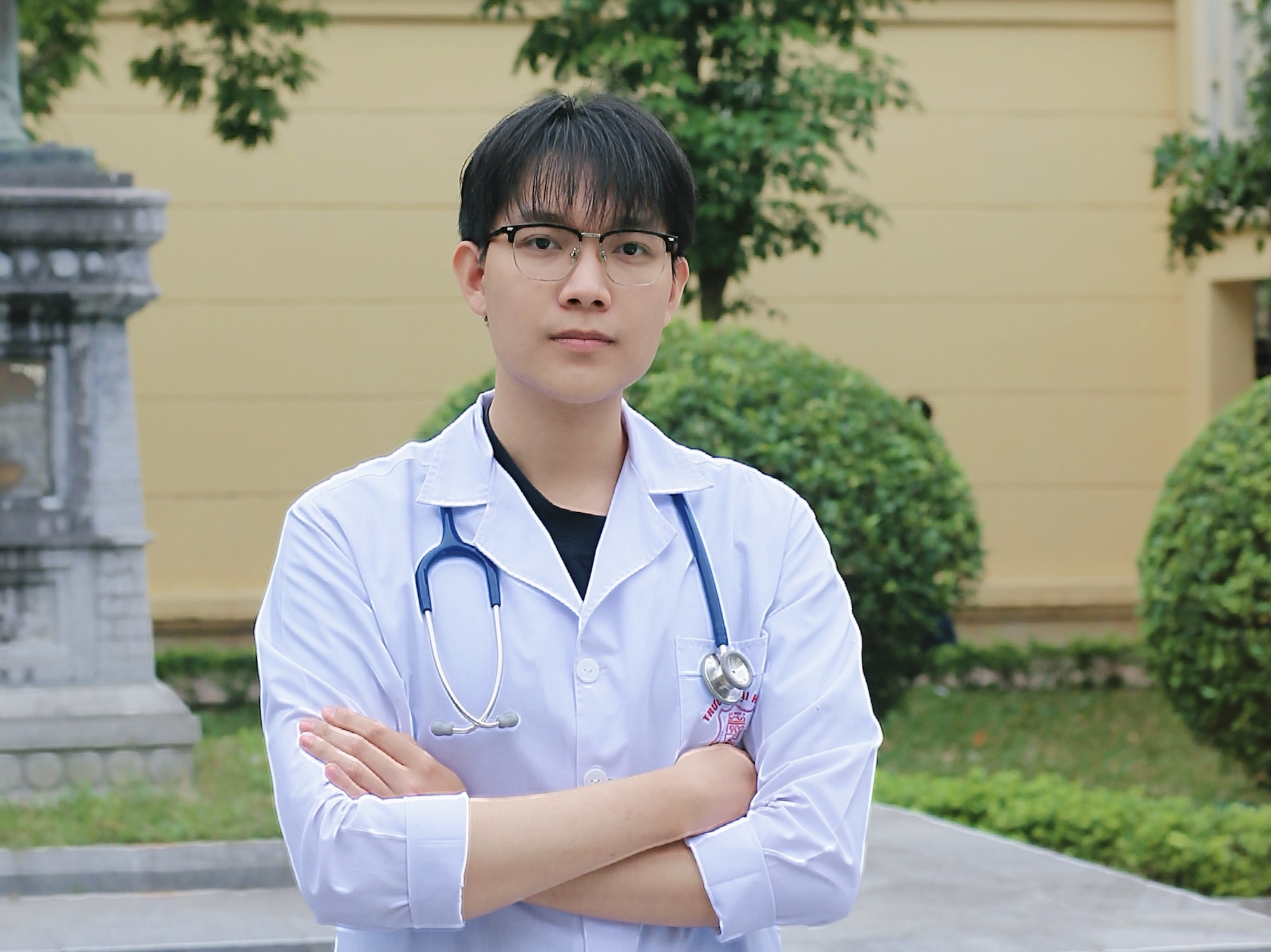 |
Nguyen Duc Anh Quan, the top scorer in the resident doctor exam for Medicine at Hanoi Medical University, 2026. Photo: Provided by subject
Quan excelled in mathematics, winning first prize in Nghia An province in 9th grade. Despite this, he opted not to enroll in Phan Boi Chau High School for the Gifted due to its distance from home, choosing instead Anh Son 1 High School in the mountainous region. In 11th grade, Quan earned third prize in mathematics.
In the 2020 high school graduation exam, he was the second-highest scorer in Block B00 (Mathematics, Chemistry, Biology) for Nghia An with 29,4 points. His mathematics score was 9,4, while the other two subjects were perfect 10s.
Driven by a childhood aspiration to become a doctor, inspired by how "impressive" they seemed, Quan chose the Medicine program at Hanoi Medical University. From his first days at the university, he recognized it as an "immense repository of knowledge" and resolved to pursue a resident doctor position after graduation.
To achieve his goal, Quan realized the importance of proactive learning and in-depth knowledge acquisition. Beyond reading textbooks in advance, he challenged himself with a series of "why" questions and sought answers. To ensure no lingering doubts, Quan delved into domestic and international research papers and other materials.
He also prioritized maintaining his health, typically not studying past 23h, even while tutoring mathematics. From his fourth year, the pressure increased as Quan began clinical rotations at the hospital each morning, attended theoretical classes at the university in the afternoons, and had to be on call one to two nights per week.
The young man from Nghia An still recalls his first on-call shift, during which he participated in resuscitating a patient with circulatory arrest under the guidance of senior doctors.
"That moment, combined with the professional anecdotes shared by the rector during Anesthesia and Resuscitation classes and university events, further motivated my studies," Quan stated.
During his final two years, he gained extensive knowledge through clinical training, especially during oral exams. The more questions his professors asked, and the more challenging they were, the more enthusiastic Quan became, as it allowed him to identify and improve his weaknesses.
For Quan, the resident doctor exam felt like "a long-distance race," requiring consistent effort from the beginning rather than scrambling at the last minute. This is because it encompasses knowledge from six years of medical school, covering numerous subjects from anatomy, physiology, biochemistry, and medical genetics to internal medicine, surgery, obstetrics, pediatrics, and various minor specialties like dermatology and psychiatry.
He believes that his consistent focus on studying from the outset prevented him from struggling during the final stretch. In the two months leading up to the exam, Quan studied approximately 10-12 hours daily while still getting eight hours of sleep.
Regarding the exam, Quan found it challenging, with many new questions compared to previous years. This cohort was the second to follow Hanoi Medical University's revised curriculum. Teaching and assessment methods have also been updated to cultivate a generation of doctors with enhanced professional capabilities.
"The multiple-choice questions were difficult because the options were very similar; a mistake in one question could easily lead to two to three subsequent errors," Quan recounted. This demanded critical thinking from candidates and speed, as each exam contained 120 questions to be completed in 90 minutes.
The resident doctor specialty selection: A unique feature of Hanoi Medical University
As the first person called on "Match Day" – the resident doctor specialty selection day on 9/9 – Quan has not yet finalized his chosen path.
"I want to explore it one more time before making a decision," the new doctor said.
Duong Tam