A survey by Nguyen Du High School in Bac Ninh province revealed that only 4% of students chose natural science subjects, marking a continued decline and half the rate of last year. Students overwhelmingly selected social science subjects, including history, geography, economic and legal education, and english.
"This presents a significant challenge for many schools," stated Principal Do Quyet Thang.
At Vinh Xuan High School in Vinh Long province, approximately 40% of students chose natural science subjects. Cho Gao High School in Dong Thap province also observed a clear shift in student preferences. Principal Nguyen Phuc Vien noted that previously, about 80-90% of the school's students pursued natural science combinations, but this figure has decreased to 60-70% in recent two years.
At a local level, Da Nang estimates over 31,500 students will take the 2026 high school graduation exam. Among elective subjects, physics was the most registered, with about 13,600 students (43%), followed by english at 37%. History and chemistry ranked immediately after, at 32% and 25% respectively.
Biology, informatics, and technology were the least chosen, accounting for only 0,5-5%.
Since the graduation exam allowed students to choose subject combinations in 2017, the number of candidates opting for natural science subjects has never exceeded those choosing social sciences. Notably, in 2024, the proportion of students selecting natural sciences was 37%—the lowest recorded.
Last year, during the first exam under the new curriculum, many schools reported this rate dropped to just 20-30%. Nationally, the group choosing subjects like chemistry, biology, informatics, and others also remained less popular, leading to concerns among B00 block universities about a potential shortage of applicants.
"We are witnessing a mass exodus from natural science subjects," assessed Doctor Dang Van Son, a STEM (science, technology, engineering, and mathematics) education expert and lecturer at the University of Natural Sciences, Vietnam National University, Hanoi.
Last week, at a STEM education workshop, Mr. Thai Van Tai, Director of the Department of General Education, Ministry of Education and Training, expressed concern over the 60-65% of students choosing social science subjects. He viewed this as a major challenge for the education sector, especially as the country requires high-quality human resources in science and technology fields, which are fundamentally rooted in natural science subjects.
Experts identify two primary reasons for students gravitating towards social science subjects.
The first is a desire for safety. Teacher Nguyen Phuc Vien observed that many students choose english as one of their two elective subjects for the graduation exam, combining it with mathematics and literature to form D01—a popular combination for university admissions. For their remaining choice, students often opt for "easier" subjects to reduce pressure, typically economic and legal education or geography.
Concurring, Doctor Dang Van Son noted that natural sciences demand a foundation of logical thinking, complex calculations, and long-term accumulation of knowledge. In contrast, social science subjects, while still requiring understanding, are often perceived as easier to achieve "safe" scores for graduation.
The second reason stems from the curriculum structure, according to Mr. Son. He argued that the inclusion of history as a compulsory subject has attracted students. Believing they have "already invested time studying it," students often choose history for the graduation exam, combining it with geography or economic and legal education to form a pair of social science subjects.
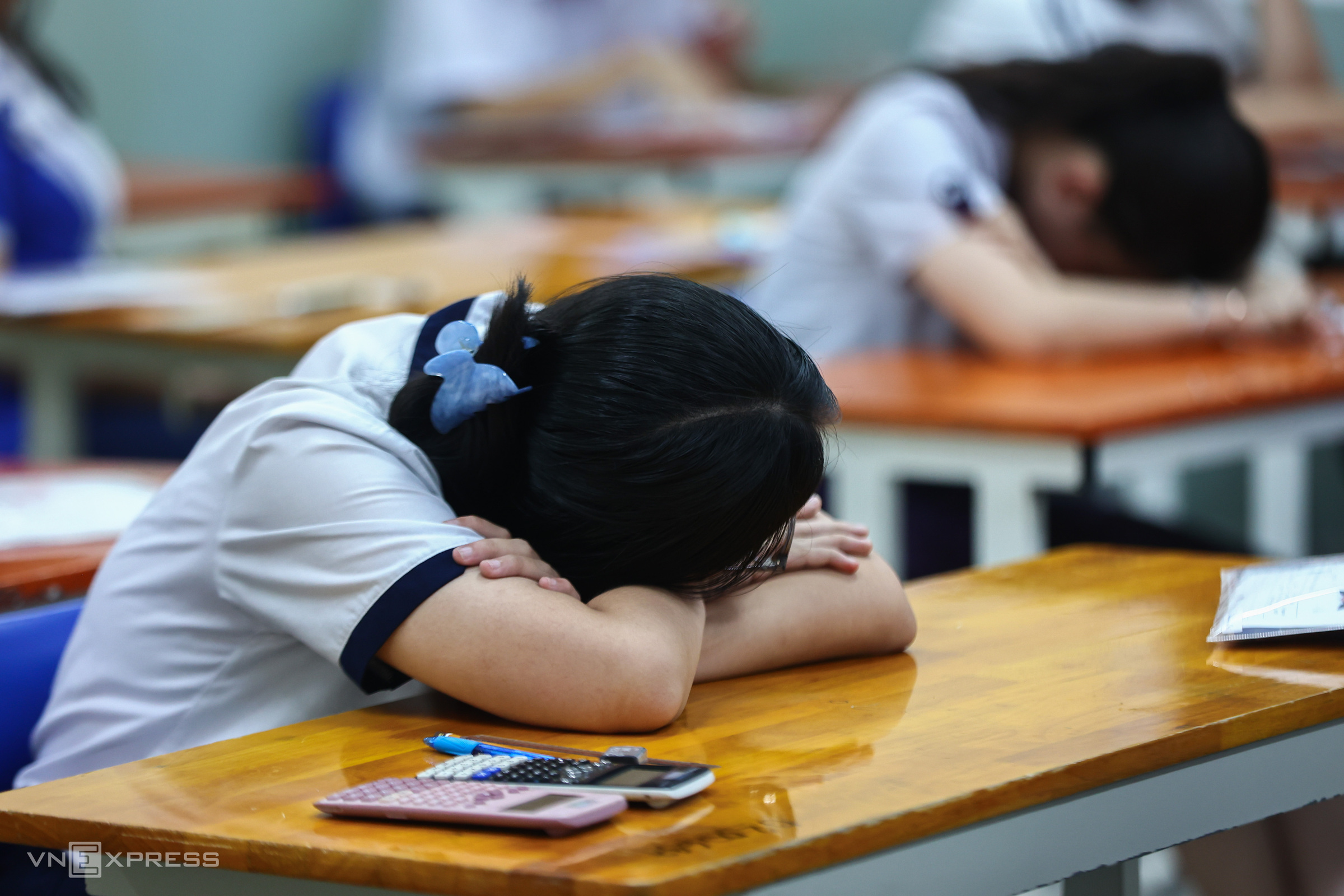 |
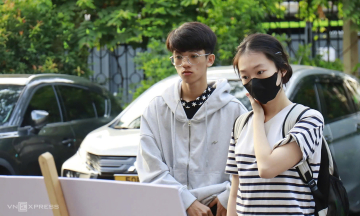
Students in Ho Chi Minh City taking the 2025 high school graduation exam. Photo: Quynh Tran
To increase the number of students choosing natural sciences, a leader from a Department of Education and Training in the Mekong Delta region suggested inspiring a love for science among students starting from junior high. He noted that the process of selecting graduation exam subjects effectively begins when students enter grade 10, the point at which they choose their subject combinations.
"It is difficult for a student who has studied geography and economic and legal education for three years to then switch to taking physics or chemistry exams," he remarked.
Therefore, junior high schools must excel in career orientation. According to the leader, students in grades 8-9 need to be informed about and analyze development trends and the country's human resource needs over the next 5-10 years. This would help them identify high-potential, high-paying careers and understand which subjects are necessary to pursue those fields.
Doctor Son emphasized the need to foster a love for science in students through more effective and practical STEM education. He believes the education sector requires a "sustainable STEM ecosystem" with strong participation not only from high schools but also from universities and businesses.
"When this system operates smoothly, subjects like physics, chemistry, biology, mathematics, informatics, and technology will no longer be viewed as 'nightmares'. They will return to their true nature, serving as a lens through which the younger generation can explore the world," Doctor Son stated.
Thanh Hang - Le Nguyen