GS Huynh Van Chuong, Director of the Quality Management Department, Ministry of Education and Training (MOET), stated on 28/7 that the Ministry submitted a proposal to the Prime Minister for organizing the computer-based high school graduation exam from 2026 to 2036.
Computer-based exams will be implemented gradually, only in localities and test centers that meet the necessary facility, technical infrastructure, and personnel requirements; implementation will not be simultaneous.
In 2027, some candidates are expected to take the exam on computers, while others will use paper. This marks a transitional phase. The exam's organization will ensure equivalent assessment and result validity.
"Candidates taking the exam on computers and on paper will use common exam content for multiple-choice subjects, differing mainly in the method of taking the exam and recording results," Chuong said.
The Ministry will evaluate and refine the system before considering expansion, prioritizing safety and fairness over speed.
The Ministry also plans to organize the computer-based high school graduation exam in multiple sessions. Exam questions for these sessions will not be identical but will be equivalent in content, difficulty, and measurement. This equivalence will be ensured through a standardized question bank, practical trials, and scientific psychometric methods. This approach ensures candidates face no advantage or disadvantage due to their specific exam session.
Exam questions will be transmitted via a secure channel from the Government Cipher Committee to servers at test centers. Candidates will take the exam on an internal local area network (LAN), without an internet connection. This model limits the exam's reliance on internet connectivity and the risk of direct cyberattacks, Chuong noted.
"A key direction is to apply technology to automate processes, minimize errors, and limit subjective human intervention," he stated.
Technologies to be researched and applied will focus on data security, automating exam organization, system monitoring, scoring, and using artificial intelligence (AI) to support question bank development.
The Ministry previously piloted computer-based exams from late 2024. Two months ago, this initiative expanded to 15 provinces and cities, involving over 36,000 candidates. Initial results show stable system operation, suggesting feasibility under Vietnam's conditions.
Chuong emphasized that transitioning from paper-based to computer-based exams is an innovation in method, not a change in the objective of assessing general education program outcomes.
The Ministry will collaborate with localities and schools to provide free practice tools, enabling students to familiarize themselves before the exam.
 |
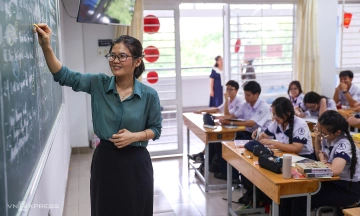
Candidate taking the 2026 high school graduation exam in Ho Chi Minh City. Photo: Thanh Tung
Duong Tam