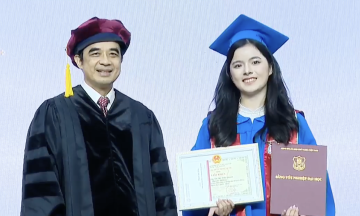
Nguyen Minh Hien, from Bac Ninh, graduated with an information technology degree from the University of Technology, Vietnam National University, Hanoi, achieving a grade point average of 3.93/4. He was one of the three valedictorians for the university in this June's graduation ceremony.
"This is a memorable milestone in my life", Hien said, attributing his success to continuous learning and experimentation.
Previously a math major at Bac Ninh High School for the Gifted and a second national prize winner in informatics, Hien entered university with a strong foundational mindset. However, a turning point came in his second year when he joined a research group and discovered the interesting intersection between information technology and biology, a subject he had loved since middle school.
"Bioinformatics showed me how programming, algorithms, and artificial intelligence can support the analysis of complex biological data, particularly in cancer research and precision medicine", Hien said. "This research direction is timely and holds significant development potential".
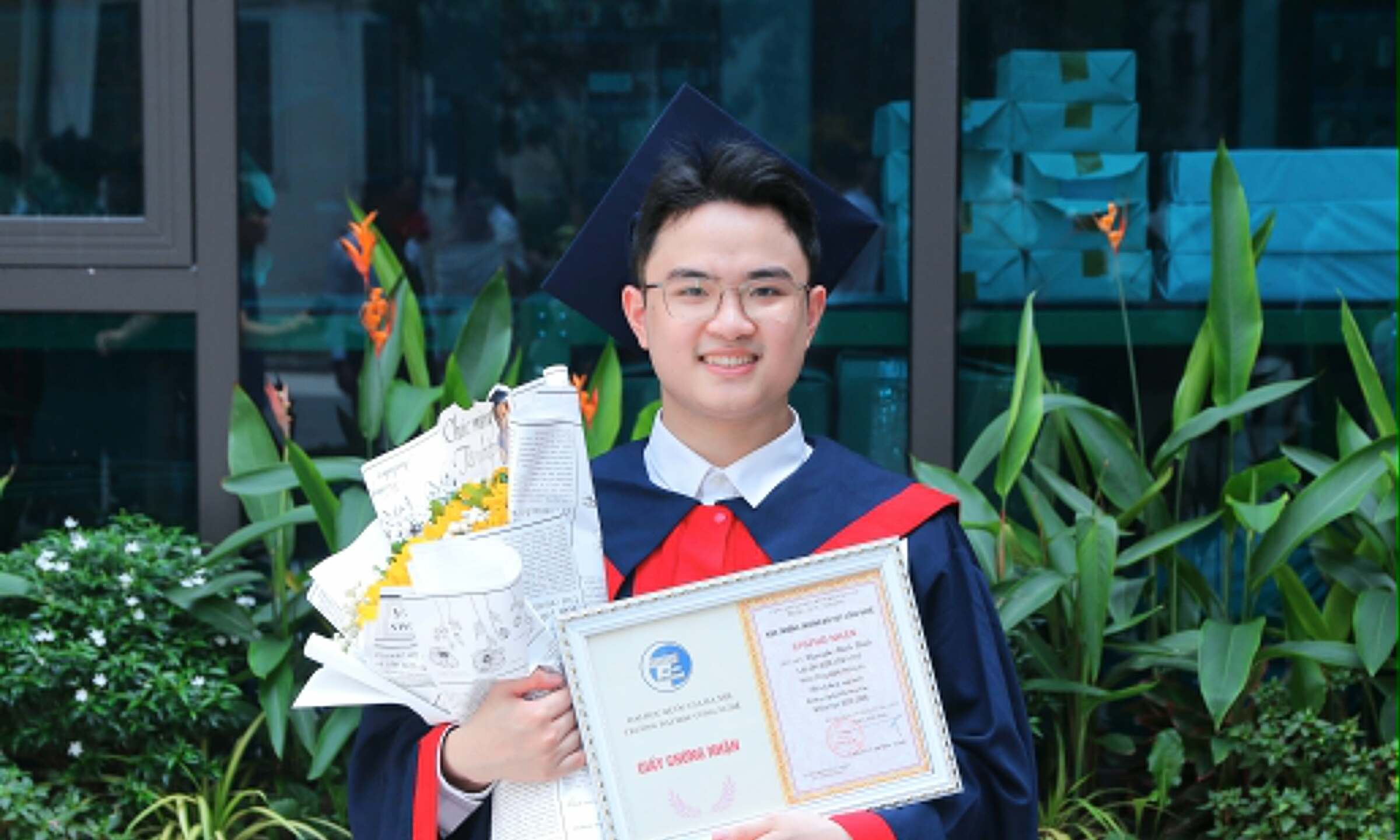 |
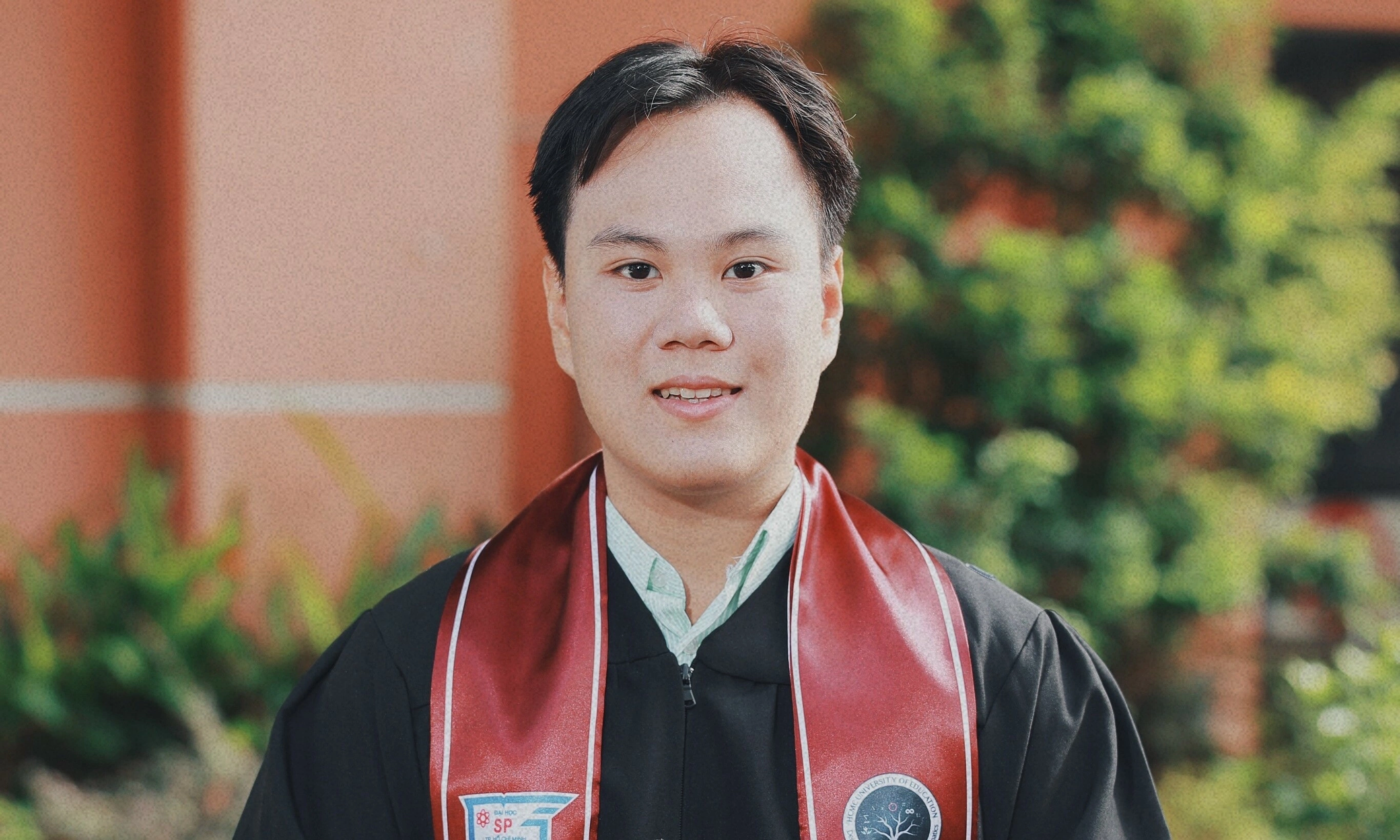
Minh Hien at the graduation ceremony at the university on 5/7. Photo: Provided by interviewee
Initially, Hien faced difficulties in his research, finding previous scientific papers "harder to understand than he anticipated". Many implementation details and small parameters were not fully presented, complicating experiment reproduction.
His group members helped him understand the source code, implement, and adjust experiments related to breast cancer data analysis. Hien also deepened his knowledge of algorithms, machine learning, and biomedical data analysis methods. For areas he didn't understand, Hien consulted international literature and discussed with lecturers and senior group members to refine his approach.
Hien likens learning to playing a long-term game; to progress, one must allocate resources and choose effective strategies. He broke down his study and research goals to lessen pressure from complex problems. Additionally, Hien planned to complete most coursework in his first three years, then work at a technology company to broaden his understanding of complex data like medical images or proteins.
Throughout this process, Hien dedicated 20-30% of his time to research. By his fourth year, he had co-authored three international publications on applying AI in cancer data analysis. Two of these papers appeared on IEEE Xplore, and one on Springer Nature, a reputable online scientific database.
These studies utilized various types of patient biological data, such as gene activity levels and DNA variations, to support cancer subgrouping and identify related biomarkers.
"These results can suggest directions for subsequent research, contributing to more tailored diagnosis and treatment for individual patients in the future", Hien said, explaining his responsibilities included literature review, data processing, running experiments, checking results, and refining experiments.
These three publications also formed the backbone of his graduation thesis on applying AI to construct evolutionary trees. This computational research direction helps analyze relationships between biological samples.
"In vaccine research, it provides information on virus changes, helping scientists evaluate and update vaccine components when necessary", he described.
Hien believes that for research, students must independently read, experiment, record discrepancies, and adjust their approach with each iteration. This is the work he enjoys most but also finds most demanding.
"AI experiments on biomedical data demand significant computational resources, so I had to learn to flexibly use GPU-enabled platforms, optimize source code, and manage experimental runtime", Hien recounted.
He realized that simply replicating a paper would not guarantee results; one must understand the problem, verify data, check source code, and systematically experiment.
Doctor Hoang Thi Diep, a lecturer in the information technology faculty and Hien's research and thesis advisor, praised him for his special passion for life sciences and excellent collaboration with group members.
"Hien has a strong algorithmic foundation, high self-learning ability, and persistence in conducting experiments", she said.
He aims to pursue a master's degree to cultivate academic knowledge in the coming years.
"The most valuable aspect for me is not just having international publications, but learning to conduct research in a rigorous group: self-reading, self-experimenting, knowing when to ask questions, and acknowledging collaborators' contributions", Hien shared.
Doan Hung